NHRC takes cognizance of industrial effluent water contamination
Source:PIB ↗
हे का महत्त्वाचे आहे
This case illustrates the intersection of human rights violations and environmental degradation, demonstrating how statutory bodies like the NHRC intervene when industrial negligence compromises public health and constitutional rights.
सारांश
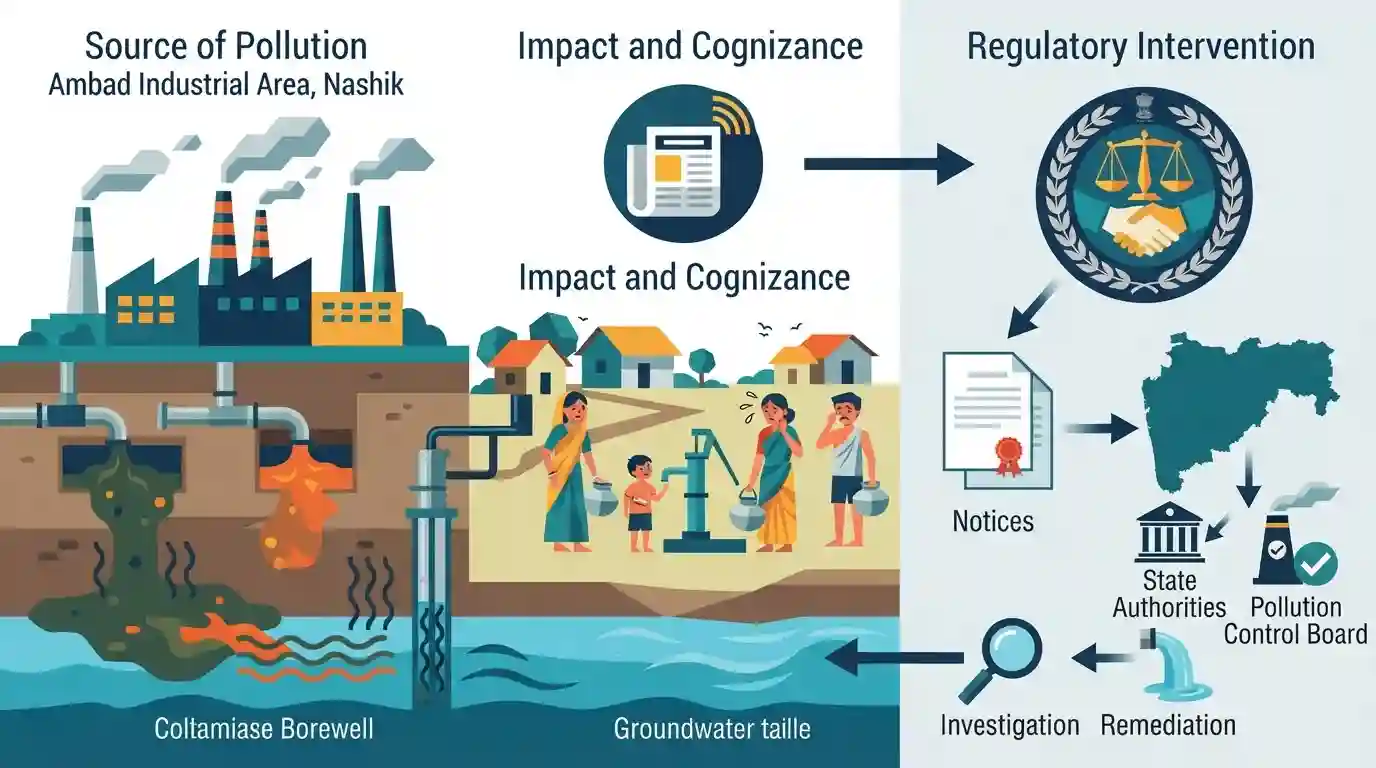
The National Human Rights Commission (NHRC) has taken suo motu cognizance of a media report regarding borewell water contamination due to the seepage of chemical-laden factory effluents near the Ambad Industrial Area in Nashik district, Maharashtra. Highlighting concerns over public health and environmental degradation, the NHRC issued notices to top state and pollution control authorities seeking a comprehensive report.
मुख्य मुद्दे
- NHRC took suo motu cognizance of borewell water contamination caused by chemical-laden factory effluents near Ambad Industrial Area in Nashik, Maharashtra.
- The contamination poses a severe threat to public health and the right to clean drinking water, which is a facet of the Right to Life under Article 21 of the Constitution.
- Notices have been issued to the Chief Secretary of Maharashtra and the Member Secretary of the State Pollution Control Board calling for a detailed report within four weeks.
- Highlights systemic gaps in industrial effluent management, enforcement of environmental laws, and protection of vulnerable populations from environmental hazards.
महत्त्वाच्या संज्ञा
National Human Rights Commission (NHRC)

A statutory body established in 1993 under the Protection of Human Rights Act to protect and promote human rights in India, with powers to inquire into rights violations.
UPSC context
Important for GS Paper II (Polity & Governance - Statutory Bodies, Human Rights Issues). Tests understanding of institutional mechanisms and accountability.
Maharashtra Pollution Control Board (MPCB)
A state-level statutory body responsible for implementing environmental laws, preventing and controlling water and air pollution, and regulating industrial effluents in Maharashtra.
UPSC context
Important for GS Paper III (Environment - Pollution Regulation & Governance). Tests knowledge of pollution control bodies and enforcement mechanisms.
पूर्वपरीक्षा सापळा
The NHRC is a constitutional body whose directives and recommendations are legally binding on the central and state governments.
Aspirants often confuse NHRC as a constitutional body or assume its recommendations are legally binding like court decrees, whereas it has powers of a civil court but makes recommendations.
संबंधित स्थिर संकल्पना
What are the composition, appointment, and powers of the National Human Rights Commission (NHRC)?
- Statutory Body: Statutory origin established under the Protection of Human Rights Act, 1993, amended in 2019.
- Composition: Chairperson must be a retired Chief Justice of India or a Supreme Court Judge.
- Appointment: Appointed by the President on the recommendation of a six-member high-powered committee.
- Nature of Powers: Powers are recommendatory in nature; it lacks penal powers or the authority to prosecute violators directly.
आंतर-विषय नमुने
NHRC Suo Motu vs. Statutory Boards
The NHRC's proactive intervention links statutory human rights protection with federal implementation of environmental laws like the Water Act, 1974.
Right to Clean Water & Article 21
Industrial effluent contamination of aquifers directly infringes upon the right to clean water, recognized by the Supreme Court as an integral part of Article 21.

Expect a statement-based question combining NHRC's statutory powers under PHRA 1993 with judicial interpretations of Article 21.
संबंधित PYQ · 4
संबंधित PYQ · 4
- 2014MainsGS2
National Human Rights Commission (NHRC) in India can be most effective when its tasks are adequately supported by other mechanisms that ensure the accountability of a government. In light of the above observation assess the role of NHRC as an effective complement to the judiciary and other institutions in promoting and protecting human rights standards.
- 2021MainsGS2
Though the Human Rights Commissions have contributed immensely to the protection of human rights in India, yet they have failed to assert themselves against the mighty and powerful. Analyzing their structural and practical limitations, suggest remedial measures.
- 2024MainsGS3
Industrial pollution of river water is a significant environmental issue in India. Discuss the various mitigation measures to deal with this problem and also the government's initiatives in this regard.
- 2025MainsGS3
Examine the factors responsible for depleting groundwater in India. What are the steps taken by the government to mitigate such depletion of groundwater?
