India Ramsar Sites Tally Reaches 103 with Two New Additions
Source:PIB ↗
Why It Matters
Wetland conservation and the Ramsar Convention framework are frequent themes in UPSC Civil Services Prelims and Mains (GS3), testing candidates' understanding of ecological preservation, international environmental conventions, and national biodiversity targets.
Summary
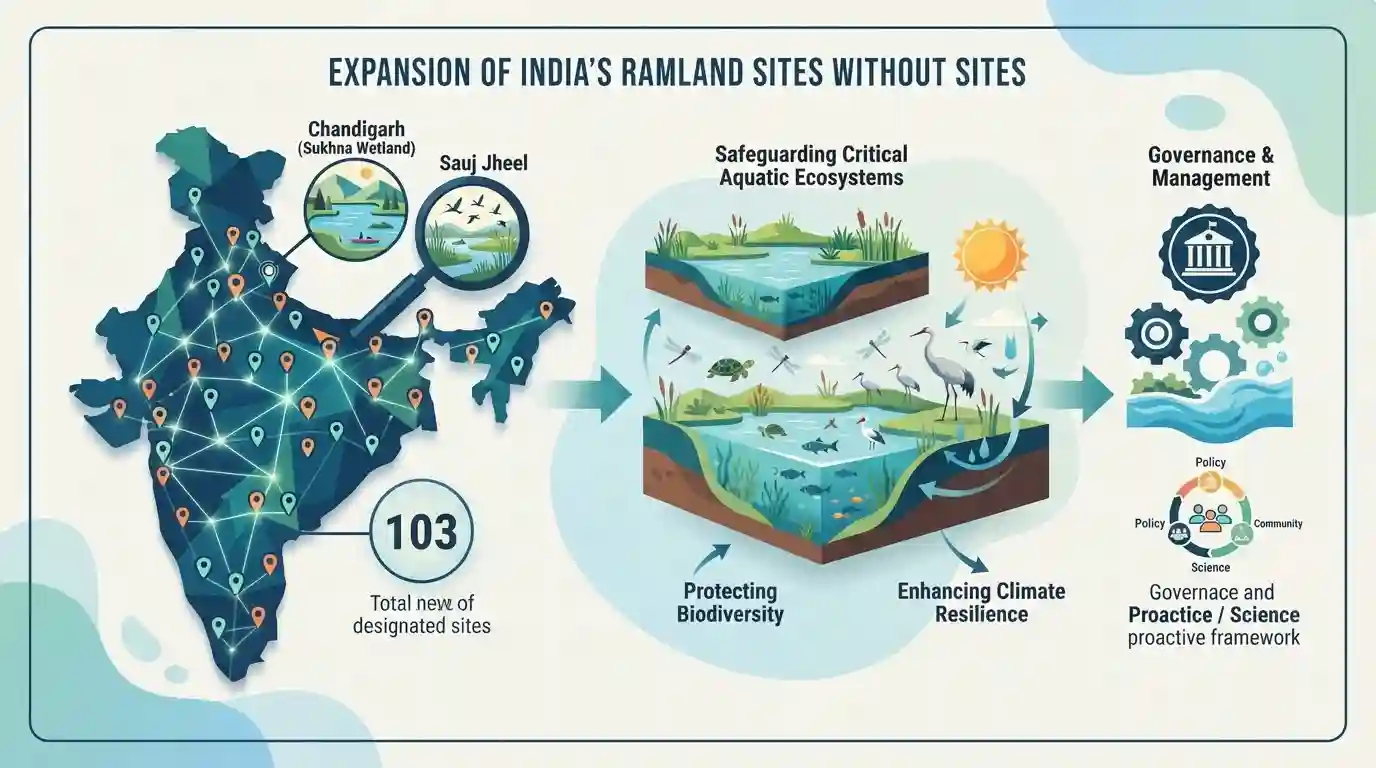
India has expanded its network of Ramsar Convention wetlands to 103 sites following the official designation of Sukhna Wetland in Chandigarh and Sauj Jheel in Uttar Pradesh. This addition underscores India's proactive conservation framework for safeguarding critical aquatic ecosystems, protecting biodiversity, and enhancing climate resilience through sustainable wetland management.
Key Points
- India's Ramsar site tally has reached 103 with the addition of Sukhna Wetland in Chandigarh and Sauj Jheel in Uttar Pradesh.
- Sukhna Wetland is a well-known man-made wetland at the foothills of the Shivalik hills, serving as a critical habitat for resident and migratory birds.
- Sauj Jheel in Uttar Pradesh is an important wetland ecosystem supporting rich biodiversity and waterfowl populations.
- The expansion of Ramsar sites highlights India's ongoing commitment to ecological preservation, biodiversity conservation, and the 'wise use' of wetlands under international frameworks.
Important Terms
Ramsar Convention

An intergovernmental environmental treaty signed in 1971 in Ramsar, Iran, providing the framework for national action and international cooperation for the conservation and wise use of wetlands and their resources.
UPSC context
Important for UPSC CSE Prelims and Mains (GS Paper III - Environment & Ecology); questions frequently focus on international conventions and wetland criteria.
Ministry of Environment, Forest and Climate Change
The nodal central ministry in India responsible for policy formulation, planning, promotion, and coordination of environmental and forestry programmes, including the designation and management of Ramsar wetlands.
UPSC context
Crucial for GS Paper II (Government Policies & Interventions) and GS Paper III (Environment), testing administrative structures for biodiversity conservation.
Prelims Trap
All Ramsar Convention sites in India are naturally occurring freshwater ecosystems untouched by anthropogenic construction.
Aspirants often assume all Ramsar sites are natural pristine lakes, missing that key additions like Sukhna Wetland are man-made reservoirs.
Static Concepts Connected
What are the foundational principles and obligations under the Ramsar Convention?
- Foundation: Signed in 1971 in Ramsar, Iran, it is the sole intergovernmental treaty focusing specifically on wetland ecosystems.
- Obligations: Contracting parties must designate at least one suitable wetland for the List of Wetlands of International Importance and promote their wise use.
- Montreux Record: It maintains the Montreux Record as a register of wetland sites on the List of Wetlands of International Importance where changes in ecological character have occurred.
Cross-Topic Patterns
Wetland Conservation and Wildlife Act Overlaps
Ramsar wetland listings are increasingly tied to wildlife corridors and bird sanctuaries, overlapping direct habitat protections under the Wildlife Protection Act (1972) and international treaty commitments.
State Capacity and Decentralized Wetland Management
Rapid addition of Ramsar sites tests state-level administrative capacity under the National Wetland Conservation Programme for decentralized management and pollution mitigation.

Expect match-the-following questions pairing newly added Ramsar sites with their correct states or ecological features.
Linked PYQs · 2
Linked PYQs · 2
- 2023MainsGS3
Comment on the National Wetland Conservation Programme initiated by the Government of India and name a few India's wetlands of international importance included in the Ramsar Sites.
- 2018MainsGS3
What is wetland? Explain the Ramsar concept of 'wise use' in the context of wetland conservation. Cite two examples of Ramsar sites from India.
