India Japan Road Infrastructure Joint Working Group
Source:PIB ↗
ఇది ఎందుకు ముఖ్యం
This meeting highlights the deepening sectoral and technological collaboration between India and Japan, which is vital for modernizing India's transport infrastructure and driving sustainable economic growth.
సారాంశం
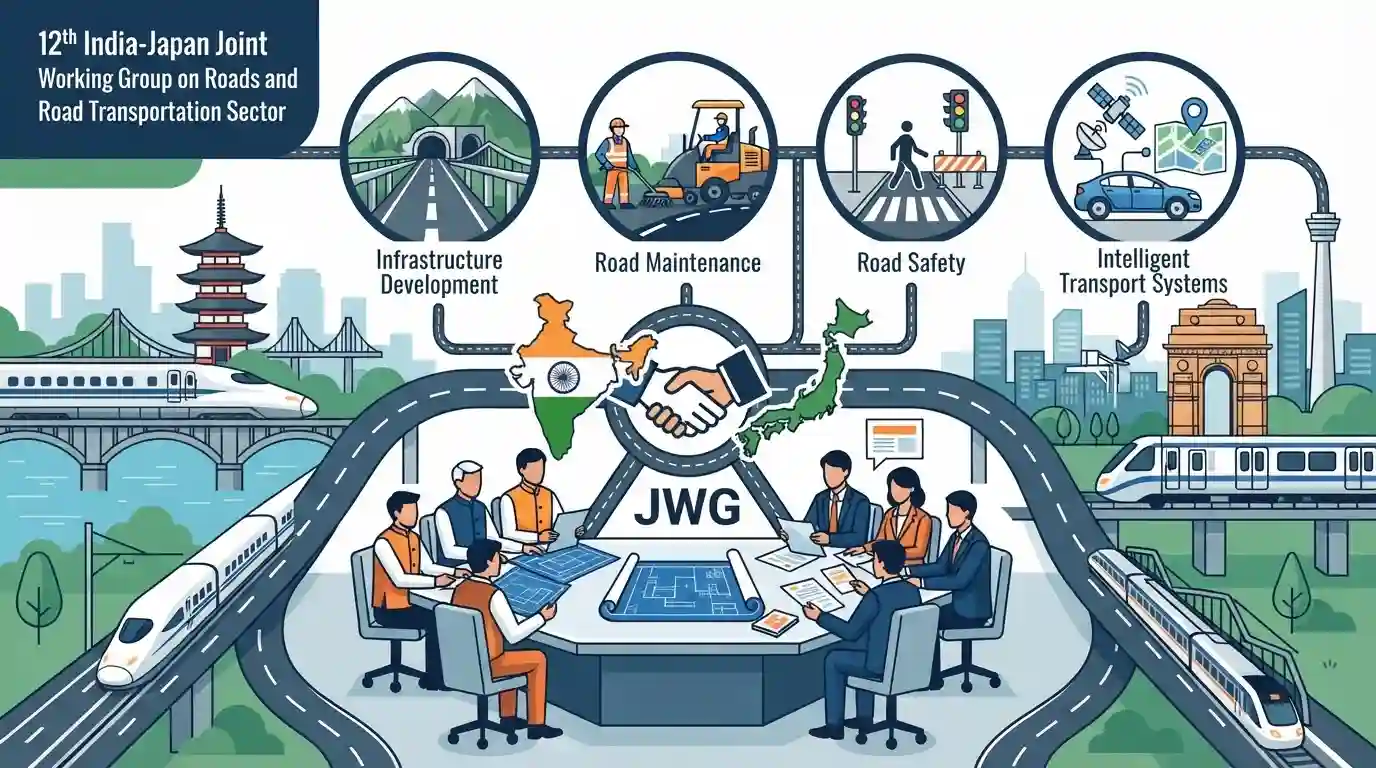
The 12th session of the India-Japan Joint Working Group (JWG) on Roads and Road Transportation Sector convened to enhance bilateral cooperation, sharing best practices in road infrastructure development, maintenance, road safety, and intelligent transport systems.
ముఖ్య అంశాలు
- The 12th session of the India–Japan Joint Working Group (JWG) on Roads and Road Transportation Sector focused on strengthening bilateral cooperation in road infrastructure, intelligent transport systems (ITS), and road safety.
- Discussions highlighted technological advancements, adoption of advanced traffic management systems, and sustainable maintenance practices in road transport.
- Both nations emphasized mutual learning, knowledge exchange, and technical collaboration between Indian ministries and Japan's Ministry of Land, Infrastructure, Transport and Tourism (MLIT).
ముఖ్యమైన పదాలు
India-Japan Joint Working Group on Roads and Road Transportation Sector

A bilateral mechanism established under a 2014 Framework of Cooperation to facilitate technical exchanges, best practices, and joint collaboration in road infrastructure, maintenance, and safety between India and Japan.
UPSC context
GS Paper II (International Relations - Bilateral Groupings) and GS Paper III (Infrastructure), testing India's strategic and technological partnerships with East Asian nations.
Ministry of Road Transport and Highways, India
The Indian central government ministry responsible for the formulation and administration of policies, laws, and regulations relating to national highways, transport research, and road infrastructure development.
UPSC context
GS Paper III (Infrastructure Development and Economic Growth), testing institutional frameworks governing national transport networks.
Ministry of Land, Infrastructure, Transport and Tourism (MLIT), Japan
The Japanese government ministry overseeing national spatial planning, infrastructure development, transport policies, tourism, and meteorological services, partnering with India on advanced road technologies.
UPSC context
GS Paper II (International Relations - Global Governance and Technical Cooperation), testing bilateral institutional arrangements for technology transfer.
ప్రిలిమ్స్ ఉచ్చు
Framework of Cooperation established in 2014 acting as a treaty requiring legislative ratification
Aspirants often assume bilateral JWGs on specialized technical sectors like roads are legally binding treaties ratified by parliaments, whereas they operate under administrative frameworks of cooperation.
అనుసంధానమైన స్థిర భావనలు
What are the key institutional mechanisms and strategic convergence pillars in India-Japan bilateral relations?
- Strategic Partnership: Special Strategic and Global Partnership established in 2014 elevated bilateral ties to a high-priority diplomatic level.
- Summit Level: India-Japan Annual Summit serves as the apex dialogue platform between the Prime Ministers of both nations.
- 2+2 Dialogue: 2+2 Ministerial Dialogue involving Foreign and Defense Ministers ensures strategic and security alignment.
- Economic Projects: Major economic catalysts include the Mumbai-Ahmedabad High-Speed Rail (MAHSR) project and the Indo-Pacific Economic Framework (IPEF).
అంతర-అంశ నమూనాలు
Japan-India Infrastructure & Act East Policy
Japan's involvement in Northeast connectivity (e.g., NH-40 network, Mizoram and Assam bridge projects) illustrates the strategic intersection of bilateral infrastructure assistance and India's Act East Policy.
Intelligent Transport Systems & Green Mobility
Collaboration on Intelligent Transport Systems and low-carbon logistics bridges bilateral transport forums with India's commitments under global climate agreements and green mobility transitions.

India-Japan institutional mechanisms like JWGs on transport, defense, and urban development are frequently tested in match-the-column or statements.
అనుసంధాన PYQలు · 2
అనుసంధాన PYQలు · 2
- 2019MainsGS2
‘The time has come for India and Japan to build a strong contemporary relationship, one involving global and strategic partnership that will have a great significance for Asia and the world as a whole.’ Comment.
- 2021MainsGS3
“Investment in infrastructure is essential for more rapid and inclusive economic growth.” Discuss in the light of India's experience.
