National Strategic Trade Command Centre Launch
Source:PIB ↗
हे का महत्त्वाचे आहे
The launch of the National Strategic Trade Command Centre marks a significant step towards data-driven governance in India's external trade sector, aiming to boost exports and streamline policy responses.
सारांश
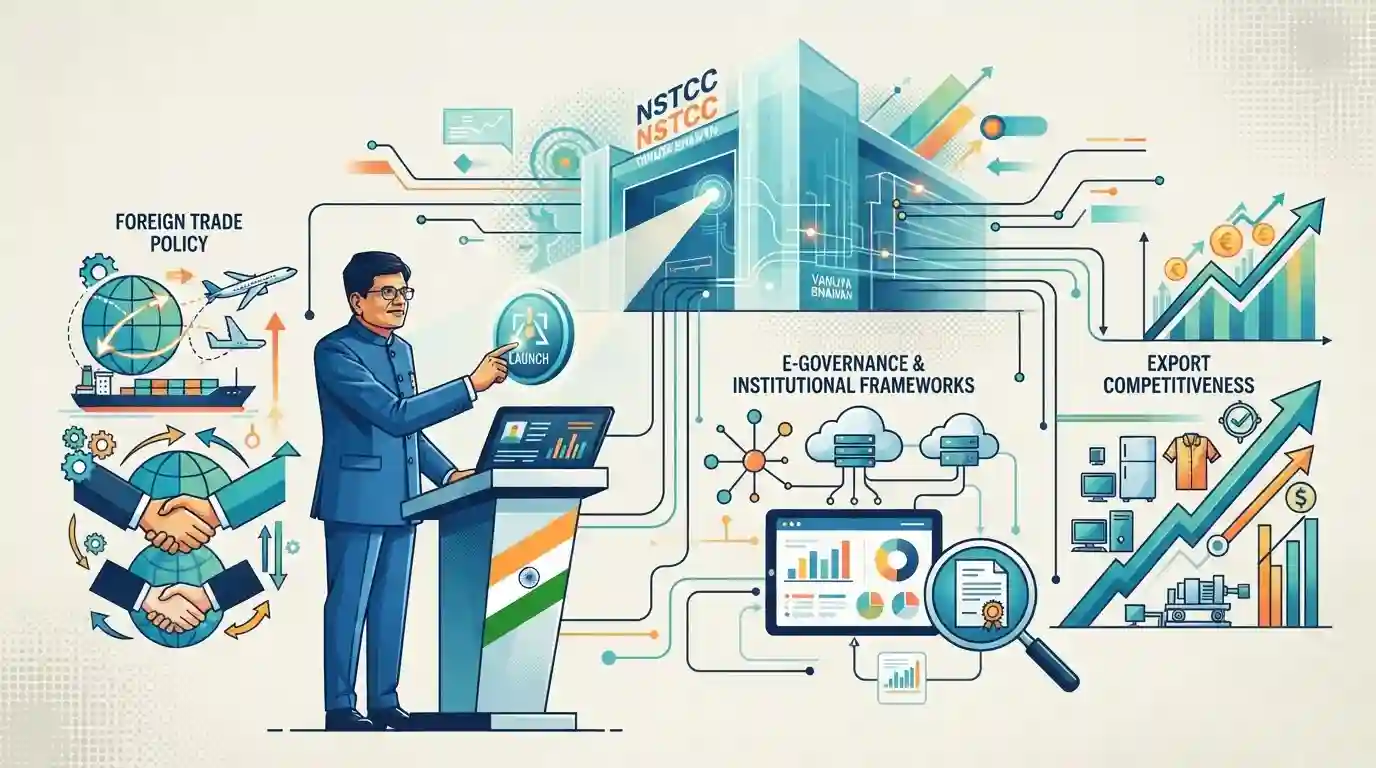
Union Commerce and Industry Minister Shri Piyush Goyal launched the National Strategic Trade Command Centre (NSTCC) at Vanijya Bhawan, designed to bolster India's foreign trade framework, enhance trade data analysis, and improve export competitiveness through institutional and technological intervention.
मुख्य मुद्दे
- Union Commerce and Industry Minister Shri Piyush Goyal launched the National Strategic Trade Command Centre (NSTCC) at Vanijya Bhawan, New Delhi.
- The initiative aims to enhance India's foreign trade competitiveness through strategic real-time monitoring and coordination.
- Serves as an institutional mechanism to boost export performance, streamline trade data analysis, and support policy formulation.
महत्त्वाच्या संज्ञा
National Strategic Trade Command Centre

A digital command and analytics hub launched at Vanijya Bhawan to monitor trade performance, consolidate DGFT application data, and facilitate data-driven policymaking for India's foreign trade.
UPSC context
UPSC Mains Paper II/III: Institutional frameworks, e-governance initiatives, and export competitiveness monitoring in India's foreign trade policy.
Vanijya Bhawan
The New Delhi headquarters of the Ministry of Commerce and Industry, inaugurated to serve as an administrative hub for trade policy and export promotion.
UPSC context
UPSC Prelims/Mains: Important governance infrastructure and administrative headquarters related to Indian economy and foreign trade.
Ministry of Commerce and Industry
The nodal central government ministry responsible for formulating and implementing foreign trade policies, export promotion, and industrial growth through its departments (Department of Commerce and DPIIT).
UPSC context
UPSC Mains Paper III: Government policies and interventions for development in industrial and foreign trade sectors.
पूर्वपरीक्षा सापळा
National Strategic Trade Command Centre is a physical port infrastructure facility established to inspect container cargo at major Indian ports.
Aspirants often confuse the NSTCC with trade negotiation forums or physical port infrastructure; it is an analytical data command hub for monitoring foreign trade and strategic controls.
संबंधित स्थिर संकल्पना
What is the SCOMET list and how does India regulate strategic trade?
- Definition: Special Chemicals, Organisms, Materials, Equipment and Technologies (SCOMET) list regulates exports of dual-use items having military and civilian applications.
- Statutory Basis: Governed under the Foreign Trade (Development and Regulation) Act, 1992, and administered by the Directorate General of Foreign Trade (DGFT).
- Global Context: Mandatory adherence to international non-proliferation standards required for India's membership in elite export control regimes like Wassenaar and Australia Group.
आंतर-विषय नमुने
Trade Digitization and Logistics Reform Linkages
The digitization of trade governance under DGFT directly impacts ease of doing business rankings and logistics cost reduction targets under PM Gati Shakti.
Strategic Trade Controls and Export Regimes
SCOMET compliance enforcement intersects with India's international non-proliferation commitments and export controls required for Wassenaar and Missile Technology Control Regime (MTCR) membership.

NSTCC mandates & SCOMET dual-use list updates likely to appear as a matching or statement-based question in Prelims.
संबंधित PYQ · 2
संबंधित PYQ · 2
- 2024MainsGS2
e-governance is not just about the routine application of digital technology in service delivery process. It is as much about multifarious interactions for ensuring transparency and accountability. In this context evaluate the role of the 'Interactive Service Model' of e-governance.
- 2023MainsGS2
e-governance, as a critical tool of governance, has ushered in effectiveness, transparency and accountability in governments. What inadequacies hamper the enhancement of these features ?
