Ayurveda Digital Initiatives and Traditional Medicine
Source:PIB ↗
આ શા માટે મહત્વનું છે
The integration of traditional Indian medicine (Ayurveda) with modern technology and digital governance structures is a core policy direction for enhancing grassroots healthcare delivery, preventive medicine, and universal health coverage in India.
સારાંશ
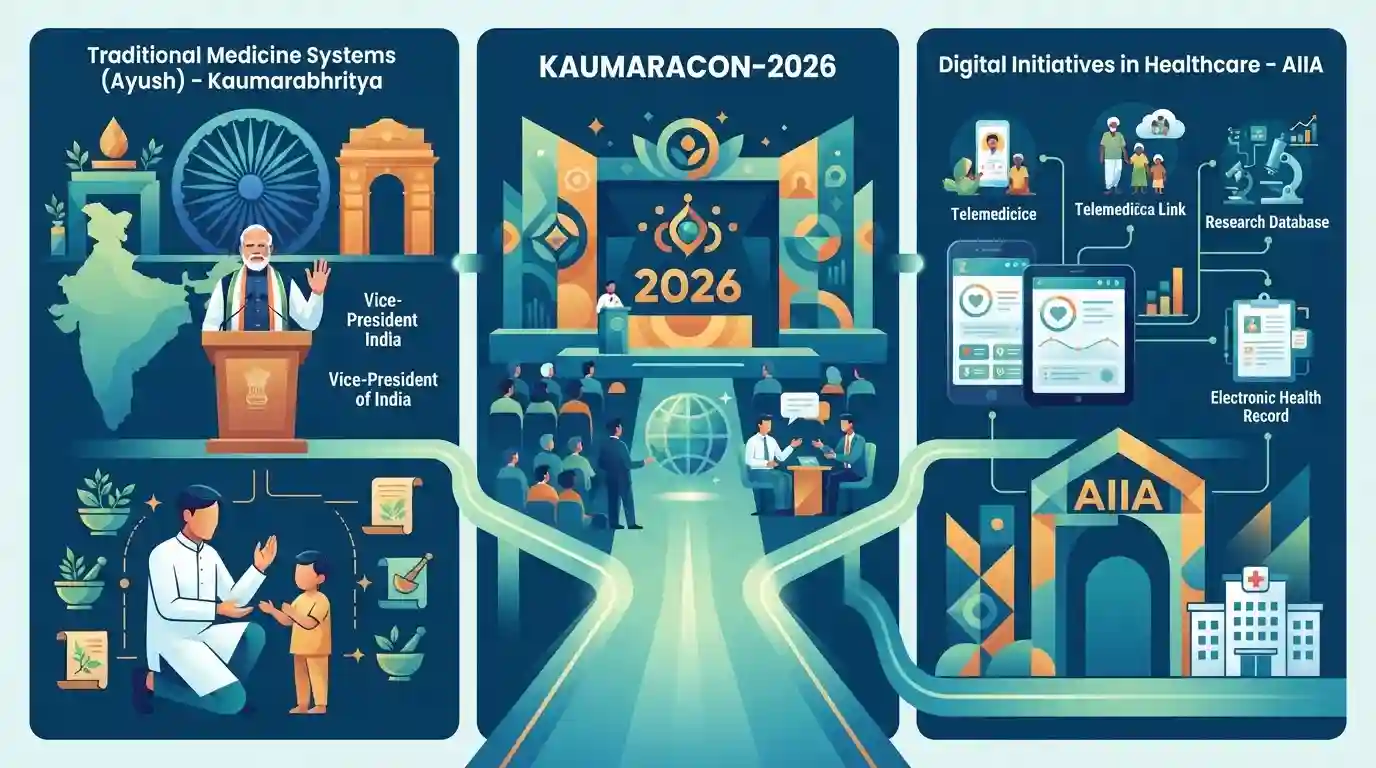
The Vice-President of India inaugurated KAUMARACON-2026 and launched various digital initiatives by the All India Institute of Ayurveda (AIIA). The event underscored the importance of traditional medicine systems like Ayurveda, specifically pediatric care (Kaumarabhritya), and leveraged digital governance tools to modernize healthcare delivery and research in India.
મુખ્ય મુદ્દા
- Vice-President inaugurated KAUMARACON-2026, highlighting the integration of traditional medicine (Ayurveda) with modern healthcare systems.
- Several digital initiatives of the All India Institute of Ayurveda (AIIA) were launched to promote digital health delivery, research transparency, and accessibility.
- Emphasized pediatric Ayurveda (Kaumarabhritya) for preventive healthcare and child development.
- Stressed the role of evidence-based research and technological integration in validating traditional Indian medical systems globally.
મહત્વપૂર્ણ શબ્દો
KAUMARACON-2026

An international conference focused on Kaumarabhritya (Ayurvedic pediatrics), highlighting advancements, research innovations, and clinical practices in child healthcare within traditional medicine systems.
UPSC context
UPSC Prelims/Mains (GS Paper II: Health Governance): Tests knowledge of traditional medicine events, pediatric health policies, and Ayush initiatives.
All India Institute of Ayurveda (AIIA)
A premier autonomous institute under the Ministry of Ayush, Government of India, dedicated to excellence in education, research, and clinical delivery in Ayurveda.
UPSC context
UPSC Prelims/Mains (GS Paper II: Health Governance): Evaluates institutional frameworks promoting research and integration of traditional medicine.
Ministry of Ayush
The Indian government ministry responsible for developing, promoting, and regulating traditional healthcare systems including Ayurveda, Yoga & Naturopathy, Unani, Siddha, Sowa-Rigpa, and Homoeopathy.
UPSC context
UPSC Prelims/Mains (GS Paper II: Social Justice/Health): Tests governance, institutional structures, and policies governing alternative systems of medicine in India.
સંલગ્ન સ્થિર ખ્યાલો
What are the core branches of Ashtanga Ayurveda, and what is Kaumarabhritya?
- Eight Branches: Ashtanga Ayurveda comprises eight branches including Kayachikiththa (Internal Medicine) and Kaumarabhritya (Pediatrics).
- Pediatric Care: Kaumarabhritya focuses on child care, infant nutrition, developmental disorders, and classical preventive measures like Swarnaprashana.
- Apex Institution: The All India Institute of Ayurveda (AIIA) functions as an apex autonomous institute under the Ministry of AYUSH.
આંતર-વિષય પેટર્ન
Ayurveda Modernization & Digital Public Infrastructure
The integration of Ayush with digital public infrastructure reflects the broader ambition of universalizing India's traditional knowledge systems globally.

Expect a statement-based question linking Ayush institutional bodies like AIIA with digital health frameworks like Ayush Grid.
સંલગ્ન PYQ · 2
સંલગ્ન PYQ · 2
- 2020MainsGS2
In order to enhance the prospects of social development, sound and adequate health care policies are needed particularly in the fields of geriatric and maternal health care. Discuss.
- 2022PrelimsGS1
With reference to Ayushman Bharat Digital Mission, consider the following statements: 1. Private and public hospitals must adopt it. 2. As it aims to achieve universal health coverage, every citizen of India should be part of it ultimately. 3. It has seamless portability across the country. Which of the statements given above is/are correct?
