National Law Universities Mobilized to Clear Criminal Case Backlogs
Source:PIB ↗
Why It Matters
Judicial backlog is a critical bottleneck for rule of law and ease of living in India. Involving National Law Universities represents an innovative institutional synergy between legal academia and practical judicial delivery.
Summary
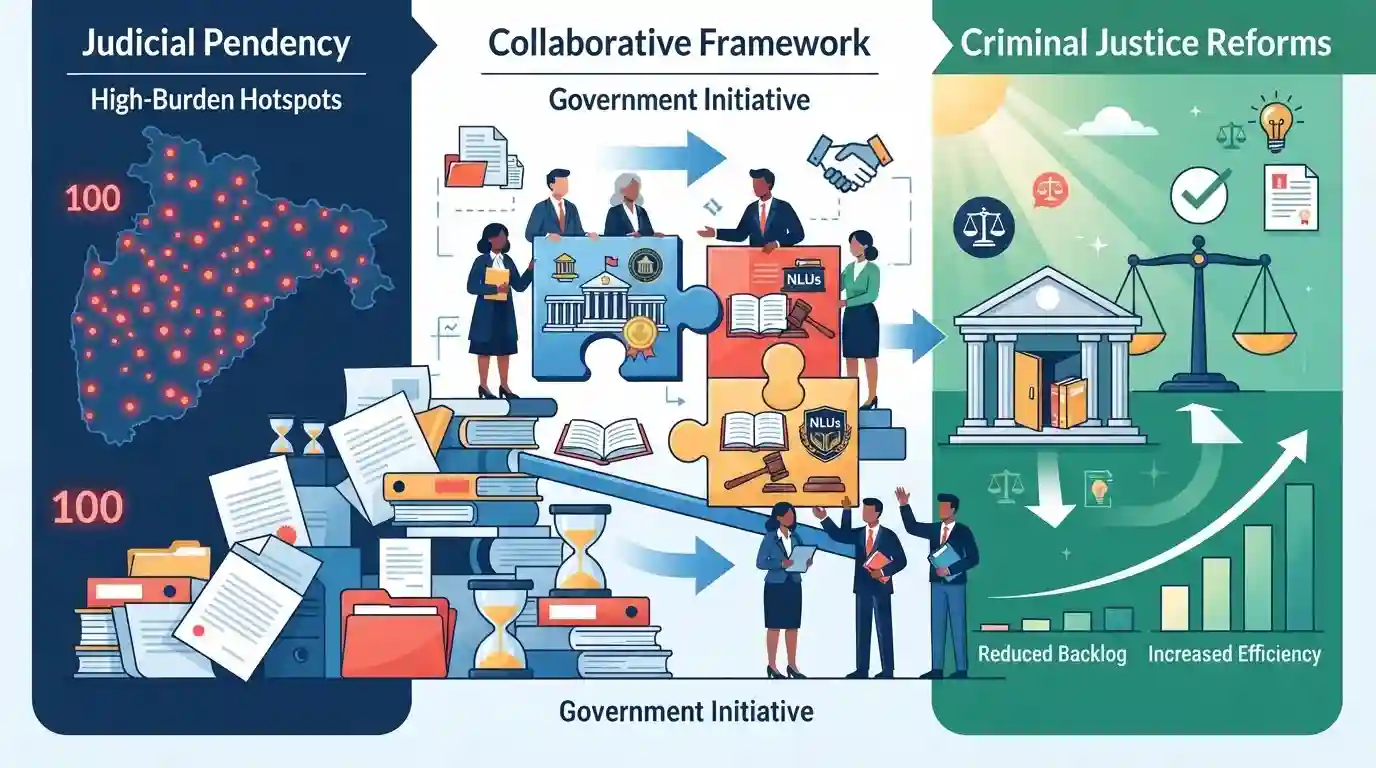
The government has initiated a collaborative framework involving National Law Universities to target and reduce criminal case backlogs in 100 high-burden hotspot districts, seeking to leverage academic expertise and legal research for judicial reform.
Key Points
- Government mobilizes National Law Universities (NLUs) to address criminal case backlogs across 100 hotspot districts.
- Aims to bridge academic institutional capacity with grassroots judicial administration to clear pending criminal cases.
- Focuses on criminal justice reform, legal aid, and reducing trial delays.
Important Terms
National Law Universities

Premier institutions of legal education in India established to provide professional legal training, conduct academic research, and assist governance systems in legal and judicial reforms.
UPSC context
GS Paper II (Governance - Judiciary): Tests the role of educational institutions and academic expertise in addressing systemic challenges like judicial pendency.
Ministry of Law and Justice
The Union government department responsible for the administration of justice, management of the legal system, and formulation of legislative policies concerning judicial reforms in India.
UPSC context
GS Paper II (Polity and Governance): Tests institutional mechanisms, executive initiatives, and administrative policies for reducing criminal case backlogs.
Prelims Trap
The Supreme Court directly mandates and administers academic deployments across district courts.
Aspirants may confuse executive-led judicial capacity initiatives with administrative interventions directly controlled by the Supreme Court collegium or High Courts.
Static Concepts Connected
What are the key institutional mechanisms and bodies established to reduce judicial pendency in India?
- Justice Mission: Apex advisory body chaired by the Union Law Minister to coordinate policy and funding for judicial infrastructure.
- E-Courts Project: E-Courts Mission Mode Project aims to computerize district and subordinate courts to improve access to justice.
- NALSA Mandate: Providing institutional legal aid, Lok Adalats, and alternative dispute resolution mechanisms to reduce court burdens.
Cross-Topic Patterns
Judicial Pendency + National Law Universities
Judicial reform initiatives connect directly to institutional design questions in GS Paper II and the historical implementation of the National Mission for Justice Delivery and Legal Reform.

NLU mobilization for judicial backlogs tests institutional intersection of academia and governance in GS-II polity questions.
Linked PYQs · 1
Linked PYQs · 1
- 2024MainsGS2
Explain and distinguish between Lok Adalats and Arbitration Tribunals. Whether they entertain civil as well as criminal cases ?
