Defence Academia Industry Collaboration for Indigenous Technology
Source:PIB ↗
ఇది ఎందుకు ముఖ్యం
It touches upon India's strategic push towards defence indigenisation, public-private-academic partnerships (triple helix model), and technological self-reliance, which are core themes under GS Paper 3 (Security, Technology, and Economic Development).
సారాంశం
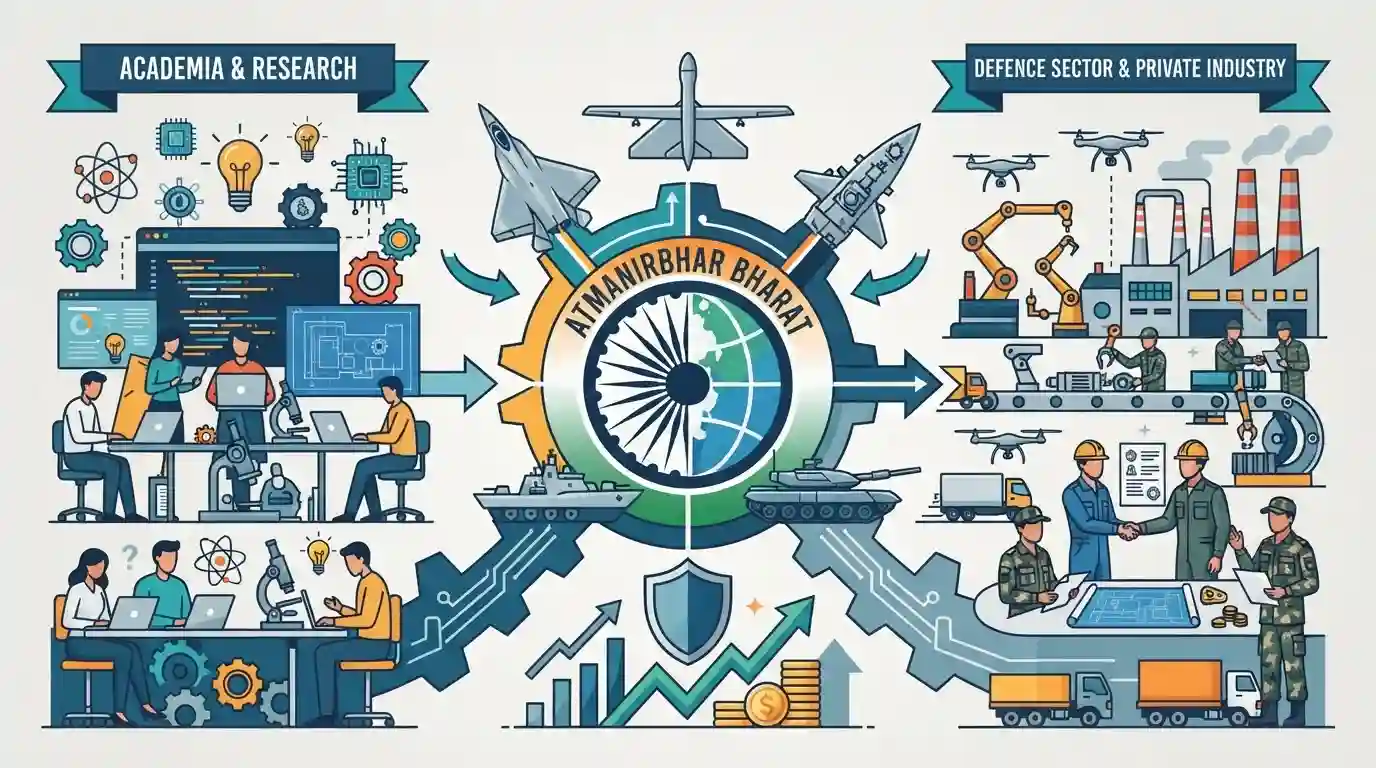
The article highlights the Raksha Mantri's emphasis on a robust collaboration between the defence sector, academia, and private industry to accelerate the creation and adoption of indigenous defence technologies. Amid changing paradigms of modern warfare, fostering domestic R&D and achieving self-reliance (Atmanirbharta) are presented as fundamental pillars for India's national security and economic growth.
ముఖ్య అంశాలు
- Raksha Mantri emphasized that close collaboration between defence, academia, and industry is crucial for accelerating the development and adoption of indigenous technology.
- Stressed the need to adapt to the evolving nature of modern warfare, which increasingly relies on niche technologies, artificial intelligence, and domestic manufacturing capabilities.
- Highlighted that self-reliance (Atmanirbharta) in defence is paramount for national security, reducing dependency on foreign imports, and fostering domestic innovation.
- Encouraged academic institutions and private industry players to actively participate in defence research, development, and production ecosystems.
ముఖ్యమైన పదాలు
Atmanirbhar Bharat

India's policy vision targeting self-reliance across economic and strategic sectors, with a major focus on domestic defense manufacturing, reducing import dependency, and fostering local research and development.
UPSC context
Crucial for GS Paper III (Economy and Security). Tests understanding of India's import substitution, domestic defense indigenization, and strategic autonomy goals.
Ministry of Defence
The central government department charged with policy formulation, resource allocation, and administrative oversight for all matters concerning national defense and the Indian Armed Forces.
UPSC context
Relevant for GS Paper II (Governance and Polity) and GS Paper III (Security). Tests institutional frameworks governing India's military apparatus.
Raksha Mantri (Defence Minister)
The official Hindi title for the Defence Minister of India, who heads the Ministry of Defence and oversees the political direction of the armed forces and national security policy.
UPSC context
Relevant for GS Paper II and III. Tests administrative terminologies and executive leadership roles in India's national security architecture.
ప్రిలిమ్స్ ఉచ్చు
iDEX framework is exclusively restricted to DPSUs and Ordnance Factory Board successors for manufacturing core military hardware.
Aspirants often assume iDEX is only for large public sector defense PSUs, whereas its core mandate is engaging startups, MSMEs, and individual innovators.
అనుసంధానమైన స్థిర భావనలు
What are the institutional mechanisms supporting defence indigenisation and innovation in India?
- iDEX Initiative:: Launched by MoD to foster innovation and technology development by engaging startups, MSMEs, and academia.
- ADITI Scheme:: A dedicated scheme under iDEX focusing on critical and strategic defence technologies with substantial grant funding.
- iDEX-DIO:: A dynamic online portal allowing domestic industry to offer solutions for military requirements, promoting co-development.
- Positive Indigenisation Lists:: Notified periodically by the Ministry of Defence to progressively ban import of specified items, boosting domestic manufacturing.
అంతర-అంశ నమూనాలు
Defense Indigenisation + Deep-Tech Startups
Defense R&D funding models under iDEX mirror India's broader push for deep-tech venture capital funds, linking national security budgets with startup ecosystem policy.
Atmanirbharta + Strategic Autonomy Policy
The shift from licensed production to indigenous co-development reconfigures India's strategic autonomy doctrine, moving away from multi-buyer military diplomacy.

Expect multi-statement prelims on iDEX/ADITI eligibility or mains analytical on tri-sectoral R&D hurdles in Indian defense manufacturing.
అనుసంధాన PYQలు · 1
అనుసంధాన PYQలు · 1
- 2014MainsGS3
Foreign Direct Investment (FDI) in the defence sector is now set to be liberalized. What influence this is expected to have on Indian defence and economy in the short and long run?
