Ministers Review Stubble Management and Air Pollution
Source:PIB ↗
কেন এটি গুরুত্বপূর্ণ
Stubble burning is a recurring environmental and public health crisis leading to severe winter air pollution in northern India. Joint ministerial reviews indicate administrative resolve and cooperative federalism approaches toward solving environmental externalities tied to agricultural practices.
সারসংক্ষেপ
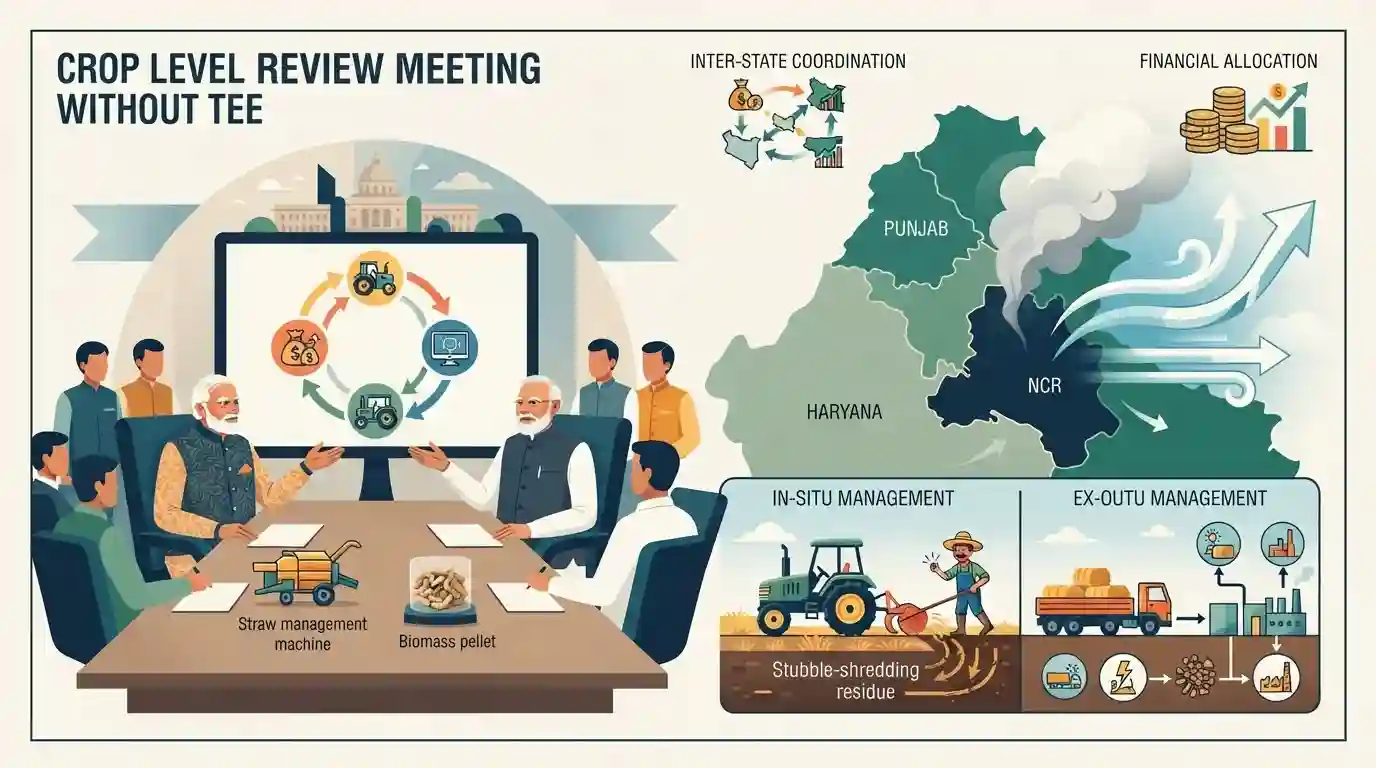
Union Agriculture Minister Shri Shivraj Singh Chouhan and Environment Minister Shri Bhupender Yadav conducted a joint high-level review meeting in New Delhi to address crop residue (stubble) management. The meeting evaluated actionable strategies, technological interventions (in-situ and ex-situ management), financial allocations, and inter-state coordination required to curb stubble burning and tackle air pollution in northern India, particularly the National Capital Region (NCR).
মূল বিষয়
- Union Agriculture Minister Shri Shivraj Singh Chouhan and Environment Minister Shri Bhupender Yadav co-chaired a high-level joint review meeting on stubble (crop residue) management.
- The Ministers emphasized coordinated multi-ministerial and multi-state strategies to curb stubble burning and mitigate air pollution in the National Capital Region (NCR) and adjoining states.
- Discussions focused on promoting in-situ (crop residue management machinery like Happy Seeder, Super Seeder) and ex-situ (industrial use, biomass power plants, bio-pellets/briquettes) management options.
- Emphasis was placed on effective utilization of Central funds, community mobilization, farmer awareness, and real-time monitoring of fire counts.
গুরুত্বপূর্ণ শব্দ
Ministry of Agriculture and Farmers Welfare

The nodal central government ministry responsible for formulating and administering national policies, schemes, and regulations relating to agricultural development, farmer welfare, crop production, and agricultural marketing in India.
UPSC context
GS Paper III (Agriculture Sector Government Policies and Interventions). Important for questions on agricultural growth, subsidies, and resource management.
Ministry of Environment, Forest and Climate Change
The apex central government body tasked with planning, promoting, and coordinating environmental policies, forestry programs, wildlife preservation, and measures to curb air and water pollution across India.
UPSC context
GS Paper III (Environment Pollution and Degradation). Tested in questions concerning air quality management, regulatory frameworks, and inter-ministerial environmental strategies.
প্রিলিমস ফাঁদ
Ex-situ management refers to relocating stubble burning activities outside the National Capital Region.
Aspirants often assume ex-situ management involves burning residue outside the NCR, whereas it refers to utilizing straw away from the field as industrial raw material.
সংযুক্ত স্থির ধারণা
What is the difference between In-situ and Ex-situ crop residue management techniques?
- In-situ Method: Managing crop residue directly in the field by incorporating straw into the soil using specialized machinery like Happy Seeders or Super Seeders.
- Ex-situ Method: Removing crop residue from the field for industrial applications such as biomass power plants, bio-ethanol production, or briquetting.
আন্তঃবিষয় প্যাটার্ন
Stubble Burning and National Clean Air Programme
Crop residue management intersects with international climate commitments under India's updated Nationally Determined Contributions (NDCs) and domestic air quality frameworks like NCAP.

Exams frequently test the distinction between in-situ and ex-situ crop residue management techniques and their central funding mechanisms.
সংযুক্ত PYQ · 1
সংযুক্ত PYQ · 1
- 2024PrelimsGS1
Consider the following materials: 1. Agricultural residues 2. Corn grain 3. Wastewater treatment sludge 4. Wood mill waste Which of the above can be used as feedstock for producing Sustainable Aviation Fuel?
