BIMSTEC Home Ministers Adopt Delhi Security Declaration
Source:PIB ↗
Why It Matters
It marks a significant institutional milestone for BIMSTEC by elevating security cooperation to the ministerial level, directly impacting India's regional security architecture and foreign policy objectives in the Bay of Bengal.
Summary
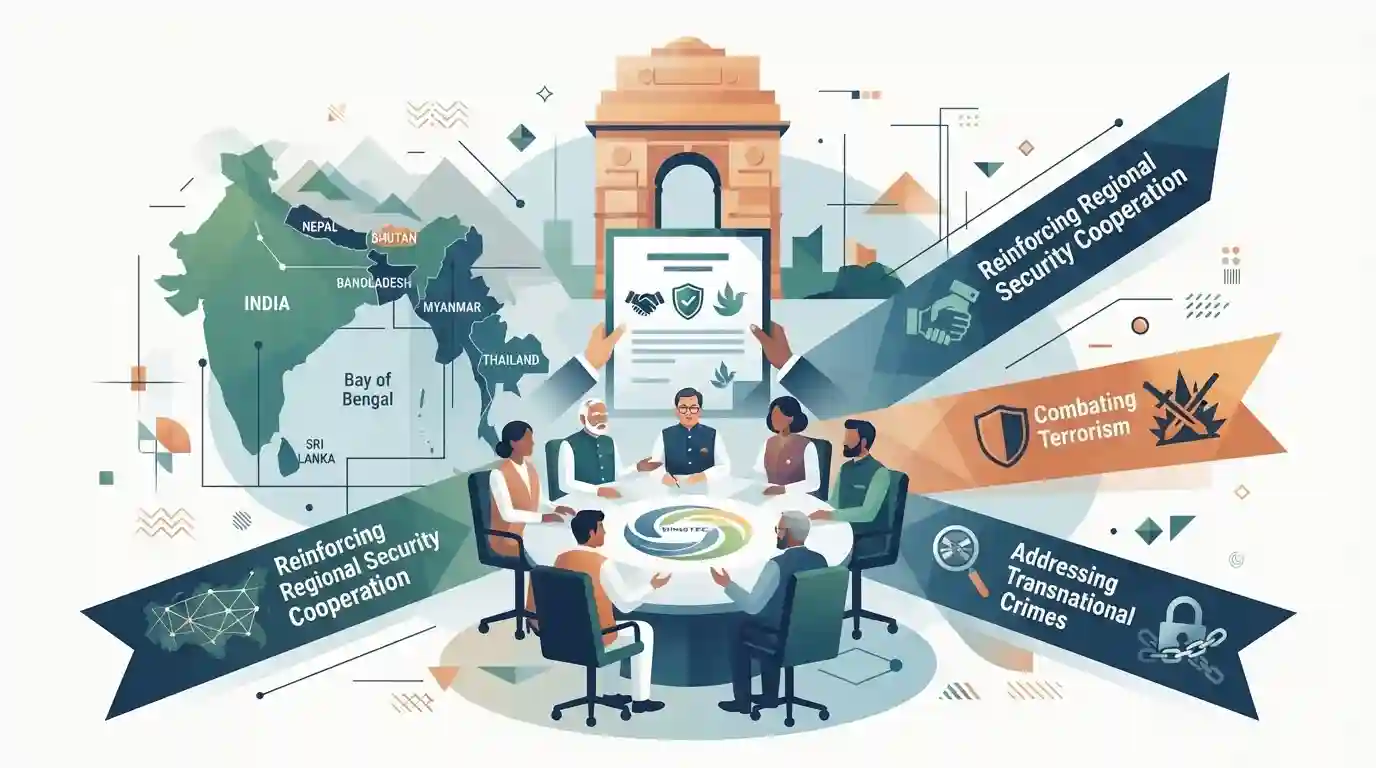
The First BIMSTEC Home Ministers’ Meeting concluded in New Delhi with the adoption of the Delhi Declaration, reinforcing regional security cooperation, combating terrorism, and addressing transnational crimes among member states in the Bay of Bengal region.
Key Points
- The First BIMSTEC Home Ministers’ Meeting concluded with the adoption of the Delhi Declaration in New Delhi.
- Focuses on strengthening security cooperation, counter-terrorism, combating transnational organized crime, drug trafficking, and cyber security in the Bay of Bengal region.
- Highlights India's strategic vision for regional stability and cooperative security under the BIMSTEC framework.
Important Terms
Delhi Declaration

Adopted at the First BIMSTEC Home Ministers’ Meeting in New Delhi, it reinforces regional security cooperation, counter-terrorism efforts, and joint strategies against transnational crimes in the Bay of Bengal region.
UPSC context
Important for GS Paper II (International Relations - Regional Groupings and India's neighborhood policy).
BIMSTEC
The Bay of Bengal Initiative for Multi-Sectoral Technical and Economic Cooperation is a regional international organization comprising seven member states around the Bay of Bengal, focusing on economic and security cooperation.
UPSC context
Crucial for GS Paper II (International Relations - Bilateral, regional and global groupings involving India) and security dynamics.
Prelims Trap
BIMSTEC is exclusively an economic and technical cooperation grouping with no mandate for internal security or counter-terrorism.
Aspirants often confuse BIMSTEC's founding documents or assume it is solely an economic bloc, missing newer security mandates like the Delhi Declaration.
Static Concepts Connected
What are the core member states and founding principles of BIMSTEC?
- Member Nations: Bimstec comprises seven member states: five from South Asia (India, Bangladesh, Bhutan, Nepal, Sri Lanka) and two from Southeast Asia (Myanmar, Thailand).
- Founding Treaty: Established in 1997 through the Bangkok Declaration, initially named BIST-EC before incorporating Myanmar and later Nepal and Bhutan.
- Core Mandate: Focuses on bridging South Asia and Southeast Asia, operating on project-driven cooperation rather than rigid supranational integration.
Cross-Topic Patterns
BIMSTEC Security Evolution vs ASEAN Architecture
BIMSTEC security frameworks increasingly mirror ASEAN's regional security architecture, shifting the Bay of Bengal grouping from a trade-centric body to a hard security dialogue partner.
Terror Financing & FATF Compliance Linkages
Joint counter-terrorism declarations tie directly into FATF compliance standards and anti-money laundering frameworks across South and Southeast Asian jurisdictions.

BIMSTEC institutional maturation vs SAARC paralysis will likely be tested via statement-based questions on regional groupings.
Linked PYQs · 2
Linked PYQs · 2
- 2011MainsGS2
Compared to the South Asian Free Trade Area (SAFTA), the Bay of Bengal Initiative for Multisectoral Technical and Economic Cooperation Free Trade Area (BIMSTEC FTA) seems to be more promising." Critically evaluate.
- 2022MainsGS2
Do you think that BIMSTEC is a parallel organisation like the SAARC ? What are the similarities and dissimilarities between the two ? How are Indian foreign policy objectives realized by forming this new organisation?
