Maritime State Development Council Concludes Mumbai Meeting
Source:PIB ↗
हे का महत्त्वाचे आहे
The MSDC meeting highlights the practical application of cooperative federalism in critical economic infrastructure, specifically port-led development, logistics cost reduction, and maritime security, which are core components of India's GS3 infrastructure and GS2 governance syllabi.
सारांश
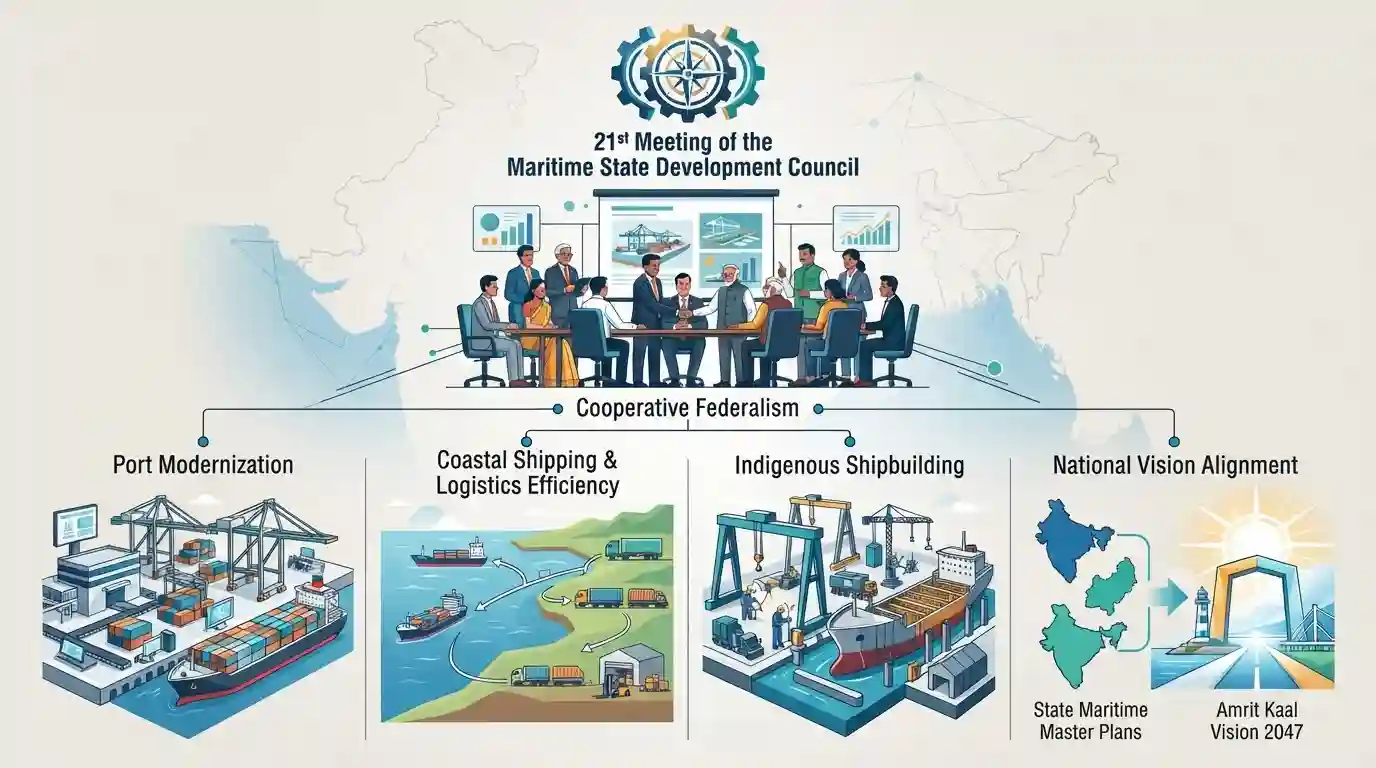
The 21st meeting of the Maritime State Development Council (MSDC) convened in Mumbai under the aegis of the Ministry of Ports, Shipping and Waterways, bringing together central and state stakeholders. The meeting underscored cooperative federalism to accelerate port modernization, coastal shipping, logistics efficiency, and indigenous shipbuilding, aligning state maritime master plans with national visions like Amrit Kaal Vision 2047.
मुख्य मुद्दे
- The 21st Meeting of the Maritime State Development Council (MSDC) concluded in Mumbai, focusing on cooperative federalism to drive maritime infrastructure development.
- Discussions emphasized port-led development, coastal shipping, inland waterways, and boosting indigenous shipbuilding and repair facilities.
- The MSDC serves as an apex advisory body for the development of the maritime sector, fostering coordination between the Centre and coastal states/union territories.
- Key strategic goals include alignment with Maritime India Vision 2030 and Amrit Kaal Vision 2047 to enhance India's global maritime standing.
महत्त्वाच्या संज्ञा
Maritime State Development Council

A consultative federal forum established to coordinate the development of both major and non-major ports across India, fostering seamless cooperation between the Central government and maritime states.
UPSC context
UPSC Prelims/Mains (Polity & Governance / Infrastructure): Tests cooperative federalism, Centre-State coordination, and port governance mechanisms.
Amrit Kaal Vision 2047
India’s long-term overarching strategic roadmap for the maritime sector, aiming to transform the nation into a global maritime leader by its centenary of independence in 2047.
UPSC context
UPSC Mains (Infrastructure & Economy): Tests long-term national planning, blue economy growth, and port-led development targets.
Maritime India Vision 2030
A comprehensive 10-year policy blueprint by the Ministry of Ports, Shipping and Waterways aimed at enhancing port capacity, efficiency, and sustainable maritime infrastructure by 2030.
UPSC context
UPSC Prelims/Mains (Economy & Infrastructure): Tests strategic planning, logistics cost reduction, and modernization of India's shipping sector.
Sagarmala
A flagship national initiative focused on port-led economic development, leveraging India's coastline to minimize logistics costs and boost export-import efficiency through multimodal connectivity.
UPSC context
UPSC Prelims/Mains (Infrastructure / Economy): Tests multimodal connectivity, coastal shipping promotion, and industrial clustering.
Ministry of Ports, Shipping and Waterways
The nodal Union Ministry responsible for formulating and administering policies, regulations, and infrastructure development programs for ports, shipping, inland water transport, and maritime trade in India.
UPSC context
UPSC Prelims (Governance): Tests institutional framework of key central ministries handling maritime transport and blue economy.
पूर्वपरीक्षा सापळा
The Maritime State Development Council is a statutory body empowered to issue binding executive directives to all state-managed ports.
Aspirants often assume the MSDC is a statutory body with executive power over state ports, whereas it is an apex advisory body.
संबंधित स्थिर संकल्पना
What is the composition and mandate of the Maritime State Development Council (MSDC)?
- Apex Body: Establishment year: Formed in May 1997 under the aegis of the Ministry of Surface Transport (now Ministry of Ports, Shipping and Waterways).
- Membership: Composition: Chaired by the Union Minister of Ports, Shipping and Waterways, comprising Ministers in charge of ports in coastal states and UTs.
- Advisory Role: Mandate: Acts as an advisory body for integrated development of major and non-major (minor) ports, promoting cooperative federalism in maritime planning.
आंतर-विषय नमुने
Cooperative Federalism in Infrastructure Governance
Cooperative federalism mechanisms like MSDC are increasingly tested against fiscal federalism disputes and Centre-state coordination in infrastructure project execution.
Spatial Planning and Export Competitiveness
Integration of state maritime master plans with national visions links decentralized spatial planning with macro-economic export-import competitiveness.

MSDC's statutory/advisory status and its role in coordinating major vs non-major ports is a high-yield statement trap for Prelims.
संबंधित PYQ · 3
संबंधित PYQ · 3
- 2015MainsGS2
The concept of cooperative federalism has been increasingly emphasized in recent years. Highlight the drawbacks in the existing structure and the extent to which cooperative federalism would answer the shortcomings.
- 2025MainsGS3
Why is maritime security vital to protect India's sea trade? Discuss maritime and coastal security challenges and the way forward.
- 2021MainsGS3
“Investment in infrastructure is essential for more rapid and inclusive economic growth.” Discuss in the light of India's experience.
