IMD Launches Advanced Cyclone Warning Decision Support System
Source:PIB ↗
हे का महत्त्वाचे आहे
Directly relevant to GS3 Disaster Management syllabus, focusing on early warning systems, disaster preparedness, and mitigating risks from hydro-meteorological hazards like cyclones.
सारांश
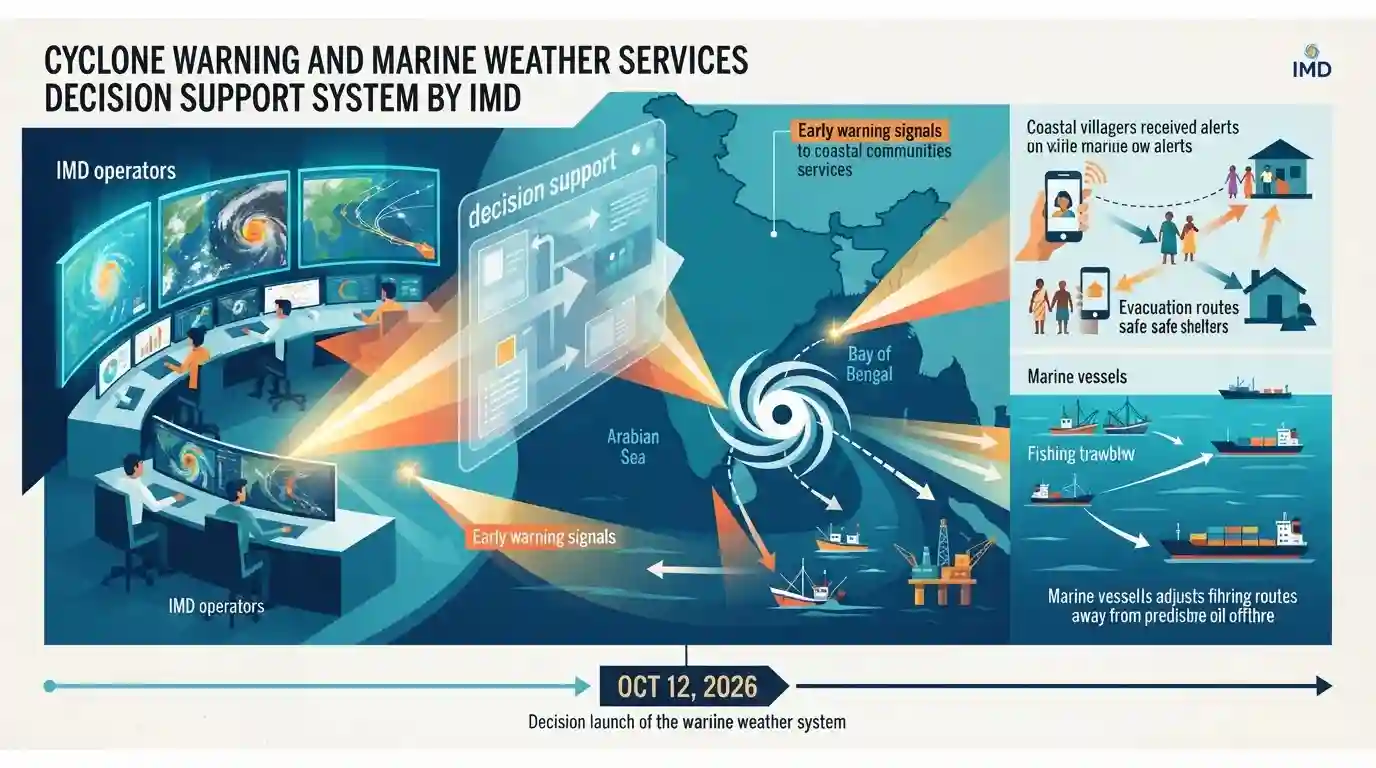
On October 12, 2026, the IMD launched an advanced Cyclone Warning and Marine Weather Services Decision Support System to fortify India's disaster management capabilities, aiming to provide sharper early warnings and streamline decision-making for marine and coastal safety.
मुख्य मुद्दे
- The India Meteorological Department (IMD) dedicated a new Cyclone Warning and Marine Weather Services Decision Support System to the nation on October 12, 2026.
- This system aims to enhance precision, reduce response time, and improve decision-making capabilities during extreme marine weather events and cyclones.
- It integrates advanced meteorological technologies, geospatial data, and forecasting tools to protect coastal communities and maritime assets.
- Aligns with India's broader focus on strengthening early warning systems and disaster resilience under disaster management frameworks.
महत्त्वाच्या संज्ञा
India Meteorological Department (IMD)

The principal government agency responsible for meteorological observations, weather forecasting, and seismology in India, operating under the Ministry of Earth Sciences and serving as a Regional Specialized Meteorological Centre for tropical cyclones.
UPSC context
UPSC GS Paper III (Disaster Management, Science & Technology) - tests institutional frameworks for weather forecasting, cyclone warnings, and early-warning systems.
Ministry of Earth Sciences
The nodal ministry of the Government of India mandated to provide services for weather, climate, ocean and coastal state forecasts, seismology, and natural hazard warnings to support public safety and national development.
UPSC context
UPSC GS Paper III (Disaster Management, Governance) - tests administrative frameworks guiding climate services, scientific research, and disaster risk reduction.
पूर्वपरीक्षा सापळा
The IMD's Decision Support System directly executes disaster relief operations and evacuation mandates across coastal districts.
Aspirants often confuse IMD's regional forecasting role with the National Disaster Management Authority (NDMA), attributing operational disaster relief command to meteorological agencies rather than executive authorities.
संबंधित स्थिर संकल्पना
What is the institutional mandate and international role of the India Meteorological Department (IMD)?
- Nodal Agency: Established in 1875, it functions under the Ministry of Earth Sciences, Government of India, as the principal national agency for meteorological observations and weather forecasting.
- WMO RSMC Role: Since 1988, IMD functions as a World Meteorological Organization (WMO) Regional Specialised Meteorological Centre (RSMC) for the North Indian Ocean.
- Cyclone Mandate: It provides advisories, storm surge predictions, and track forecasts for tropical cyclones affecting countries in the Bay of Bengal and Arabian Sea region.
आंतर-विषय नमुने
Cyclone Forecasting + SAGAR & HADR Diplomacy
The IMD's WMO RSMC mandate for North Indian Ocean cyclones intersects with India's SAGAR vision and HADR operations across the Indo-Pacific.
Early Warning Systems + Decentralized Disaster Governance
Deploying decision support systems down to the village level links advanced meteorological science with decentralized Panchayati Raj disaster mitigation frameworks under NDMA guidelines.

Expect a match-the-following or statement-based question linking IMD's WMO RSMC mandate, Vision 2035 zero-casualty targets, and DSS tech.
संबंधित PYQ · 3
संबंधित PYQ · 3
- 2019MainsGS3
Disaster preparedness is the first step in any disaster management process. Explain how hazard zonation mapping will help disaster mitigation in the case of landslides.
- 2013MainsGS3
How important are vulnerability and risk assessment for pre-disaster management ? As an administrator, what are key areas that you would focus on in a Disaster Management System.
- 2021MainsGS3
Describe the various causes and the effects of landslides. Mention the important components of the National Landslide Risk Management Strategy.
