CAQM Reviews Road Dust Mitigation Preparedness in Delhi
Source:PIB ↗
हे का महत्त्वाचे आहे
Road dust is a major contributor to severe particulate air pollution (PM10 and PM2.5) in the National Capital Region (NCR). Understanding institutional mechanisms like the CAQM and mitigation strategies like mechanical sweeping and road cleaning is crucial for GS3 Environment and Pollution topics.
सारांश
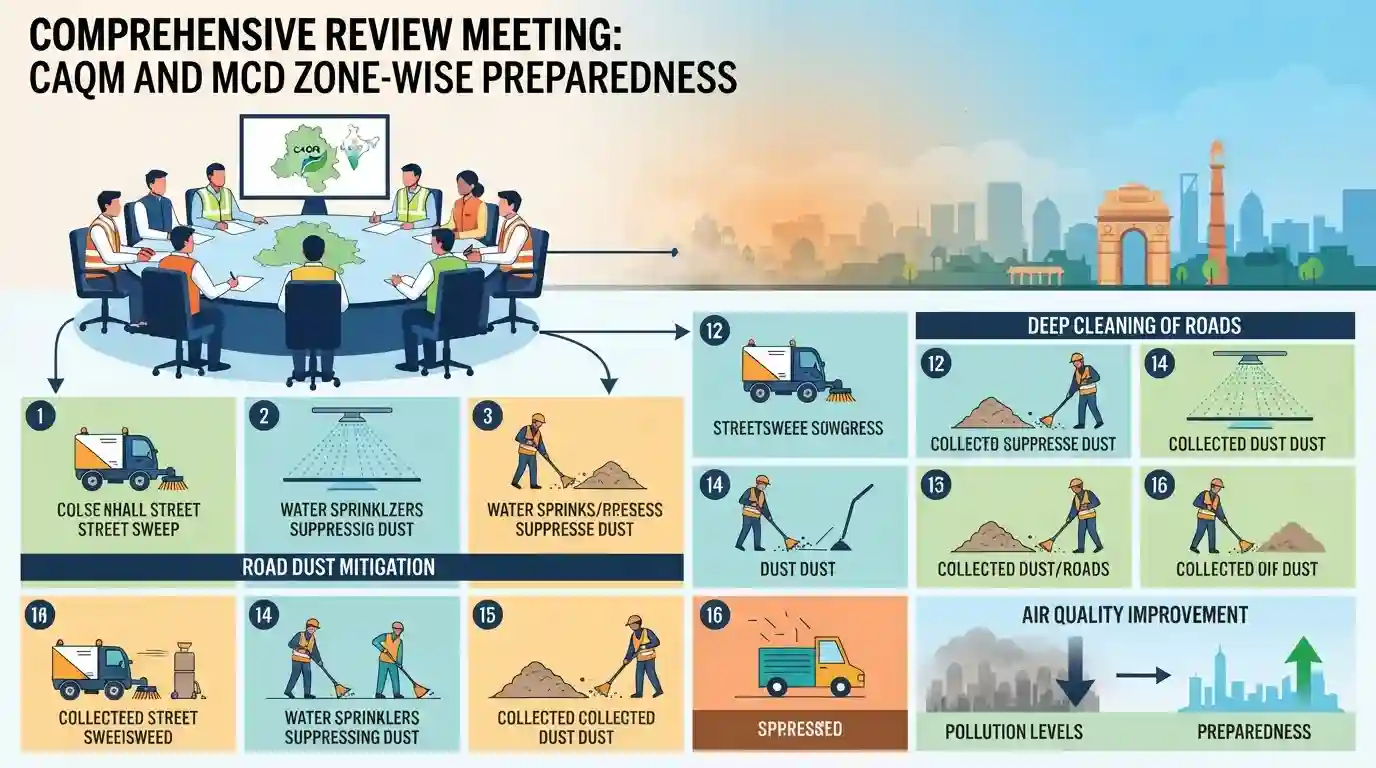
The Commission for Air Quality Management (CAQM) held a comprehensive review meeting regarding the zone-wise preparedness of all 12 Municipal Corporation of Delhi (MCD) zones, focusing on road dust mitigation strategies and deep cleaning of roads to combat air pollution in Delhi.
मुख्य मुद्दे
- CAQM reviewed zone-wise preparedness of all 12 MCD zones for road dust mitigation and deep cleaning of roads in Delhi.
- Focus was placed on mechanical road sweeping, water sprinkling, anti-smog guns, and repairing broken pavements to curb dust pollution.
- Emphasized coordinated efforts among civic agencies to tackle particulate matter (PM2.5 and PM10) concentrations in the capital.
महत्त्वाच्या संज्ञा
Commission for Air Quality Management (CAQM)

A statutory body established under the CAQM Act 2021 to coordinate, monitor, and regulate air quality management across the National Capital Region and adjoining areas, replacing various ad-hoc committees.
UPSC context
Important for GS Paper III (Environmental Pollution and Conservation). Tests institutional frameworks for tackling air pollution in northern India.
Municipal Corporation of Delhi (MCD)
The civic body responsible for municipal administration, sanitation, and urban infrastructure across 12 zones in the National Capital Territory of Delhi.
UPSC context
Relevant for GS Paper II (Governance, Urban Administration) and GS Paper III (Urban Environmental Management and Waste Control).
पूर्वपरीक्षा सापळा
CAQM is a continuation of the erstwhile Environment Pollution (Prevention and Control) Authority (EPCA) established under the Environment Protection Act, 1986.
The EPCA was an ad-hoc body set up by Supreme Court orders, whereas CAQM is a statutory body created by an Act of Parliament (2021). Aspirants often confuse their legal origins.
संबंधित स्थिर संकल्पना
What is the statutory mandate, composition, and powers of the Commission for Air Quality Management (CAQM)?
- Act of 2021: Statutory Basis: Established under the Commission for Air Quality Management in National Capital Region and Adjoining Areas Act, 2021, replacing the EPCA.
- Territorial Scope: Jurisdiction: Covers Delhi and adjoining areas in NCR (Haryana, Punjab, Rajasthan, and UP) with overriding powers over state governments and other statutory bodies on air pollution matters.
- Enforcement Powers: Powers: Can issue binding directions, impose environmental compensation (penalties) for non-compliance, and entertain appeals against its orders only in the Supreme Court.
आंतर-विषय नमुने
Urban Governance vs. Statutory Environmental Regulators
Air quality governance bridges local urban governance (Schedule 12) with federal environmental statutes, testing coordination between municipal bodies and statutory regulators like CAQM.
Municipal Finances and Air Quality Management
PM2.5 and PM10 mitigation directly intersects with fiscal devolution and urban local body capacity for purchasing mechanical sweepers and anti-smog equipment.

CAQM's statutory powers, composition, and jurisdiction vs EPCA will likely be tested in a multi-statement prelims question.
संबंधित PYQ · 1
संबंधित PYQ · 1
- 2021MainsGS3
Describe the key points of the revised Global Air Quality Guidelines (AQGs) recently released by the World Health Organisation (WHO). How are these different from its last update in 2005? What changes in India's National Clean Air Programme are required to achieve these revised standards?
