India and EU Discuss CBAM and Carbon Tax Implications
Source:PIB ↗
কেন এটি গুরুত্বপূর্ণ
The implementation of the EU's Carbon Border Adjustment Mechanism (CBAM) poses major trade and economic challenges for developing nations like India, affecting energy-intensive exports (such as steel and aluminum). High-level engagements between India and the European Commission are crucial for addressing non-tariff barriers, carbon pricing alignment, and protecting India's industrial competitiveness while pursuing global climate goals.
সারসংক্ষেপ
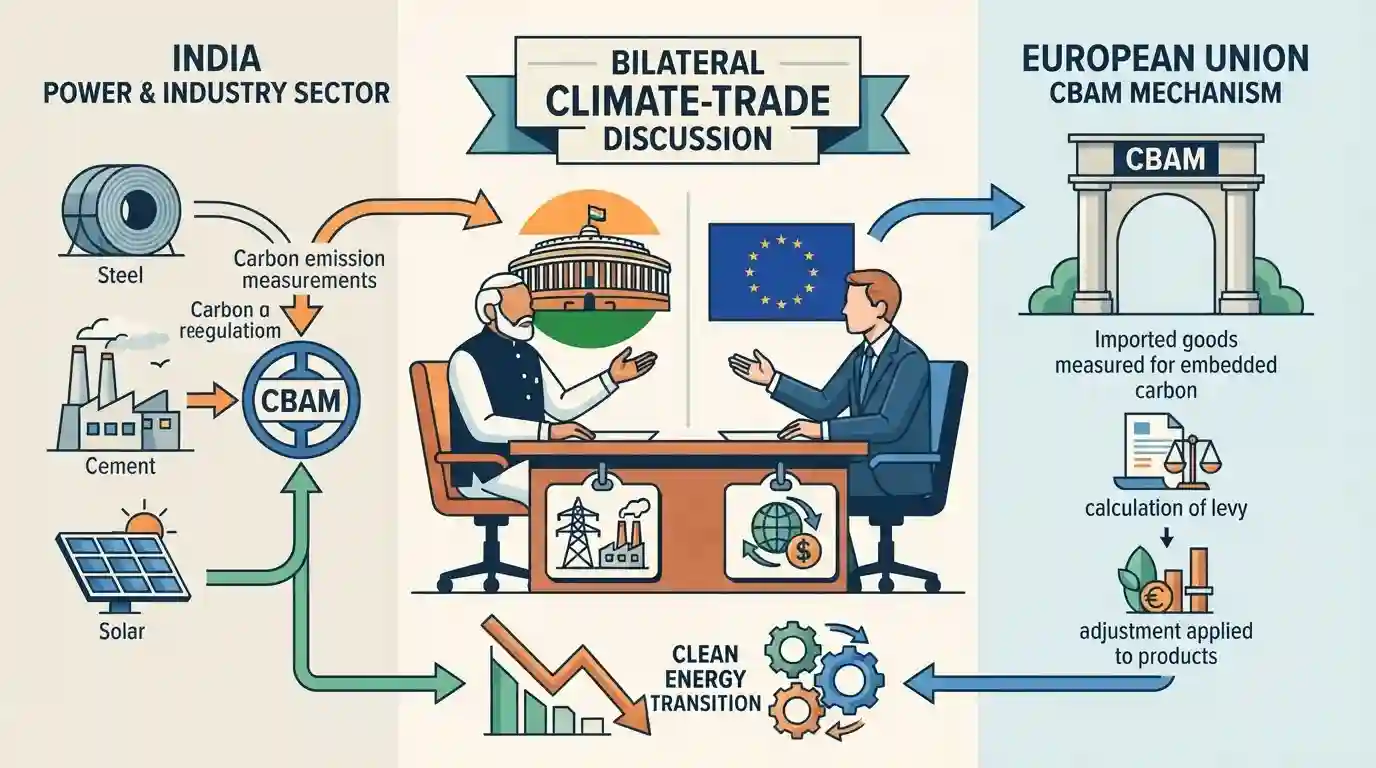
The Secretary (Power) of India held a high-level bilateral meeting with Mr. Gerassimos Thomas, Director General for Taxation and Customs Union, European Commission, to discuss critical climate-trade matters including the European Union's Carbon Border Adjustment Mechanism (CBAM) and its implications for Indian industries and power sector.
মূল বিষয়
- India's Secretary (Power) held a bilateral meeting with Mr. Gerassimos Thomas, Director General for Taxation and Customs Union, European Commission.
- Discussions centered on trade implications and decarbonization efforts, specifically concerning the European Union's Carbon Border Adjustment Mechanism (CBAM).
- Both sides addressed regulatory alignment, carbon pricing, and the impact of cross-border environmental taxes on Indian exports and energy sectors.
গুরুত্বপূর্ণ শব্দ
Carbon Border Adjustment Mechanism (CBAM)

A trade policy instrument introduced by the European Union requiring importers of carbon-intensive goods (e.g., steel, aluminum, cement) to purchase certificates reflecting the carbon emissions embedded in their production.
UPSC context
UPSC GS Paper III (Environment & Climate Change; International Trade) - tests understanding of carbon pricing, trade barriers, and India-EU economic diplomacy.
European Commission
The politically independent executive arm of the European Union responsible for proposing legislation, enforcing EU law, managing policies, and representing the EU in international trade negotiations.
UPSC context
UPSC GS Paper II (International Relations) - tests knowledge of major international organizations, bloc governance, and plurilateral institutional structures.
Directorate-General for Taxation and Customs Union (DG TAXUD)
A directorate-general of the European Commission responsible for formulating and implementing EU policies on taxation, customs unions, and managing border regulatory instruments like the CBAM.
UPSC context
UPSC GS Paper III (Economy and International Trade) - tests awareness of specialized regulatory bodies shaping global taxation and trade compliance.
Ministry of Power, Government of India
The apex administrative body of the Government of India responsible for formulating policies, planning, and overseeing the country's power sector, generation, transmission, and energy transition initiatives.
UPSC context
UPSC GS Paper III (Infrastructure - Energy) - tests knowledge of key Indian ministries handling power policy, decarbonization, and international climate negotiations.
সংযুক্ত স্থির ধারণা
What are the key features and operational timeline of the EU's Carbon Border Adjustment Mechanism (CBAM)?
- Carbon Equivalence: It equalizes carbon price between domestic EU products and imported goods to prevent carbon leakage.
- Covered Sectors: Covers carbon-intensive sectors including iron, steel, aluminum, cement, fertilizer, electricity, and hydrogen.
- Phased Timeline: Transitional reporting began in Oct 2023; full financial obligations and certificate purchases start January 1, 2026.
আন্তঃবিষয় প্যাটার্ন
CBAM and WTO Trade Remedies Clash
While CBAM functions as a customs levy under DG TAXUD, India views it as a potential non-tariff barrier violating GATT national treatment principles, setting up a clash in WTO dispute forums.
Domestic CCTS as Export Defense Mechanism
India's internal Carbon Credit Trading Scheme (CCTS) is being fast-tracked to prove equivalent domestic carbon pricing, directly linking domestic environmental regulation to international trade defense.

Expect a multi-statement prelims question pairing EU's CBAM timeline with India's domestic Carbon Credit Trading Scheme (CCTS).
সংযুক্ত PYQ · 2
সংযুক্ত PYQ · 2
- 2025MainsGS3
Write a review on India's climate commitments under the Paris Agreement (2015) and mention how these have been further strengthened in COP26 (2021). In this direction, how has the first Nationally Determined Contribution intended by India been updated in 2022?
- 2014MainsGS3
Should the pursuit of carbon credits and clean development mechanisms set up under UNFCCC be maintained even though there has been a massive slide in the value of a carbon credit? Discuss with respect to India's energy needs for economic growth.
