Government Launches Commercialisation Catalogue for Technologies
Source:PIB ↗
Why It Matters
Commercializing indigenous technologies developed through public-sponsored programs is vital for translating research into economic value, reducing import dependency, and strengthening India's manufacturing ecosystem.
Summary
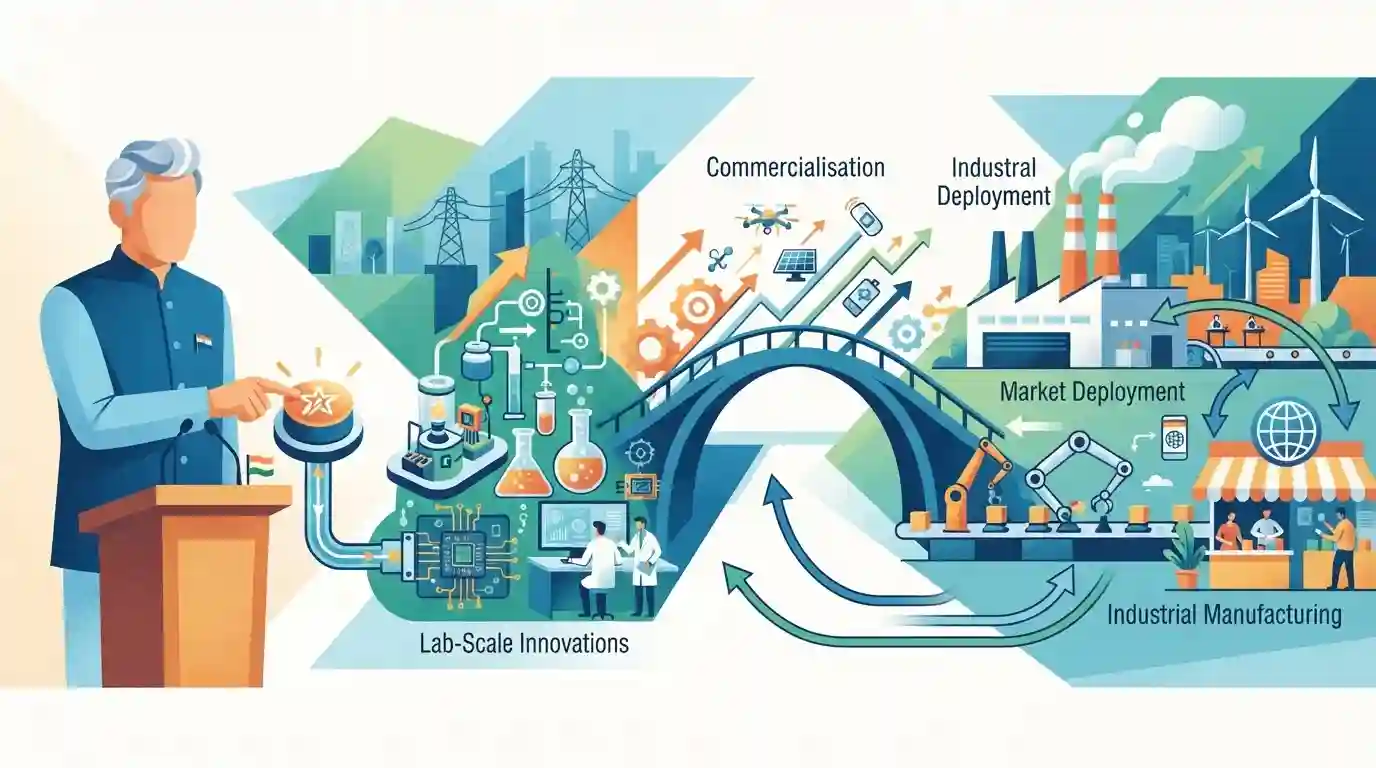
Union Minister Shri G. Kishan Reddy launched the Commercialisation Catalogue of Technologies developed under various sponsored programmes, seeking to bridge the gap between lab-scale innovations and market deployment to bolster indigenous R&D and industrial manufacturing.
Key Points
- Union Minister Shri G. Kishan Reddy launched a Commercialisation Catalogue of Technologies developed under various sponsored programmes.
- The initiative aims to bridge the gap between laboratory research and commercial market application, promoting indigenous technologies.
- Focuses on enhancing collaboration between research institutions, public sector undertakings, and private industries or MSMEs.
- Aims to foster innovation, self-reliance (Atmanirbhar Bharat), and technology transfer within the industrial sector.
Important Terms
Commercialisation Catalogue of Technologies

A compilation of indigenous lab-scale technologies and innovations developed via government-sponsored R&D programs, designed to facilitate market deployment, technology transfer, and commercial industrial manufacturing.
UPSC context
GS Paper III (Science & Technology - Indigenization of Technology and Commercialization). Tests awareness of lab-to-market translation policies.
Ministry of Mines
The central government department responsible for the survey, exploration, and regulation of mines and minerals other than natural gas, petroleum, and atomic minerals in India.
UPSC context
GS Paper II/III (Governance and Economic Development - Mineral Resources and Industrial Policies). Tests institutional framework of mineral regulation.
Prelims Trap
The Commercialisation Catalogue grants statutory intellectual property rights and patents to private industries for laboratory-scale innovations.
Such catalogues facilitate industry adoption and technology transfer; they do not grant intellectual property rights or statutory patents directly.
Static Concepts Connected
What is the role of the Department of Scientific and Industrial Research (DSIR) in India's R&D ecosystem?
- Mandate: DSIR operates under the Ministry of Science and Technology, promoting indigenous R&D and technology transfer.
- Incentives: It provides financial incentives and recognition to in-house R&D units in industry and industrial research organizations.
Cross-Topic Patterns
Indigenous R&D + MSME Manufacturing Linkage
Translating research breakthroughs from public labs into commercial MSME products connects science policy directly to Make in India and Atmanirbhar Bharat manufacturing targets.

Commercialisation of lab research + Atmanirbhar Bharat bridging mechanisms will feature in matching or statement-based prelims questions.
Linked PYQs · 1
Linked PYQs · 1
- 2023MainsGS3
Faster economic growth requires increased share of the manufacturing sector in GDP, particularly of MSMEs. Comment on the present policies of the Government in this regard.
