NHRC Hosts Conference on Human Dignity and Right to Water
Source:PIB ↗
हे का महत्त्वाचे आहे
It links basic developmental utilities like clean drinking water directly to constitutional rights and human dignity, while highlighting the mandate of the NHRC in protecting such rights.
सारांश
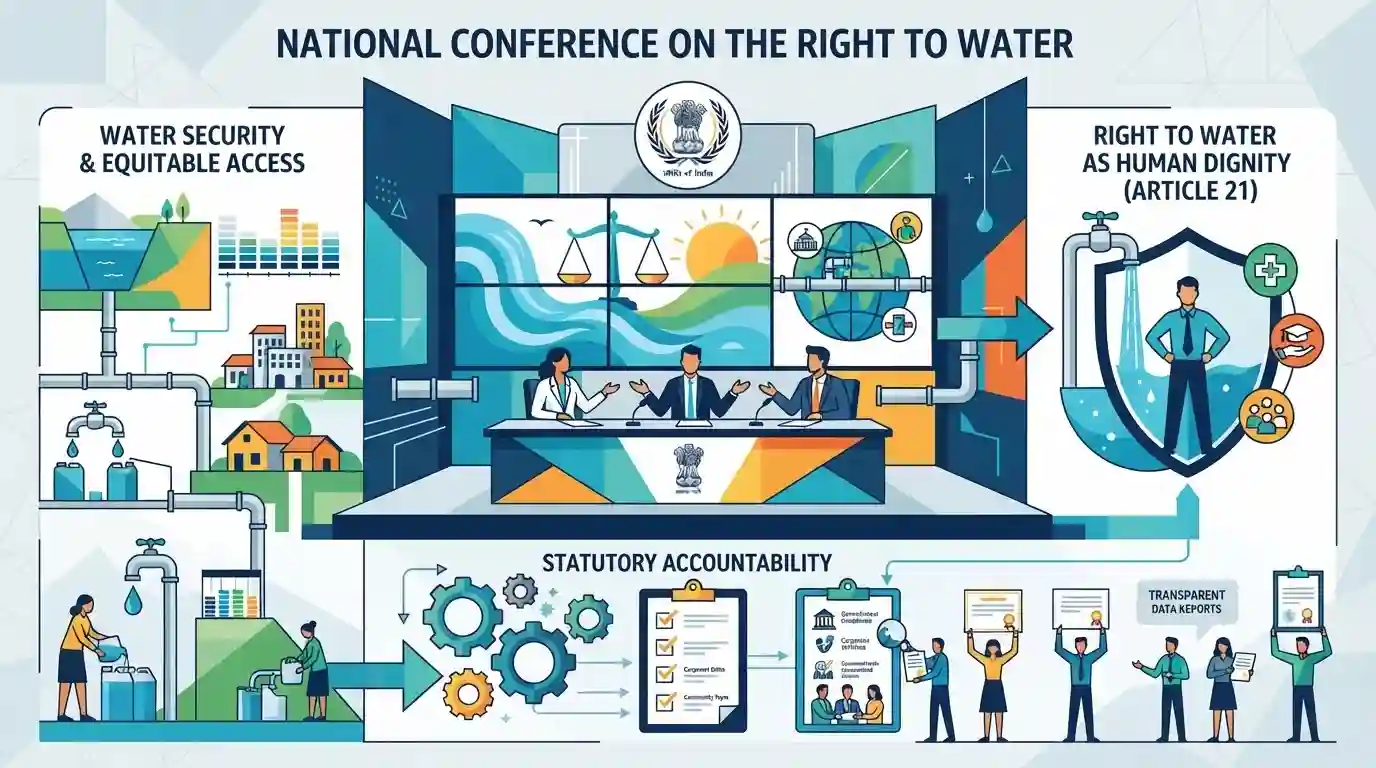
The National Human Rights Commission (NHRC) of India celebrated its 33rd Foundation Day by hosting a National Conference focusing on the right to water as a core component of human dignity and life under Article 21. The deliberations highlighted water security, equitable access, and statutory accountability.
मुख्य मुद्दे
- The National Human Rights Commission (NHRC), India organized a National Conference on 'Water as the Elixir of Life: Advancing Human Dignity through the Right to Water' on its 33rd Foundation Day.
- The conference emphasized the linkage between clean, accessible drinking water, human dignity, and fundamental human rights under Article 21 of the Constitution.
- Discussions focused on challenges related to water scarcity, equitable distribution, pollution, and the role of statutory bodies in safeguarding citizen entitlements.
महत्त्वाच्या संज्ञा
National Human Rights Commission (NHRC)

An independent statutory body established under the Protection of Human Rights Act, 1993, responsible for the promotion and protection of human rights in India.
UPSC context
UPSC Prelims/Mains (GS Paper II): Statutory bodies, constitutional/human rights framework, mechanisms for protecting vulnerable sections.
पूर्वपरीक्षा सापळा
The NHRC possesses binding judicial authority to enforce human rights violations and penalize erring state functionaries directly.
Aspirants often assume the NHRC has binding, enforceable judicial powers, whereas its recommendations are fundamentally recommendatory in nature under the Protection of Human Rights Act.
संबंधित स्थिर संकल्पना
What is the composition and jurisdictional scope of the National Human Rights Commission (NHRC)?
- Statutory Basis: Established on October 12, 1993, under the Protection of Human Rights Act, 1993, amended in 2019 to enhance efficacy.
- Composition: Comprises a Chairperson who has been a Chief Justice or Judge of Supreme Court, plus members with human rights expertise.
- Powers Limit: Functions primarily as a recommendatory body with powers to inquire into violations, visit jails, and intervene in court proceedings.
आंतर-विषय नमुने
NHRC Mandate + Right to Water (Article 21)
The NHRC's thematic focus on water links constitutional rights under Article 21 with welfare schemes like the Jal Jeevan Mission, testing administrative accountability in governance.

NHRC composition, statutory powers, and its expansion into socio-economic rights like water under Article 21 frequently feature in prelims.
संबंधित PYQ · 2
संबंधित PYQ · 2
- 2014MainsGS2
National Human Rights Commission (NHRC) in India can be most effective when its tasks are adequately supported by other mechanisms that ensure the accountability of a government. In light of the above observation assess the role of NHRC as an effective complement to the judiciary and other institutions in promoting and protecting human rights standards.
- 2024MainsGS3
The world is facing an acute shortage of clean and safe freshwater. What are the alternative technologies which can solve this crisis? Briefly discuss any three such technologies citing their key merits and demerits.
