Infrastructure Projects in Chennai and Regional Economic Growth
Source:PIB ↗
हे का महत्त्वाचे आहे
Infrastructure investments worth thousands of crores directly feed into India's capabilities in reducing logistics costs, boosting regional manufacturing, and supporting integrated multimodal connectivity, which are core themes of GS Paper III.
सारांश
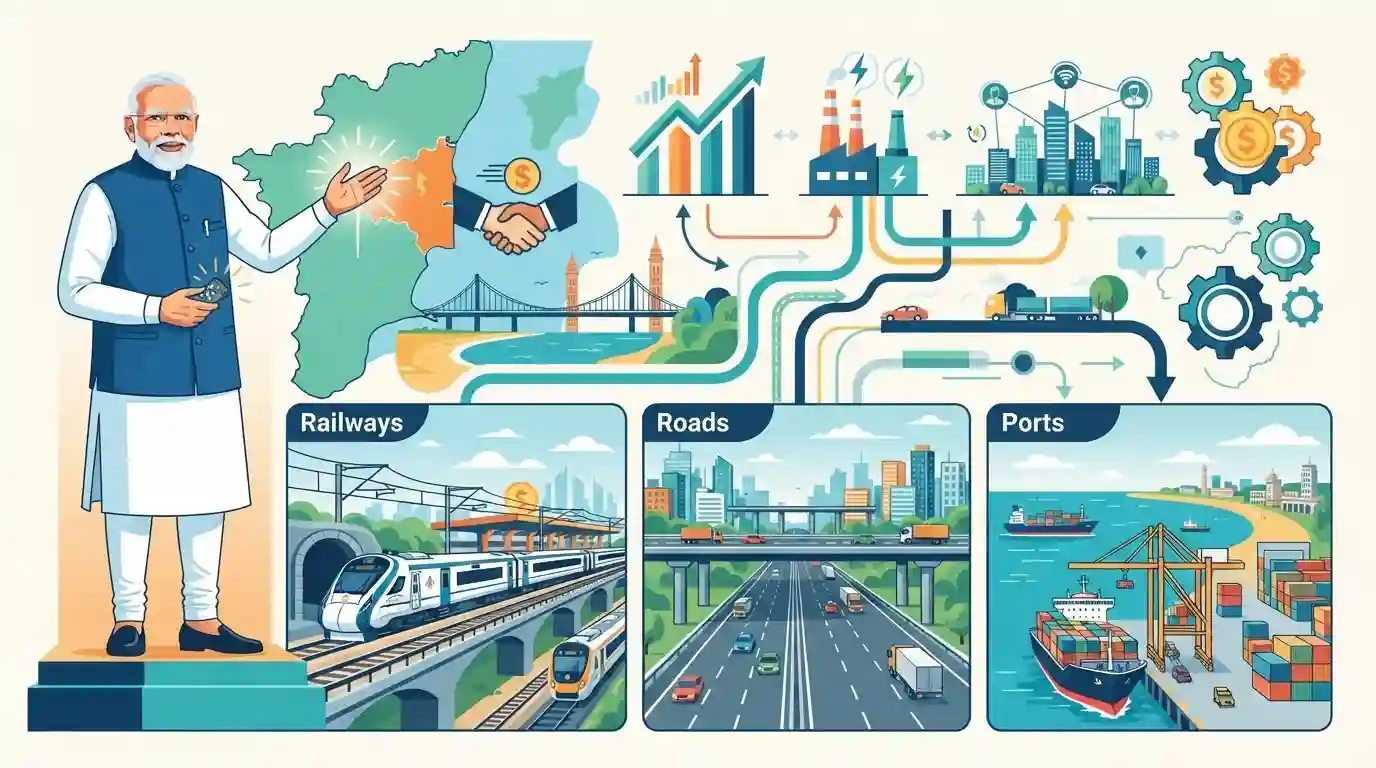
Prime Minister Narendra Modi launched multiple infrastructure and development projects worth over ₹13,000 crore in Chennai, Tamil Nadu, focusing on transport, railways, and urban connectivity to strengthen economic growth and logistical efficiency.
मुख्य मुद्दे
- Prime Minister Narendra Modi inaugurated, dedicated, and laid the foundation stone for various development projects worth over ₹13,000 crore in Chennai, Tamil Nadu.
- Projects span critical infrastructure sectors including railways, roadways, port connectivity, and urban mobility aimed at boosting regional economic development and reducing logistics costs.
- Emphasized modernizing urban infrastructure and enhancing ease of living and ease of doing business in South India.
महत्त्वाच्या संज्ञा
Southern Railway

One of the 19 railway zones of Indian Railways, headquartered in Chennai, operating rail networks across Tamil Nadu, Kerala, and parts of neighboring states to enhance regional connectivity.
UPSC context
GS Paper III (Infrastructure - Railways): Tests knowledge of critical transport networks, regional logistics, and railway zones in India.
Government of Tamil Nadu
The sub-national executive and administrative authority governing the state of Tamil Nadu, responsible for regional policy implementation and infrastructure coordination.
UPSC context
GS Paper II / Polity & Governance: Tests federal governance, Centre-State coordination, and state administration of development projects.
पूर्वपरीक्षा सापळा
All urban transit and metro rail projects in Indian states are fully funded and executed directly by the Ministry of Railways without state participation.
Aspirants often assume central schemes fund 100% of metro rail projects, whereas most large urban rail projects in India are implemented via 50:50 joint ventures between the Central Government and respective State Governments with multilateral loan assistance.
संबंधित स्थिर संकल्पना
What are the key institutional mechanisms and funding models for Metro Rail projects in India?
- Statutory Framework: Governing Act,Implemented under the Metro Railways (Operation and Maintenance) Act, 2002, or through dedicated Joint Venture companies (e.g., Chennai Metro Rail Limited).
- Equity & Debt: Funding Structure,Typically structured as a 50:50 equity sharing between the Central Government and the State Government, supplemented by sovereign-guaranteed multilateral loans (e.g., JICA, ADB).
- TOD Policy: Transit-Oriented Development,Emphasizes high-density vertical growth along transit corridors to capture land value and reduce private vehicle dependency.
आंतर-विषय नमुने
Ports + National Logistics Policy
Coastal infrastructure upgrades integrate with the Sagarmala Programme and National Logistics Policy to reduce multimodal transport bottlenecks in southern industrial hubs.
Urban Transit + PM Gati Shakti
Double-decker metro rail engineering converges with PM Gati Shakti targets for integrated multi-modal urban transport corridors.

Infrastructure funding models and metro rail execution frameworks (like double-decker viaducts) are high-yield for Prelims matching.
संबंधित PYQ · 2
संबंधित PYQ · 2
- 2023MainsGS3
Faster economic growth requires increased share of the manufacturing sector in GDP, particularly of MSMEs. Comment on the present policies of the Government in this regard.
- 2026PrelimsGS1
In what way(s) does the Vizhinjam International Seaport represent a structural shift in India's maritime trade and logistics policy? 1. By functioning exclusively as a domestic cargo hub to reduce reliance on coastal shipping and eliminate the need for foreign collaborations. 2. By focusing primarily on passenger cruise tourism and heritage shipping to increase Kerala's profile as a maritime heritage destination. 3. By leveraging its natural deep draft and strategic location to reduce dependence on foreign trans-shipment ports, enhance revenue retention, and reposition India in regional maritime trade. Select the answer using the code given below :
