Pulse Production Self Sufficiency and Agricultural Policy Measures
Source:PIB ↗
ఇది ఎందుకు ముఖ్యం
Understanding India's transition toward self-sufficiency in pulses is crucial for GS3 Agriculture and Food Security, as pulses are a key component of dietary protein, sustainable farming (nitrogen fixation), and price stability.
సారాంశం
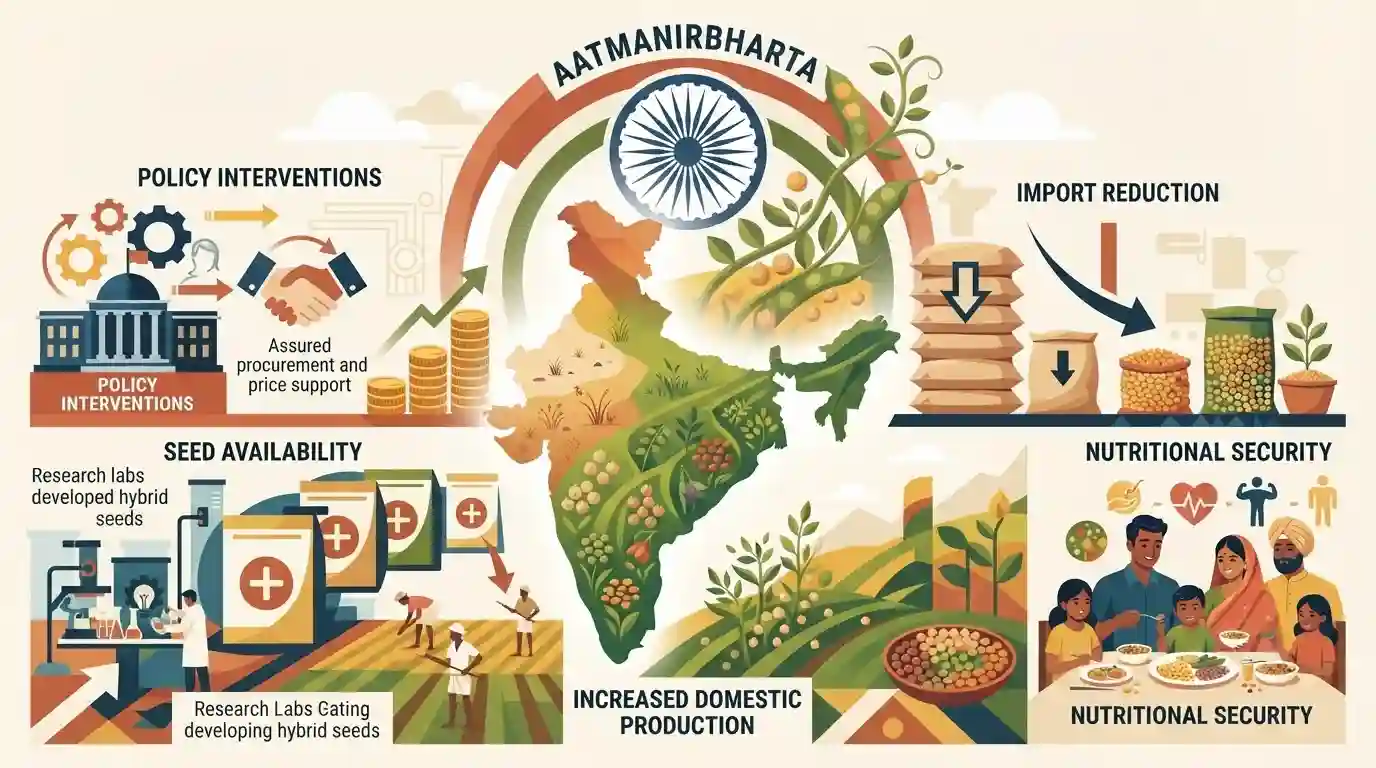
The article discusses India's strategic push towards self-reliance (Aatmanirbharta) in pulse production. It highlights key governmental initiatives, including assured procurement under price support mechanisms, enhanced availability of high-yielding seeds, and price incentives, which collectively aim to reduce import dependency, enhance farmers' income, and ensure long-term nutritional security.
ముఖ్య అంశాలు
- India has witnessed a significant transformation in pulse production, moving towards self-reliance (Aatmanirbharta).
- Government interventions such as assured procurement through NAFED and NCCF, attractive Minimum Support Prices (MSP), and targeted schemes like PM-AASHA have boosted farmer confidence.
- Enhanced adoption of high-yielding certified seeds, intercropping techniques, and climate-resilient agricultural practices have contributed to acreage and yield expansion.
- Achieving self-sufficiency in pulses reduces import dependence, stabilizes domestic prices, and promotes nutritional security and sustainable soil health through nitrogen fixation.
ముఖ్యమైన పదాలు
PM-AASHA

An umbrella scheme launched by the government to ensure remunerative prices to farmers for their produce, encompassing mechanisms like the Price Support Scheme (PSS), Price Deficiency Payment Scheme (PDPS), and private procurement pilots.
UPSC context
UPSC Mains GS Paper III (Agriculture): Important for questions on minimum support prices, farmer income security, and food management policies.
Price Support Scheme (PSS)
A component of PM-AASHA under which central agencies physically procure pulses, oilseeds, and copra at the Minimum Support Price (MSP) directly from farmers when market prices fall below the MSP.
UPSC context
UPSC Mains GS Paper III (Agriculture): Tests understanding of crop procurement mechanisms and market intervention policies.
National Agricultural Cooperative Marketing Federation of India (NAFED)
An apex organization of agricultural cooperative marketing federations in India, designated as a central nodal agency for procuring pulses and oilseeds under the Price Support Scheme.
UPSC context
UPSC Mains GS Paper III (Agriculture/Co-operatives): Important for institutional support systems in agriculture and cooperative marketing.
National Cooperative Consumers Federation of India (NCCF)
A central cooperative society engaged in consumer goods distribution and agricultural procurement, working alongside NAFED to execute government procurement operations for essential food commodities like pulses.
UPSC context
UPSC Mains GS Paper III (Agriculture): Tests knowledge of institutional players involved in food security and market intervention.
అనుసంధానమైన స్థిర భావనలు
What are the key institutional mechanisms and schemes supporting pulse procurement and price stabilization in India?
- PM-AASHA Scheme: PM-AASHA umbrella scheme integrates Price Support Scheme (PSS), Price Deficiency Payment Scheme (PDPS), and Private Procurement & Stockist Scheme (PPSS) to protect farmers.
- Procurement Agencies: Central agencies like NAFED and NCCF undertake 100% procurement of targeted pulses (Tur, Urad, Masoor) at MSP to incentivize domestic production and build buffer stocks.
- NFSM-Pulses: National Food Security Mission (NFSM-Pulses) focuses on area expansion, productivity enhancement through high-yielding varieties, and demonstration of improved agronomic practices.
అంతర-అంశ నమూనాలు
Pulses + Fertilizer Subsidies + Soil Health
Pulse cultivation naturally fixes atmospheric nitrogen through root nodules, directly reducing synthetic urea requirements and lowering fiscal subsidy burdens on the exchequer.
Pulse Procurement + WTO Agriculture Rules
India's shift from major pulse importers to self-reliance models interacts directly with WTO amber-box subsidy notifications and domestic food security stockholding rules.

Expect a statement-based prelims question linking pulse procurement schemes (PM-AASHA, NAFED) to biological nitrogen fixation and crop diversification.
అనుసంధాన PYQలు · 3
అనుసంధాన PYQలు · 3
- 2024MainsGS3
Explain the role of millets for ensuring health and nutritional security in India.
- 2020PrelimsGS1
Consider the following statements: 1. In the case of all cereals, pulses and oil-seeds, the procurement at Minimum Support Price (MSP) is unlimited in any State/UT of India. 2. In the case of cereals and pulses, the MSP is fixed in any State/UT at a level to which the market price will never rise. Which of the statements given above is/are correct?
- 2020PrelimsGS1
With reference to pulse production in India, consider the following statements: 1. Black gram can be cultivated as both kharif and rabi crop. 2. Green-gram alone accounts for nearly half of pulse production. 3. In the last three decades, while the production of kharif pulses has increased, the production of rabi pulses has decreased. Which of the statements given above is/are correct?
