CAQM Reviews Stubble Burning Prevention Measures in Punjab
Source:PIB ↗
हे का महत्त्वाचे आहे
Stubble burning in northwestern India is a primary contributor to severe winter air pollution in the National Capital Region (NCR). Evaluating the institutional responses, ground-level monitoring by bodies like CAQM, and technological interventions for crop residue management is vital for Mains GS-3 environment questions.
सारांश
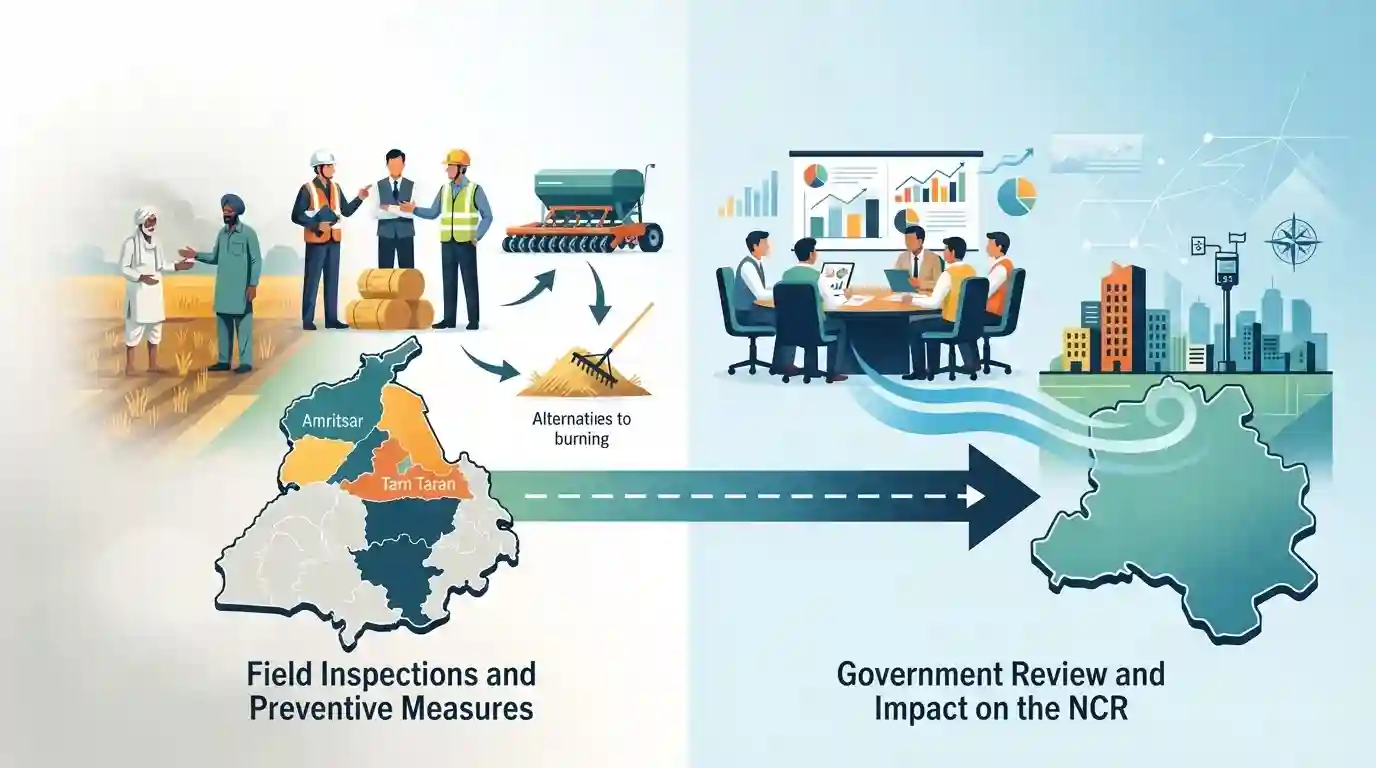
The Commission for Air Quality Management (CAQM) conducted high-level reviews and field inspections in the high-stubble-burning districts of Amritsar and Tarn Taran in Punjab to evaluate preventive measures against paddy residue burning and mitigate seasonal air pollution in the National Capital Region (NCR).
मुख्य मुद्दे
- The Commission for Air Quality Management (CAQM) reviewed stubble burning prevention and control measures with district officials of Amritsar and Tarn Taran in Punjab.
- CAQM officials conducted field visits to hotspot villages in these districts to inspect ground-level implementation, crop residue management (CRM) machinery utilization, and administrative monitoring.
- The review emphasized stringent penal action against violators, active tracking of paddy straw management, and promoting alternative in-situ and ex-situ management methods to curb NCR air pollution during winter.
महत्त्वाच्या संज्ञा
Commission for Air Quality Management (CAQM)

A statutory body established under the Commission for Air Quality Management in National Capital Region and Adjoining Areas Act, 2021, to coordinate, monitor, and resolve air pollution issues in the NCR and surrounding areas.
UPSC context
UPSC Prelims/Mains GS Paper III (Environmental Pollution and Degradation, Government Policies and Interventions); tests knowledge of statutory environmental regulatory bodies.
पूर्वपरीक्षा सापळा
CAQM is an advisory body created through an executive resolution of the Ministry of Environment.
CAQM is frequently mistaken for an executive or advisory body, but it possesses statutory backing with overriding powers over state governments and pollution control boards on air quality matters.
संबंधित स्थिर संकल्पना
What is the composition, mandate, and statutory status of the Commission for Air Quality Management (CAQM)?
- Legal Status: Statutory Origin established under the CAQM Act, 2021, replacing the former Environment Pollution (Prevention and Control) Authority (EPCA).
- Wide Reach: Jurisdiction covers NCR and adjoining areas in Punjab, Haryana, Rajasthan, and Uttar Pradesh impacting NCR air quality.
- Legal Supremacy: Overriding Powers orders and directions of CAQM prevail over conflicting directives of state governments or state pollution control boards.
आंतर-विषय नमुने
Statutory Bodies vs. Cooperative Federalism
CAQM's statutory mandate overriding state directives in Punjab and Haryana directly links cooperative federalism debates with environmental governance and public health emergencies.
Agricultural Subsidies & Air Quality Governance
Stubble burning management connects direct benefit transfers for crop residue machinery with fiscal federalism and agricultural subsidy rationalization across agrarian states.

CAQM's statutory jurisdiction, overriding powers over state boards, and legal basis under the 2021 Act are prime UPSC prelims targets.
संबंधित PYQ · 1
संबंधित PYQ · 1
- 2019PrelimsGS1
Consider the following: 1. Carbon monoxide 2. Methane 3. Ozone 4. Sulphur dioxide Which of the above are released into atmosphere due to the burning of crop/biomass residue?
