Next-Generation GST Process Reforms and Compliance Measures
Source:PIB ↗
Why It Matters
Understanding upcoming structural and process reforms in GST is critical for aspirants analyzing India's indirect taxation framework, fiscal federalism, and measures to improve the ease of doing business and compliance efficiency.
Summary
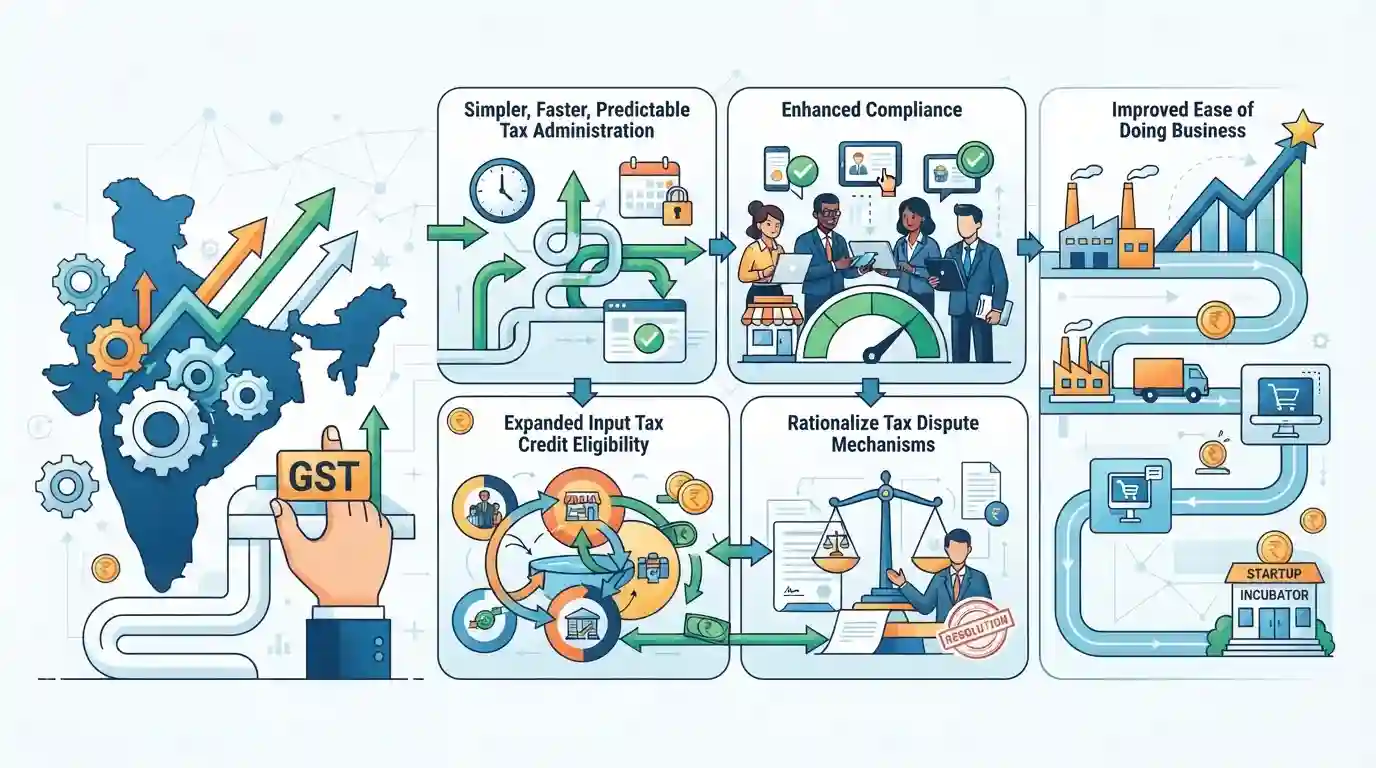
The PIB backgrounder outlines the next-generation GST process reforms recommended by the GST Council, aiming to establish simpler, faster, and more predictable tax administration, enhance compliance, expand input tax credit eligibility, rationalize tax dispute mechanisms, and improve ease of doing business in India.
Key Points
- The 57th GST Council meeting recommended next-generation process reforms focusing on simplification of registration, returns, refunds, input tax credit (ITC), and dispute resolution.
- Registration and cancellation processes are moving towards automatic and system-based approvals to reduce human intervention and enhance ease of doing business.
- Expansion of ITC eligibility for capital goods and input services, along with relaxed restrictions on blocked ITC, aims to reduce working capital bottlenecks.
- Decriminalisation measures include raising the prosecution threshold from ₹1 crore to ₹5 crore and withdrawing certain arrest powers to foster a trust-based tax regime.
Prelims Trap
The Union Finance Ministry directly enacted the next-generation GST process reforms without state consultation.
Aspirants often confuse GST Council decisions as executive orders of the Union Finance Ministry, overlooking its constitutional status under Article 279A where states hold two-thirds voting weight.
Static Concepts Connected
What are the constitutional provisions and structure of the Goods and Services Tax Council (GST Council)?
- Constitutional Basis: Constituted under Article 279A of the Constitution, introduced via the 101st Constitutional Amendment Act, 2016.
- Composition: Chaired by the Union Finance Minister, with State Finance/Taxation Ministers as members.
- Voting Weight: Union vote has a weightage of one-third, and all states' votes combined have a weightage of two-thirds of total votes cast.
- Decision Rule: Decisions require a majority of not less than three-fourths of the weighted votes of members present and voting.
Cross-Topic Patterns
GST Reforms and Ease of Doing Business
Simplifying registration, automating refunds, and raising prosecution thresholds directly target compliance burdens, feeding into India's Ease of Doing Business rankings and manufacturing competitiveness under Make in India.
Cooperative Federalism and the GST Council
The GST Council operates on cooperative federalism principles under Article 279A, balancing state revenue compensation needs with national market integration.

GST Council recommendations + prosecution threshold hikes + ITC rationalization likely to be tested via analytical statements in Prelims.
Linked PYQs · 3
Linked PYQs · 3
- 2023MainsGS3
Faster economic growth requires increased share of the manufacturing sector in GDP, particularly of MSMEs. Comment on the present policies of the Government in this regard.
- 2020MainsGS3
Explain the rationale behind the Goods and Services Tax (Compensation to States) Act of 2017. How has COVID-19 impacted the GST compensation fund and created new federal tensions?
- 2019MainsGS3
Enumerate the indirect taxes which have been subsumed in the Goods and Services Tax (GST) in India. Also, comment on the revenue implications of the GST introduced in India since July 2017.
