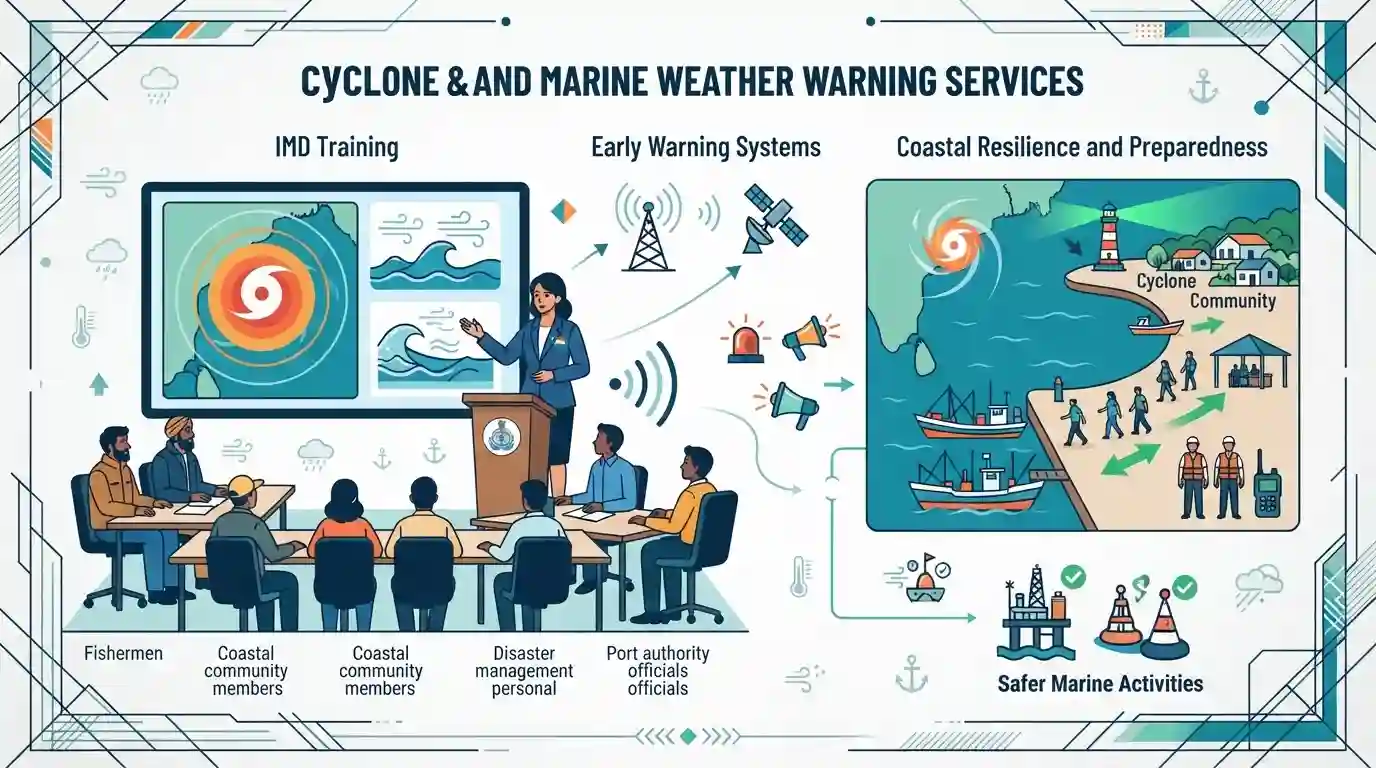
IMD training workshop on cyclone and marine weather warning systems
Source:PIB ↗
কেন এটি গুরুত্বপূর্ণ
Enhancing early warning systems and capacity building for extreme weather events like cyclones is critical for minimizing loss of life and property in India's vulnerable coastal regions, aligning with Sendai Framework goals for disaster risk reduction.
সারসংক্ষেপ
The India Meteorological Department (IMD) organized a training workshop focused on cyclone and marine weather warning services. The initiative aims to bolster disaster preparedness, strengthen early warning systems, and improve the application of meteorological data among key stakeholders and users in coastal and marine sectors.
মূল বিষয়
- The India Meteorological Department (IMD) conducted a specialized Training Workshop on Cyclone and Marine Weather Warning Services.
- The workshop aimed to enhance capacity building, skill development, and operational efficiency among users and stakeholders dependent on marine and meteorological forecasts.
- Focuses on improving early warning communication, disaster preparedness, and coordination for cyclones and marine hazards affecting coastal regions.
গুরুত্বপূর্ণ শব্দ
India Meteorological Department (IMD)

The principal government agency responsible for meteorological observations, weather forecasting, and seismology in India, functioning under the Ministry of Earth Sciences.
UPSC context
Important for GS Paper III (Disaster Management and Environment), testing knowledge of institutional frameworks for early warning systems.
Ministry of Earth Sciences
The nodal ministry of the Government of India mandated to provide services for weather, climate, ocean state, seismology, and natural hazards, and to explore polar regions.
UPSC context
Relevant for GS Paper III (Environment, Science and Technology), testing governance structures for scientific research and disaster mitigation.
সংযুক্ত স্থির ধারণা
What are the stages and criteria of tropical cyclone classification used by the IMD?
- Depression Class: Depression winds range from 31 to 49 kmph (17-27 knots).
- VSCS Class: Very Severe Cyclonic Storm winds range from 118 to 165 kmph (64-89 knots).
- Super Cyclone: Super Cyclone threshold exceeds 221 kmph (120 knots).
আন্তঃবিষয় প্যাটার্ন
Marine Meteorology + Blue Economy Linkage
Improved marine weather warning services directly support India's Deep Ocean Mission and Sagarmala initiative by safeguarding coastal infrastructure and maritime trade routes.
Sendai Framework + National Disaster Management Plan
Training workshops on early warning systems operationalize Sendai Framework Priority 4 (enhancing disaster preparedness for effective response).

Expect a multi-statement prelims question on IMD's warning nomenclature (e.g., Depression vs. Super Cyclone criteria) or institutional mandates.
সংযুক্ত PYQ · 2
সংযুক্ত PYQ · 2
- 2025PrelimsGS1
The World Bank warned that India could become one of the first places where wet-bulb temperatures routinely exceed 35 °C. Which of the following statements best reflect(s) the implication of the above-said report? I. Peninsular India will most likely suffer from flooding, tropical cyclones and droughts. II. The survival of animals including humans will be affected as shedding of their body heat through perspiration becomes difficult. Select the correct answer using the code given below.
- 2019MainsGS3
Disaster preparedness is the first step in any disaster management process. Explain how hazard zonation mapping will help disaster mitigation in the case of landslides.
