GST Council Reforms for Trust Based Tax Administration
Source:PIB ↗
Why It Matters
The GST Council's decisions shape India's indirect taxation structure, impacting ease of doing business, compliance costs, federal fiscal relations, and overall macroeconomic growth.
Summary
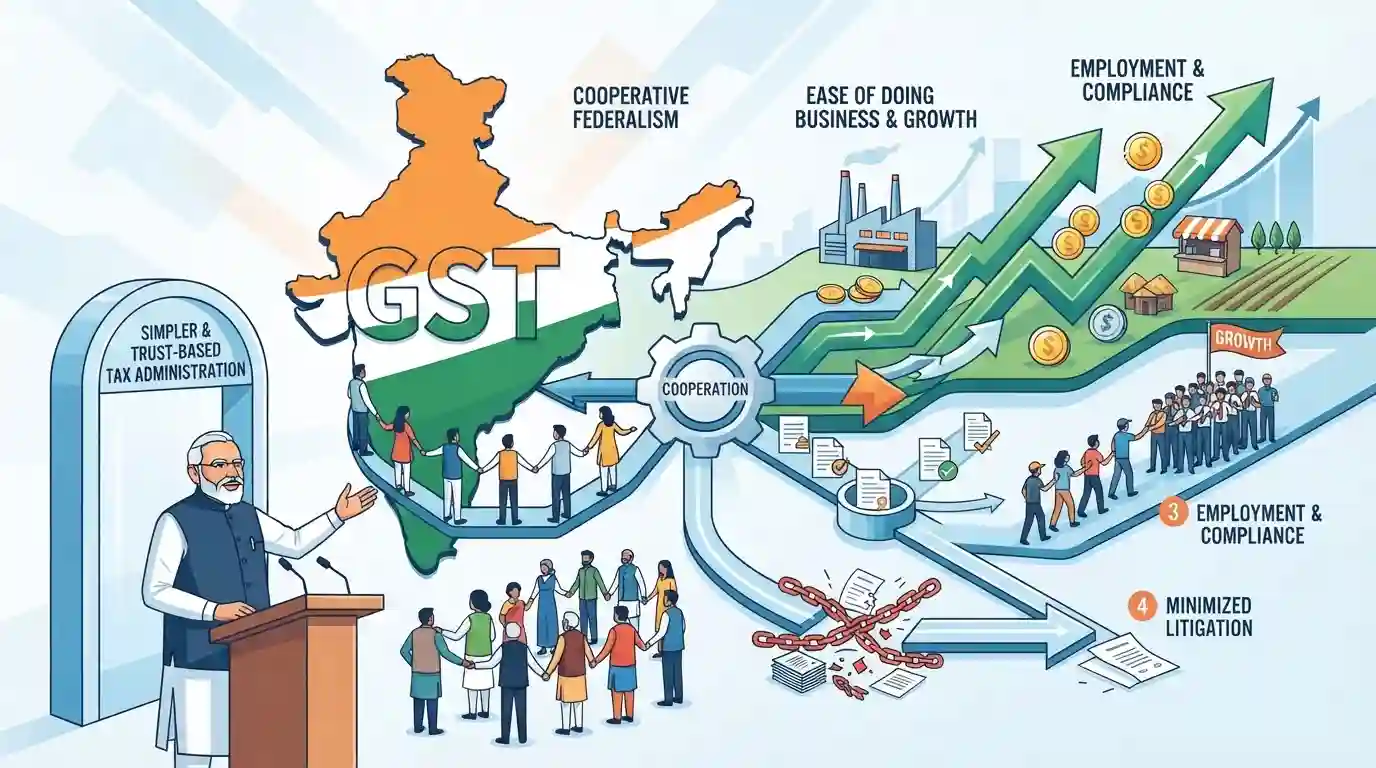
Prime Minister Narendra Modi welcomed the recent recommendations of the GST Council, emphasizing that they advance a simpler, transparent, and trust-based tax administration framework in India. The reforms are aimed at strengthening cooperative federalism, minimizing litigation, improving ease of doing business, and giving a fillip to economic growth and compliance.
Key Points
- The Prime Minister welcomed the GST Council's recommendations focused on building a simpler, trust-based tax administration.
- Key focus areas include improving compliance, reducing litigation, easing doing business, and fostering cooperative federalism through consensus-driven policy making.
- Reforms aim to reduce the compliance burden on taxpayers, particularly MSMEs, thereby supporting broader economic growth and manufacturing.
Important Terms
Goods and Services Tax (GST)

An indirect tax levied on the supply of goods and services across India, subsuming multiple central and state taxes to create a unified national market.
UPSC context
UPSC GS Paper III (Indian Economy): Tests understanding of taxation reforms, resource mobilization, and fiscal federalism.
GST Council
A constitutional federal body chaired by the Union Finance Minister and comprising state finance ministers, tasked with making recommendations on GST rates, laws, and administrative procedures.
UPSC context
UPSC GS Paper II (Polity & Governance) & GS Paper III: Evaluates cooperative federalism, constitutional bodies, and fiscal governance.
Static Concepts Connected
What is the constitutional basis, composition, and voting mechanism of the GST Council in India?
- Constitutional Basis: Article 279A introduced via the 101st Constitutional Amendment Act, 2016 establishes the GST Council as a constitutional body.
- Composition: Chaired by the Union Finance Minister, with State Finance/Taxation Ministers as members, making it a key forum for fiscal federalism.
- Voting Weight: Centre holds one-third voting weight and all states collectively hold two-thirds, with decisions requiring a three-fourths majority.
Cross-Topic Patterns
GST Council & Cooperative Federalism
GST Council decisions highlight how fiscal federalism mechanisms require structured consensus between the Centre and States, directly influencing cooperative federalism dynamics in policy implementation.

GST Council voting weights (1/3 Centre, 2/3 States) and Article 279A constitutional provisions are perennial UPSC prelims favourites.
Linked PYQs · 2
Linked PYQs · 2
- 2023MainsGS3
Faster economic growth requires increased share of the manufacturing sector in GDP, particularly of MSMEs. Comment on the present policies of the Government in this regard.
- 2020MainsGS3
Explain the rationale behind the Goods and Services Tax (Compensation to States) Act of 2017. How has COVID-19 impacted the GST compensation fund and created new federal tensions?
