International Bharat 6G Symposium and Next Gen Telecom
Source:PIB ↗
ఇది ఎందుకు ముఖ్యం
The article highlights India's transition from a technology consumer to a global standard-setter and leader in next-generation communication systems like 6G, aligning with goals of Atmanirbhar Bharat and advanced digital infrastructure.
సారాంశం
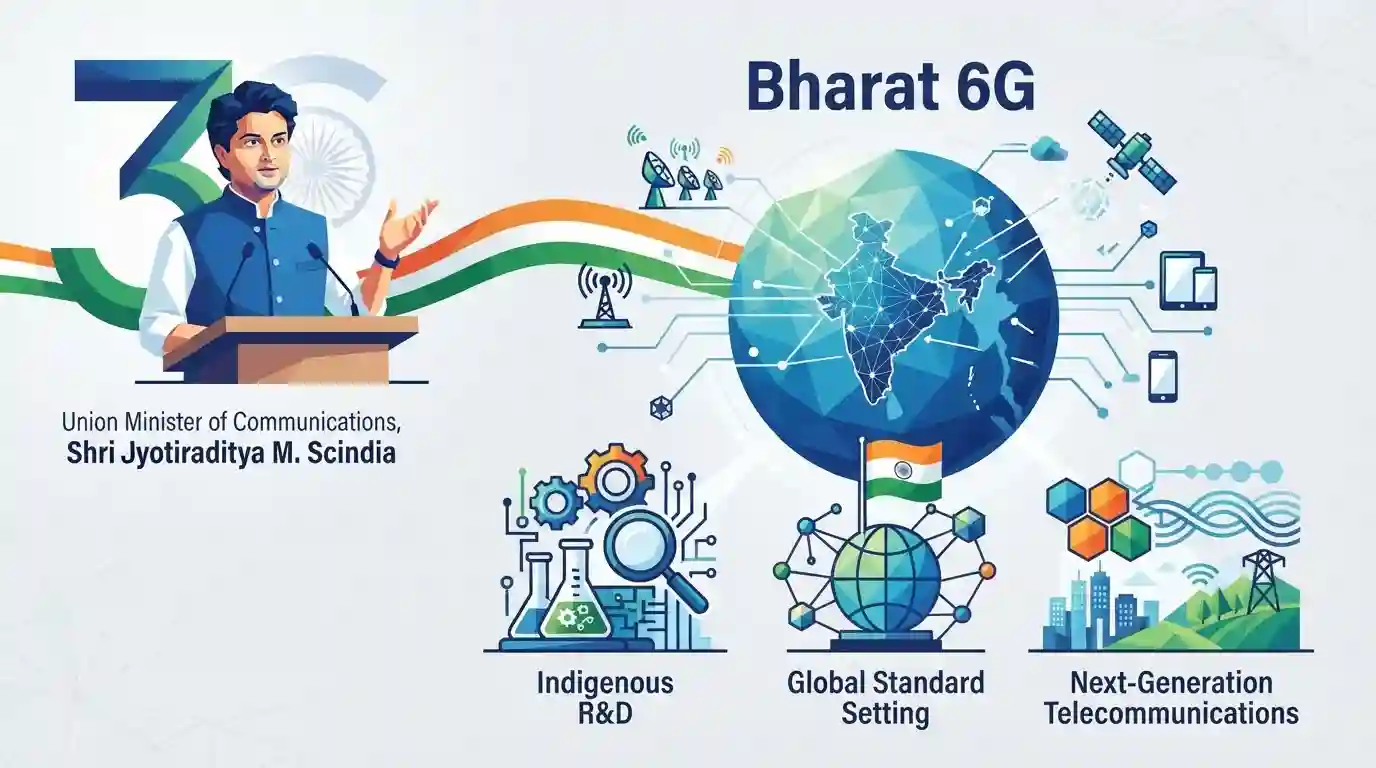
Union Minister of Communications Shri Jyotiraditya M. Scindia inaugurated the 3rd International Bharat 6G Symposium 2026, highlighting India's growing prominence in next-generation telecommunications, indigenous R&D, and global standard-setting for 6G technology.
ముఖ్య అంశాలు
- Union Minister of Communications Shri Jyotiraditya M. Scindia inaugurated the 3rd International Bharat 6G Symposium 2026.
- The symposium highlights India's strategic push towards indigenous research, development, and standardisation in next-generation telecommunication technologies (6G).
- Emphasizes international collaboration, bridging the digital divide, and positioning India as a global leader in telecom innovation and manufacturing.
ముఖ్యమైన పదాలు
Bharat 6G Symposium

A premier international platform focusing on the 5G-to-6G evolution roadmap, regulatory frameworks, spectrum strategy, and standardization to foster indigenous R&D and global collaboration in next-generation telecommunications.
UPSC context
GS Paper III (Science and Technology - Indigenous Technology & IT/Computers); tests awareness of India's roadmap for next-gen telecom infrastructure and standard-setting.
Bharat 6G Vision
A strategic roadmap formulated by the Department of Telecommunications aiming to position India as a global leader in 6G design, development, and standard-setting by 2030, driven by affordability and sustainability.
UPSC context
GS Paper III (Science and Technology - Telecommunications Infrastructure); tests understanding of policy initiatives for cutting-edge technology adoption and intellectual property creation.
Ministry of Communications
The union government ministry responsible for postal services and telecommunications in India, overseeing policy formulation, spectrum management, and the rollout of major digital infrastructure initiatives.
UPSC context
GS Paper II/III (Governance / S&P - IT and Telecom); tests knowledge of institutional bodies managing national communication networks and digital growth.
ప్రిలిమ్స్ ఉచ్చు
India's 6G rollout is driven entirely by private telecom operators without state-led R&D frameworks.
Aspirants often assume 6G deployment and standardisation are solely commercial ventures, whereas Bharat 6G Vision specifically emphasizes indigenous R&D and public-funded testbeds like the Terahertz Testbed.
అనుసంధానమైన స్థిర భావనలు
What are the key pillars and institutional mechanisms of India's National Telecom Policy and 6G Vision?
- Target Year: Bharat 6G Vision aims to make India a leading global supplier of affordable, secure 6G products and solutions by 2030.
- B6GA Role: Bharat 6G Alliance (B6GA) acts as a collaborative platform uniting public/private industry, academia, and R&D bodies for standard-setting.
- Core Tech: Core technologies include Integrated Sensing and Communication (ISAC), Native AI, and Terahertz (THz) communication for ultra-high speeds.
అంతర-అంశ నమూనాలు
6G Telecommunications & Satellite Spectrum Allocation
Bharat 6G's focus on Terahertz testbeds and Non-Terrestrial Networks intersects directly with IN-SPACe satellite authorization frameworks and Department of Telecommunications (DoT) spectrum allocation policies.

Bharat 6G Vision, ISAC, and Terahertz testbeds are prime candidates for science-tech multi-statement matching questions.
అనుసంధాన PYQలు · 1
అనుసంధాన PYQలు · 1
- 2025MainsGS3
India aims to become a semiconductor manufacturing hub. What are the challenges faced by the semiconductor industry in India? Mention the salient features of the India Semiconductor Mission.
