National Biodiversity Authority Access and Benefit Sharing Collections
Source:PIB ↗
આ શા માટે મહત્વનું છે
It highlights the operationalization of India's Access and Benefit Sharing (ABS) framework under the Biological Diversity Act, 2002, connecting commercial bio-resource usage directly to grassroots environmental conservation and local community empowerment via Biodiversity Management Committees (BMCs).
સારાંશ
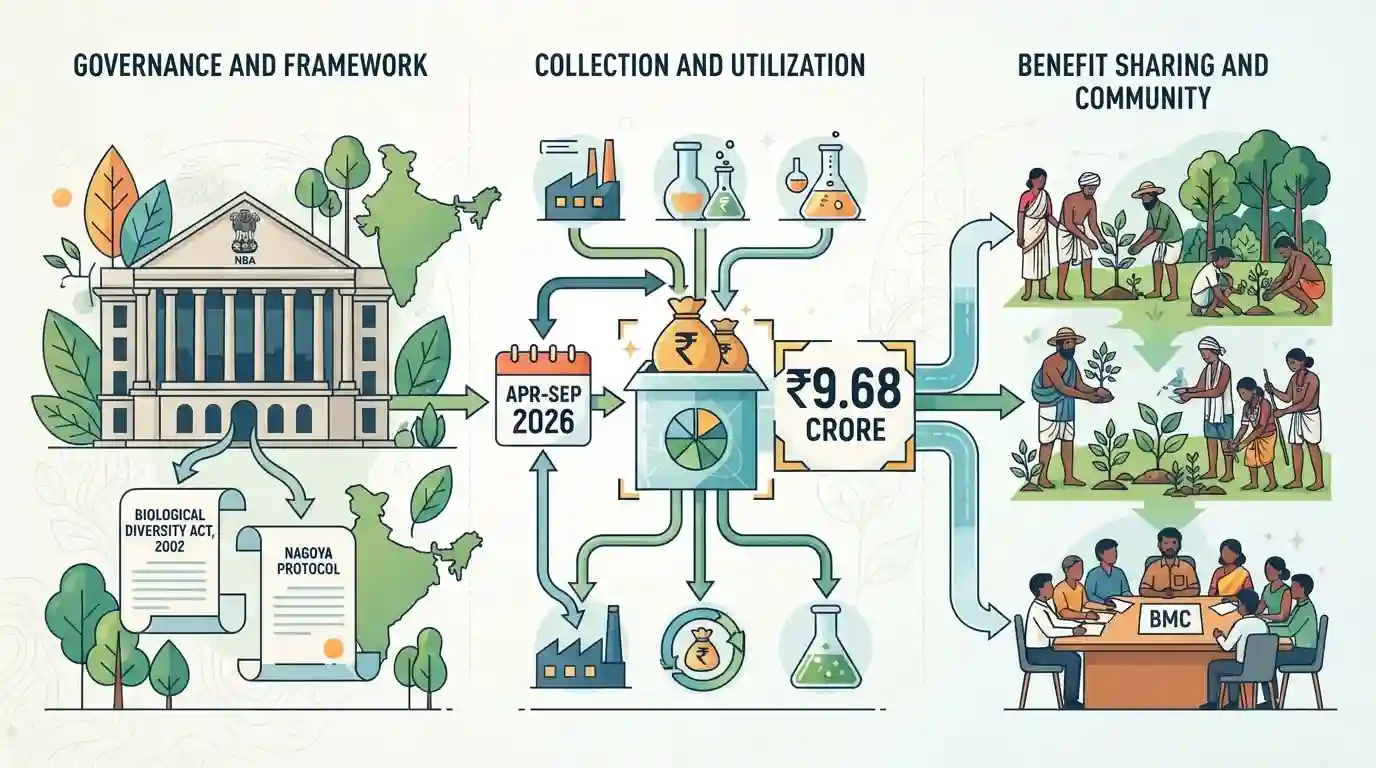
The National Biodiversity Authority (NBA) collected Rs 9.68 crore under the Access and Benefit Sharing (ABS) framework between April and September 2026. This mechanism, anchored by India's Biological Diversity Act, 2002 and the Nagoya Protocol, ensures fair and equitable sharing of benefits arising from the utilization of biological resources with local communities and grassroots conservation bodies like Biodiversity Management Committees (BMCs).
મુખ્ય મુદ્દા
- The National Biodiversity Authority (NBA) received Rs 9.68 crore under the Access and Benefit Sharing (ABS) framework during the April–September 2026 period.
- Access and Benefit Sharing (ABS) is a core mechanism under the Biological Diversity Act, 2002, and the international Nagoya Protocol, ensuring that commercial utilization of biological resources or traditional knowledge shares financial benefits with local communities and conservation efforts.
- Funds collected under ABS are channeled down to local-level Biodiversity Management Committees (BMCs) to support biodiversity conservation, sustainable livelihoods, and documentation of local people's biodiversity registers.
- The growth in ABS collections reflects better compliance, monitoring, and awareness among industrial users of biological resources (such as pharma, cosmetics, and botanical sectors) in India.
મહત્વપૂર્ણ શબ્દો
National Biodiversity Authority (NBA)

A statutory body established by India under the Biological Diversity Act, 2002 to regulate access to biological resources and coordinate the implementation of benefit-sharing mechanisms.
UPSC context
UPSC Prelims/Mains (GS Paper III - Environment): Core statutory regulatory body for biodiversity conservation and ABS implementation in India.
Biological Diversity Act, 2002
India's umbrella legislation enacted to conserve biological diversity, promote sustainable use, and ensure fair and equitable sharing of benefits with local communities.
UPSC context
UPSC Prelims/Mains (GS Paper III): Fundamental environment law tested frequently regarding institutional mechanisms, tribal rights, and conservation.
Nagoya Protocol on Access and Benefit Sharing
An international supplementary agreement to the Convention on Biological Diversity that provides a transparent legal framework for the fair and equitable sharing of benefits arising from genetic resources.
UPSC context
UPSC Prelims: International environmental conventions, protocols, and India's international commitments under CBD.
Biodiversity Management Committees (BMCs)
Local-level bodies mandated under the Biological Diversity Act to document local biodiversity resources and prepare People's Biodiversity Registers (PBRs).
UPSC context
UPSC Prelims/Mains: Grassroots governance, decentralized conservation, and community participation in environmental management.
State Biodiversity Boards (SBBs)
State-level statutory boards that regulate commercial utilization and access to biological resources by Indian citizens and corporate entities within respective states.
UPSC context
UPSC Prelims: Federal structure of environmental governance and distribution of powers under the Biodiversity Act.
પ્રિલિમ્સ ટ્રેપ
Funds collected under the ABS framework are deposited directly into the Consolidated Fund of India for national environmental projects.
Aspirants often assume ABS funds go directly to the Consolidated Fund of India or central ministries, whereas statutory rules mandate channeling them to local BMCs and grassroots conservation bodies.
સંલગ્ન સ્થિર ખ્યાલો
What is the three-tier institutional structure under India's Biological Diversity Act, 2002?
- National Biodiversity Authority: National level body established under the Act to regulate bio-resources, advise the Central Government, and coordinate approvals.
- State Biodiversity Boards: State level bodies established to coordinate with the NBA, regulate commercial use by Indians, and guide local committees.
- Biodiversity Management Committees: Grassroots local bodies mandated to promote conservation, sustainable use, and documentation of biodiversity in People's Biodiversity Registers (PBRs).
આંતર-વિષય પેટર્ન
Nagoya Protocol meets fiscal federalism
The ABS mechanism bridges international biodiversity treaties with decentralized fiscal federalism, linking local grassroots bodies like BMCs directly to industrial compliance revenue.
Bio-prospecting, IPR, and biodiversity finance
Bio-prospecting revenues from sectors like pharma and cosmetics connect global IPR debates with domestic conservation finance under the Biological Diversity Act.

Expect a statement-based question testing the three-tier institutional structure of NBA, SBBs, and BMCs alongside Nagoya Protocol mandates.
સંલગ્ન PYQ · 1
સંલગ્ન PYQ · 1
- 2023PrelimsGS1
Consider the following statements: 1. In India, the Biodiversity Management Committees are key to the realization of the objectives of the Nagoya Protocol. 2. The Biodiversity Management Committees have important functions in determining access and benefit sharing, including the power to levy collection fees on the access of biological resources within its jurisdiction. Which of the statements given above is/are correct?
