Maritime Vision and Inclusive Human Resource Development in India
Source:PIB ↗
ఇది ఎందుకు ముఖ్యం
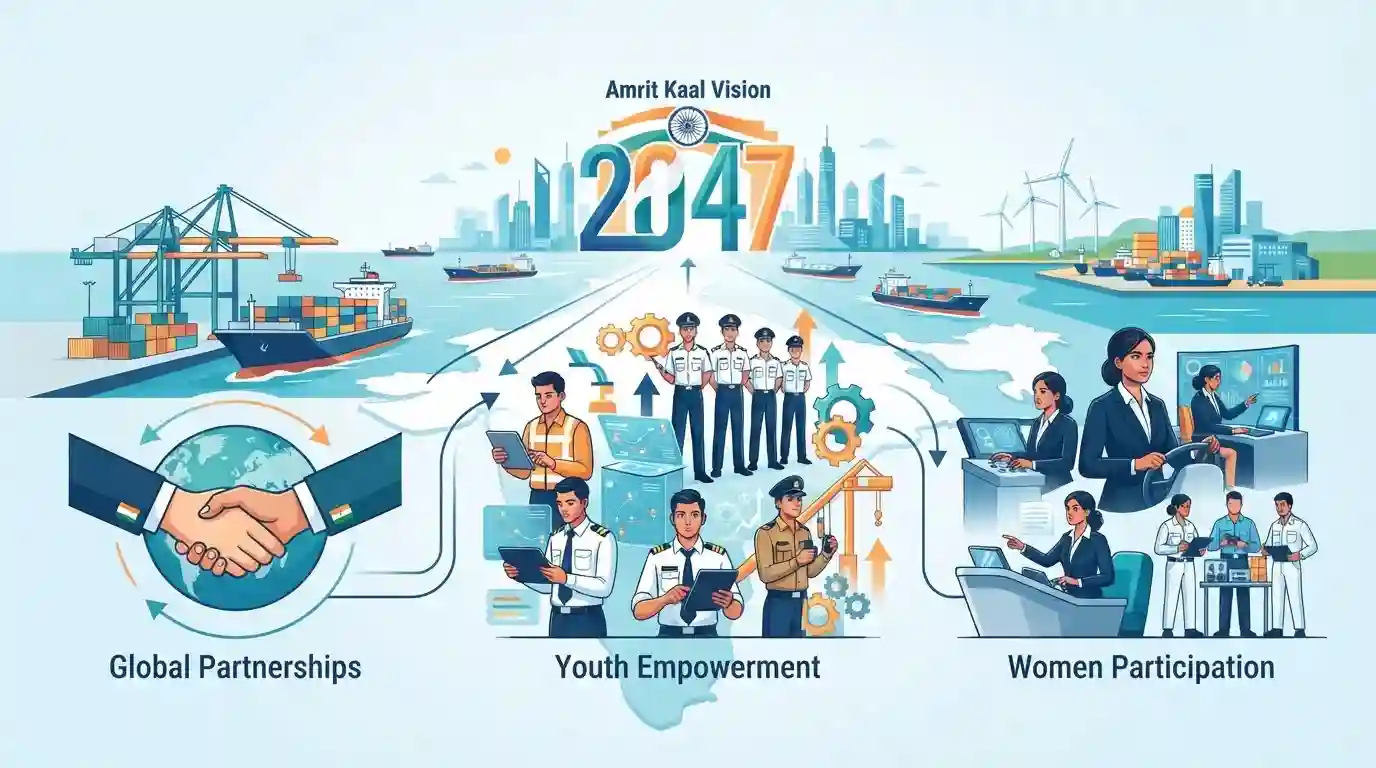
It highlights how India's strategic maritime modernization frameworks (such as Maritime Amrit Kaal Vision 2047) are increasingly incorporating inclusive human resource development, gender participation, and global partnerships.
సారాంశం
Union Minister Sarbananda Sonowal highlighted that global partnerships, youth empowerment, and women participation form the core of India's maritime future, aligning with national development goals like Maritime Amrit Kaal Vision 2047.
ముఖ్య అంశాలు
- Union Minister Sarbananda Sonowal emphasized global partnerships, youth, and women empowerment as vital components of India's future maritime strategy.
- The vision integrates inclusive growth, leveraging human capital, skill development, and gender inclusivity in the maritime sector.
- Aligns with India's broader goals under the Maritime Amrit Kaal Vision 2047 and Viksit Bharat 2047 to build advanced, sustainable coastal and maritime infrastructure.
ముఖ్యమైన పదాలు
Maritime Amrit Kaal Vision 2047

A comprehensive strategic roadmap formulated by the Ministry of Ports, Shipping and Waterways to transform India into a global maritime leader by 2047 through infrastructure modernization and sustainable blue economy initiatives.
UPSC context
UPSC Prelims/Mains (GS Paper III - Infrastructure, Economy): Tests knowledge of long-term economic planning, port-led growth, and India's 2047 developmental milestones.
Sagarmala Programme
A flagship national initiative focused on port-led economic development by leveraging India's extensive coastline and waterways to enhance connectivity, lower logistics costs, and drive industrialization.
UPSC context
UPSC Prelims/Mains (GS Paper III - Infrastructure & Logistics): Tests understanding of flagship government schemes aimed at multimodal connectivity and coastal economic development.
Ministry of Ports, Shipping and Waterways
The central government department responsible for formulating and administering national policies, laws, and infrastructure development programs concerning ports, shipping, maritime transport, and inland waterways in India.
UPSC context
UPSC Prelims/Mains (GS Paper II/III - Governance & Infrastructure): Important for questions on institutional frameworks governing India's blue economy and trade logistics.
ప్రిలిమ్స్ ఉచ్చు
Maritime Amrit Kaal Vision 2047 is merely an extension of the Sagarmala Programme focusing solely on port construction.
Aspirants often confuse the Maritime Amrit Kaal Vision 2047 with the Sagarmala Programme; while Sagarmala focuses primarily on port-led direct infrastructure development and coastal connectivity, the Vision 2047 is a comprehensive long-term blueprint covering global partnerships, human capital, decarbonization, and institutional reforms up to 2047.
అనుసంధానమైన స్థిర భావనలు
What are the key pillars and targets of the Maritime Amrit Kaal Vision 2047?
- Comprehensive Roadmap: Strategic Roadmap formulated by the Ministry of Ports, Shipping and Waterways to transform India into a global maritime leader by 2047.
- Investment Outlay: Targets massive investments worth ₹75-80 lakh crore across ports, shipping, and inland waterways infrastructure.
- Cargo Capacity: Aims to quadruple port cargo handling capacity to over 10,000 million tonnes per annum (MTPA) by 2047.
- Core Focus: Focuses on decarbonization, ease of doing business, and promoting domestic shipbuilding and human resource development.
అంతర-అంశ నమూనాలు
Maritime Infrastructure & Indo-Pacific Geopolitics
India's maritime logistics expansion under Amrit Kaal directly supports Indo-Pacific strategy, securing supply chains and projecting soft power through port diplomacy and regional connectivity initiatives.
Inclusive Growth in Heavy Industries
Integrating women and youth in the blue economy bridges skill deficits in heavy industries, linking social sector development with industrial manufacturing growth.

Maritime Amrit Kaal Vision 2047 targets and financial outlays are prime candidates for matching or numerical statement questions in Prelims.
అనుసంధాన PYQలు · 2
అనుసంధాన PYQలు · 2
- 2025MainsGS3
Why is maritime security vital to protect India's sea trade? Discuss maritime and coastal security challenges and the way forward.
- 2026PrelimsGS1
Consider the following statements with reference to the Sagarmala Programme of the Government of India : I. The Sagarmala Programme seeks to achieve port-led economic growth through cost-effective and sustainable coastal infrastructure. II. The success of the Sagarmala Programme is reflected in significant growth in coastal and inland waterway shipping, along with improved global port rankings. III. Sagarmala 2.0 aims to position India as a global maritime innovation hub aligned with Atmanirbhar Bharat and Viksit Bharat 2047 visions. Which of the following relationships among the above statements is/are correct ? 1. Statement II validates the effectiveness of the strategies envisioned in statement I. 2. Statement III extends the objectives of statement I by embedding them into a future-oriented innovation framework. 3. Statement I contradicts statement III by focusing only on traditional infrastructure instead of modern innovation. Select the answer using the code given below :
