DWBDNC Governing Body and Welfare of Nomadic Communities
Source:PIB ↗
हे का महत्त्वाचे आहे
De-notified, Nomadic and Semi-Nomadic Communities (DNCs) represent some of the most marginalized and vulnerable segments of Indian society, often falling outside conventional tracking and welfare nets. Understanding the institutional frameworks like the DWBDNC is crucial for analyzing targeted welfare administration and inclusive development policies in India.
सारांश
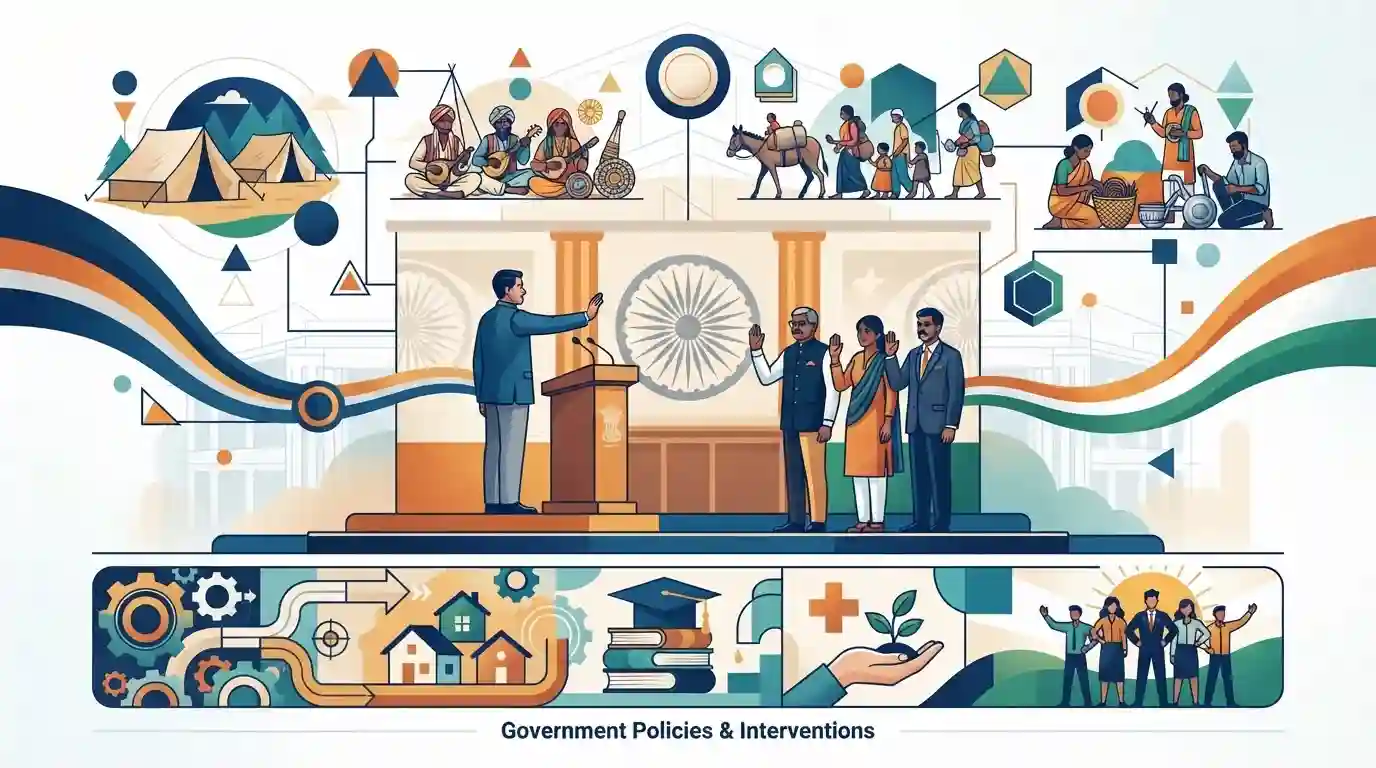
Secretary of the Ministry of Social Justice and Empowerment, Shri Sudhansh Pant, administered the oath of office to newly appointed members of the Governing Body of the Development and Welfare Board for De-notified, Nomadic and Semi-Nomadic Communities (DWBDNC), reinforcing institutional commitment towards vulnerable marginalized populations.
मुख्य मुद्दे
- Shri Sudhansh Pant, Secretary, Ministry of Social Justice and Empowerment, is set to administer the oath to newly appointed members of the Governing Body of the Development and Welfare Board for De-notified, Nomadic and Semi-Nomadic Communities (DWBDNC).
- DWBDNC works specifically towards the welfare, development, and social protection of historically marginalized de-notified, nomadic, and semi-nomadic communities in India.
- The board plays a vital role in recommending welfare measures, educational access, livelihood support, and health facilities tailored to these vulnerable groups.
महत्त्वाच्या संज्ञा
Development and Welfare Board for De-notified, Nomadic and Semi-Nomadic Communities (DWBDNC)

A statutory-backed board under the Ministry of Social Justice and Empowerment established to design, implement, and monitor welfare and development programs for India's vulnerable de-notified, nomadic, and semi-nomadic communities.
UPSC context
UPSC GS Paper II: Vulnerable sections of the population, welfare schemes, and measures for development and empowerment of marginalized groups.
Ministry of Social Justice and Empowerment
The nodal ministry at the central level responsible for welfare, social justice, empowerment, and formulation of targeted policies for marginalized, vulnerable, and disadvantaged groups including SCs, OBCs, and DNTs.
UPSC context
UPSC GS Paper II: Governance, institutional structures, and central ministries dealing with vulnerable sections.
Schemes for Development and Welfare of De-notified, Nomadic and Semi-Nomadic Communities
Specialized welfare interventions like the Scheme for Economic Empowerment of DNTs (SEED) aimed at providing coaching, health insurance, livelihood support, and housing to DNTs.
UPSC context
UPSC GS Paper II: Government policies and interventions for development in various sectors and issues arising out of their design and implementation.
पूर्वपरीक्षा सापळा
DWBDNC is a constitutional/statutory body established under a specific article of the Constitution.
Aspirants often confuse DNT boards with constitutional bodies or statutory commissions like the National Commission for Scheduled Castes; DWBDNC is a welfare board under the Ministry of Social Justice and Empowerment.
संबंधित स्थिर संकल्पना
What are the key committees and commissions associated with De-notified, Nomadic and Semi-Nomadic Communities in India?
- Renke Commission: Renke Commission (2008) identified around 1,100 de-notified, nomadic, and semi-nomadic communities and recommended special safeguards.
- Idate Commission: Idate Commission (2015) recommended the creation of a permanent welfare board (leading to DWBDNC) and specific developmental measures.
- SEED Scheme: SEED Scheme provides financial assistance for coaching, health insurance, livelihood, and housing specifically for DNTs, NTs, and SNTs.
आंतर-विषय नमुने
Colonial Legislation and Post-Independence Vulnerable Sections
The historical legacy of the Criminal Tribes Act 1871 connects social justice initiatives with legal history and colonial administrative policies.

DWBDNC mandate + SEED scheme matching statements are high-probability options in Prelims governance questions.
संबंधित PYQ · 2
संबंधित PYQ · 2
- 2023MainsGS2
“Development and welfare schemes for the vulnerable, by its nature, are discriminatory in approach.” Do you agree? Give reasons for your answer.
- 2019MainsGS2
Performance of welfare schemes that are implemented for vulnerable sections is not so effective due to absence of their awareness and active involvement at all stages of policy process. Discuss.
