Integrated Transport and Logistics Authority and Multimodality
Source:PIB ↗
हे का महत्त्वाचे आहे
High logistics costs are a major structural bottleneck for the Indian economy. Understanding the institutional mechanisms like the Integrated Transport and Logistics Authority (ITLA) is crucial for evaluating India's logistics reform policies, supply chain efficiency, and competitiveness under GS Paper 3 (Infrastructure).
सारांश
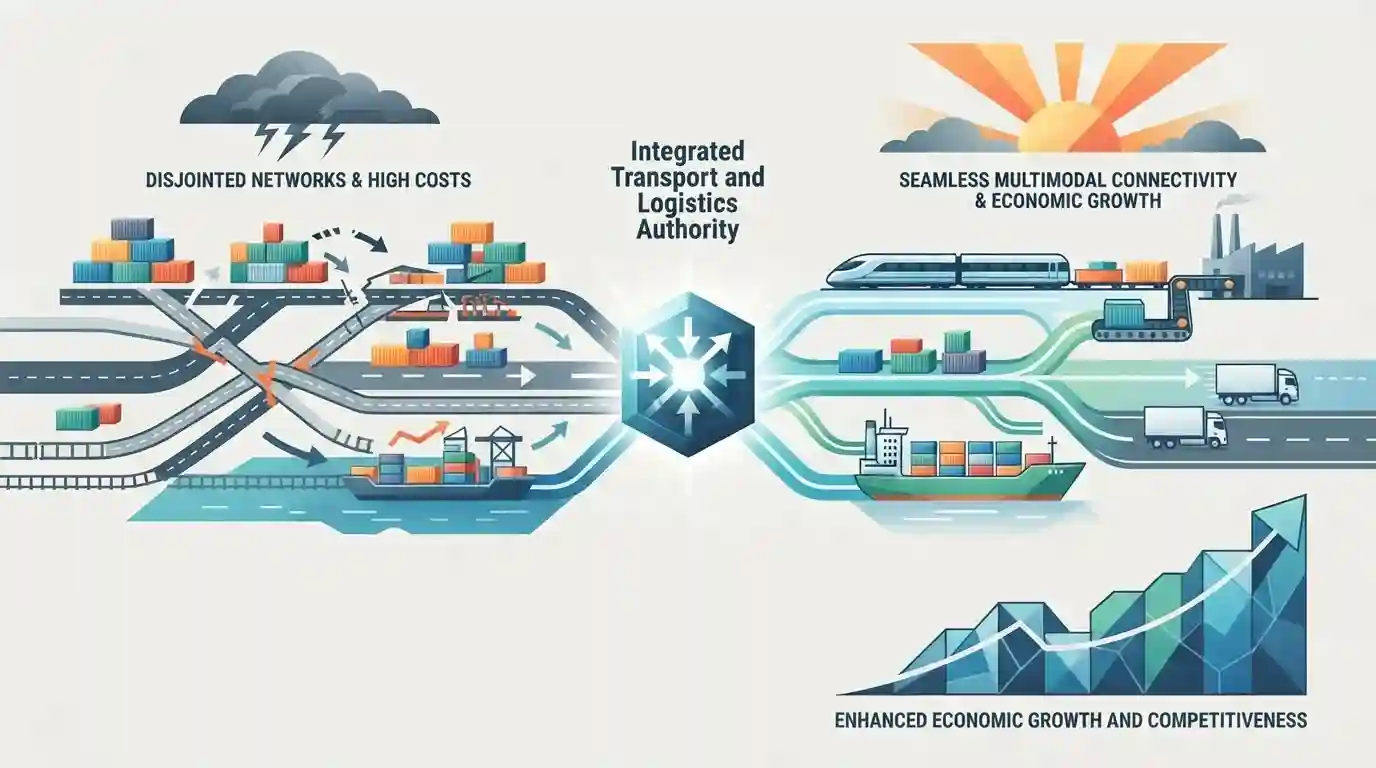
The establishment of the Integrated Transport and Logistics Authority (ITLA) represents a strategic institutional framework designed to optimize transportation networks, reduce high logistics costs, and drive seamless multimodal connectivity for enhanced economic growth and industrial competitiveness.
मुख्य मुद्दे
- The Integrated Transport and Logistics Authority (ITLA) is established to streamline, coordinate, and regulate transport and logistics planning in a unified manner.
- Aims to cut down logistics costs, improve supply chain efficiency, and promote multimodal transport integration across regions.
- Addresses key infrastructure bottlenecks to support inclusive economic growth and enhance industrial competitiveness.
महत्त्वाच्या संज्ञा
Integrated Transport and Logistics Authority (ITLA)

A centralized institutional framework established as a Special Purpose Vehicle (SPV) to optimize transport networks, eliminate fragmented planning across ministries, and drive multimodal connectivity.
UPSC context
Mains GS Paper III (Infrastructure, Logistics, Economic Development). Important for questions on governance reforms, multimodal connectivity, and reducing logistics costs.
National Transport Master Plan
A long-term strategic plan prepared by ITLA with a horizon of ten or more years to synchronize multimodal transport networks across roads, railways, ports, and civil aviation.
UPSC context
Mains GS Paper III (Infrastructure and Economic Development). Tests knowledge of long-term infrastructure planning, project appraisal, and asset creation.
National Logistics Policy (NLP), 2022
A comprehensive policy framework aimed at transforming India's logistics sector by reducing high logistics costs, improving competitiveness, and leveraging data-driven decision-making systems.
UPSC context
Mains GS Paper III (Economy, Infrastructure). Vital for evaluating policy measures to enhance industrial competitiveness and export logistics efficiency.
पूर्वपरीक्षा सापळा
ITLA operates as an independent, standalone ministry that absorbs all existing transport ministries.
Aspirants might confuse ITLA with a standalone statutory ministry, whereas it functions as an apex SPV / coordinating authority linking multiple existing transport ministries.
संबंधित स्थिर संकल्पना
What are the core pillars and implementation tools of the PM GatiShakti National Master Plan?
- GIS Platform: Unified digital platform integrating spatial data from 16 ministries for synchronized infrastructure planning and project monitoring.
- Multimodal Connectivity: Focuses on seamless movement of people and goods through railways, roadways, waterways, and airways to lower logistics costs.
- Network Planning: Network Planning Group (NPG) evaluates projects to ensure adherence to GatiShakti principles before clearance.
आंतर-विषय नमुने
Logistics Cost Reduction & Fiscal Discipline
ITLA institutionalizes PM GatiShakti data layers, connecting spatial GIS planning with fiscal appraisals for infrastructure projects above ₹500 crore to curb capital cost overruns.
Logistics Efficiency vs. Make in India
High logistics costs in India (traditionally estimated near 13-14% of GDP) act as an indirect tariff on domestic manufacturing, undercutting export competitiveness against global peers.

Expect a multi-statement prelims question pairing ITLA's ₹500 crore appraisal mandate with PM GatiShakti's institutional architecture.
संबंधित PYQ · 1
संबंधित PYQ · 1
- 2021MainsGS3
“Investment in infrastructure is essential for more rapid and inclusive economic growth.” Discuss in the light of India's experience.
