Ministry of Coal E-Waste Management and Special Campaign 6
Source:PIB ↗
हे का महत्त्वाचे आहे
Highlights administrative measures and institutional drives taken by government bodies for e-waste management and swachhata/efficiency campaigns, directly tying into GS3 environment and governance syllabus topics.
सारांश
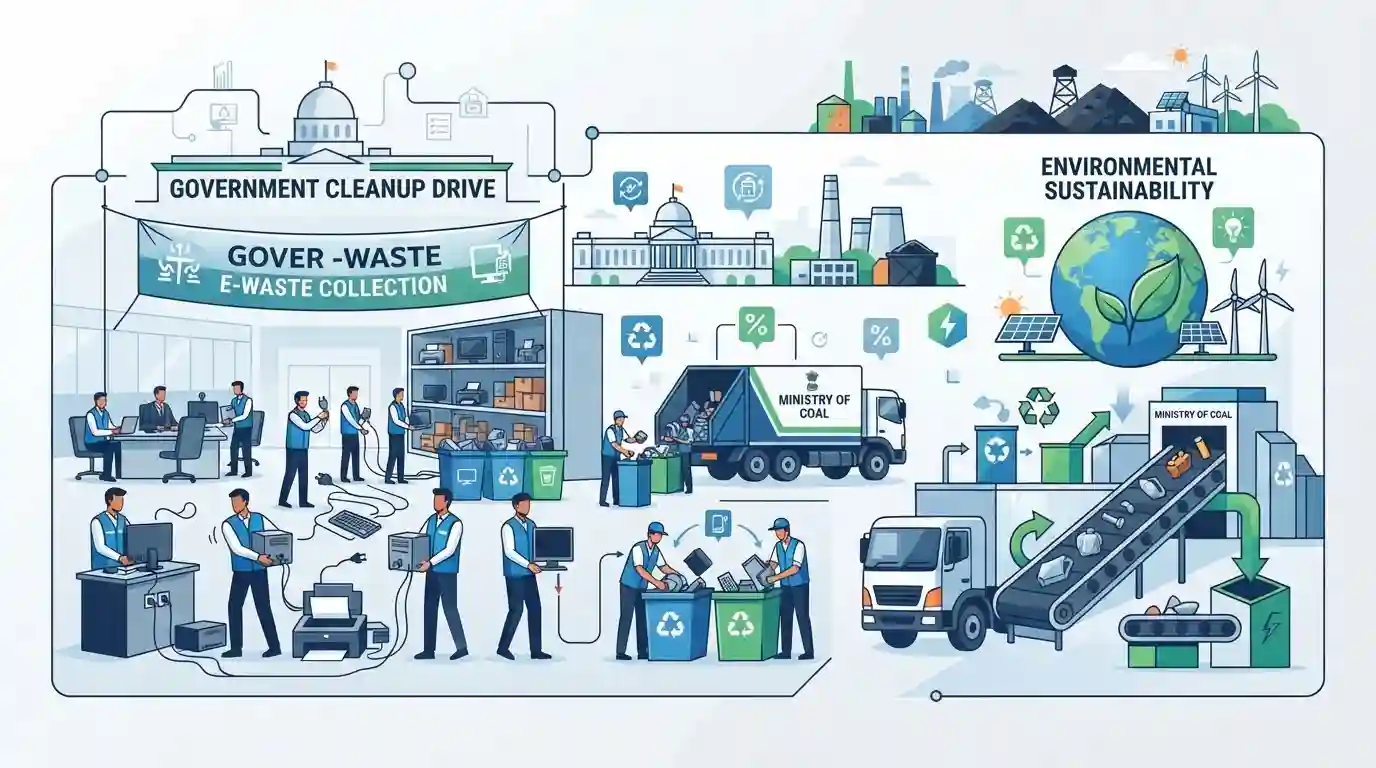
The Ministry of Coal organized a special drive focusing on e-waste management under Special Campaign 6 to ensure efficient disposal, recycling of obsolete electronic assets, and promotion of environmental sustainability across its establishments.
मुख्य मुद्दे
- The Ministry of Coal conducted a special drive with a dedicated focus on e-waste management as part of Special Campaign 6.
- The initiative aims to promote sustainable environmental practices, proper disposal of electronic waste, and office cleanliness across coal PSUs and field offices.
- Emphasis was placed on recycling, inventory reduction of obsolete electronic equipment, and creating awareness about the circular economy.
महत्त्वाच्या संज्ञा
Special Campaign 6

An annual cleanliness and institutional housekeeping drive overseen by the DARPG, focusing on reducing pendency, disposing of scrap, and managing electronic and solid waste across government ministries.
UPSC context
GS Paper II / Governance - Tests government accountability, institutional cleanliness campaigns, and administrative efficiency in public sector offices.
E-Waste (Management) Rules
Regulatory framework mandating the safe disposal, collection, and recycling of electronic waste based on the principle of Extended Producer Responsibility (EPR) for manufacturers and institutions.
UPSC context
GS Paper III / Environment and Ecology - Tests knowledge of hazardous waste regulations, circular economy policies, and statutory compliance.
Ministry of Coal
The central government ministry responsible for the formulation of national policies and rules regarding coal and lignite exploration, production, and allocation in India.
UPSC context
GS Paper III / Economic Development - Tests institutional roles in industrial governance, environmental sustainability, and public sector undertaking performance.
पूर्वपरीक्षा सापळा
Special Campaign 6 is strictly an administrative housekeeping drive focused on physical file weeding and office space management without environmental mandates.
Aspirants often assume Special Campaign initiatives are solely focused on physical file weeding and cleanliness, missing their statutory integration with specialized rules like E-Waste Management.
संबंधित स्थिर संकल्पना
What are the key compliance mechanisms under the E-Waste (Management) Rules in India?
- EPR Mandate: Mandates Extended Producer Responsibility (EPR) making manufacturers responsible for collecting and recycling end-of-life electronics.
- Registration & Portals: Requires producers, recyclers, and refurbishers to obtain registration and maintain digital waste records on a centralized portal.
- Sound Recycling: Enforces environmentally sound recycling standards to prevent toxic leakage of heavy metals like lead, cadmium, and mercury.
आंतर-विषय नमुने
Governance Cleanliness Drives + E-Waste Management
Public sector campaigns like Special Campaign 6 institutionalize the E-Waste Rules, bridging administrative governance reform with environmental compliance in state-owned enterprises.

Expect a match-the-following or statement-based question linking E-Waste Management Rules and public sector housekeeping campaigns.
संबंधित PYQ · 3
संबंधित PYQ · 3
- 2019PrelimsGS1
In India, 'extended producer responsibility' was introduced as an important feature in which of the following?
- 2021PrelimsGS1
'R2 Code of Practices' constitutes a tool available for promoting the adoption of
- 2013PrelimsGS1
Due to improper/indiscriminate disposal of old and used computers or their parts, which of the following are released into the environment as e-waste? 1. Beryllium 2. Cadmium 3. Chromium 4. Heptachlor 5. Mercury 6. Lead 7. Plutonium Select the correct answer using the codes given below.
