CAQM Flying Squad Deployment for Paddy Stubble Burning Prevention
Source:PIB ↗
ఇది ఎందుకు ముఖ్యం
Stubble burning is a recurrent ecological crisis contributing heavily to winter air pollution in northern India. Analyzing the enforcement role of specialized bodies like the CAQM is crucial for understanding institutional mechanisms in environmental governance and pollution mitigation.
సారాంశం
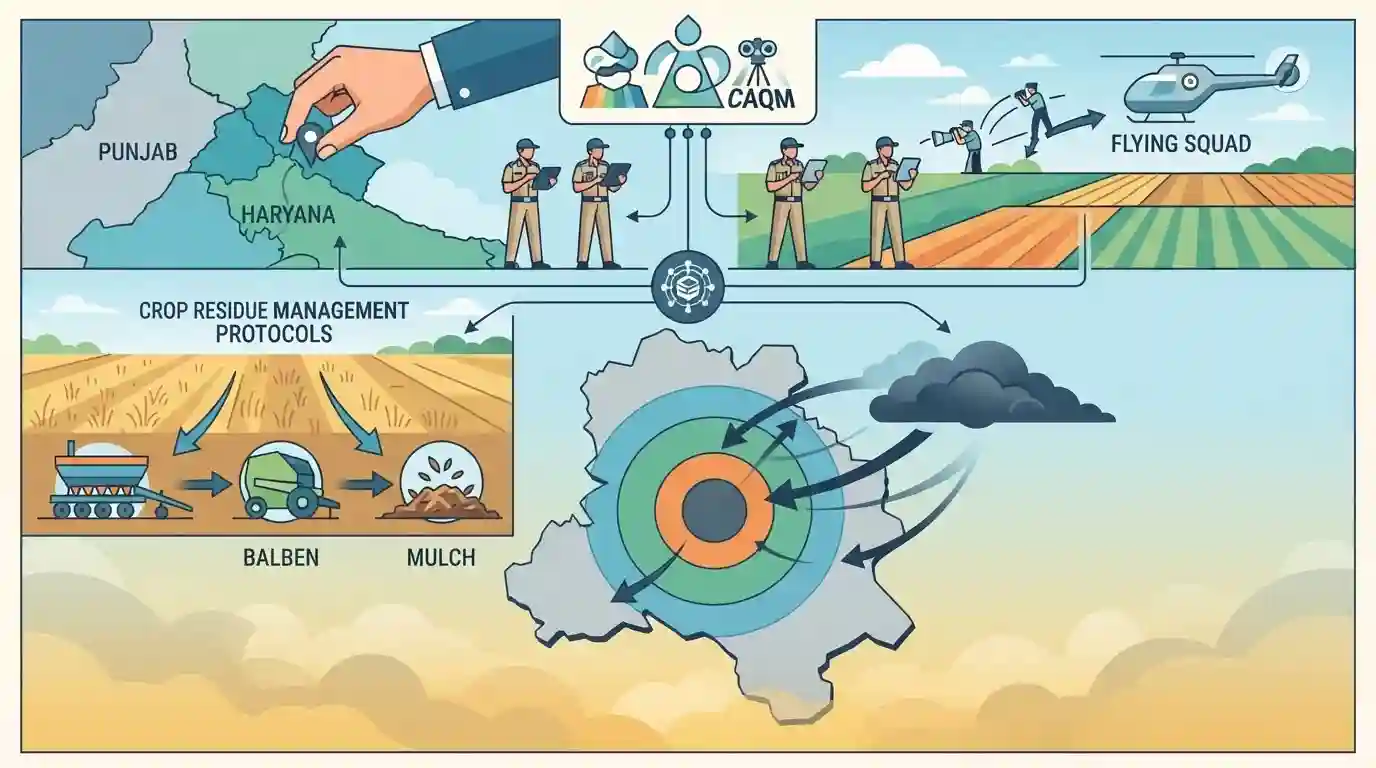
The Commission for Air Quality Management (CAQM) has ramped up enforcement and field-level monitoring by deploying Flying Squads to Punjab and Haryana to prevent paddy stubble burning incidents. This proactive governance measure addresses seasonal air quality degradation in the National Capital Region (NCR) through coordinated administrative interventions and strict adherence to crop residue management protocols.
ముఖ్య అంశాలు
- The Commission for Air Quality Management (CAQM) has intensified field-level monitoring to curb paddy stubble burning incidents in Punjab and Haryana during the kharif season.
- Specialized Flying Squads have been deployed to coordinate with state governments, district administrations, and local enforcement machinery.
- The focus is on strict implementation of statutory frameworks, in-situ and ex-situ crop residue management, and real-time monitoring of fire counts.
- These measures aim to mitigate severe winter air pollution and smog episodes in the National Capital Region (NCR).
ముఖ్యమైన పదాలు
Commission for Air Quality Management (CAQM)

A statutory body established to coordinate, monitor, and plan for air quality management in the National Capital Region and adjoining areas, superseding earlier fragmented committees.
UPSC context
UPSC Prelims/Mains (GS Paper III): Important statutory bodies, environmental pollution, and regulatory frameworks for NCR air quality.
Commission for Air Quality Management in National Capital Region and Adjoining Areas Act, 2021
Legislation providing statutory backing and comprehensive enforcement powers to the CAQM for tackling air pollution sources like stubble burning across northern states.
UPSC context
UPSC Prelims: Statutory acts, legal mechanisms, and environmental governance frameworks in India.
Ministry of Environment, Forest and Climate Change
The central government ministry responsible for planning, promotion, coordination, and implementation of India's environmental, forestry, and climate change policies and statutory legislations.
UPSC context
UPSC Prelims/Mains (GS Paper II & III): Government ministries, institutional mandates, and environmental governance.
అనుసంధానమైన స్థిర భావనలు
What are the key mandate, statutory status, and jurisdiction of the Commission for Air Quality Management (CAQM)?
- Statutory origin: Statutory status established under the CAQM Act, 2021 (superseding the 2020 ordinance), replacing the EPCA.
- Wider jurisdiction: Jurisdiction covers the National Capital Region (NCR) and adjoining areas in Punjab, Haryana, Rajasthan, and Uttar Pradesh.
- Enforcement powers: Powers include issuing binding directions, entertaining appeals, and penalizing violations with fines or imprisonment.
అంతర-అంశ నమూనాలు
Statutory environmental bodies vs federal state governance
CAQM actions intersect with cooperative federalism debates as central statutory bodies issue binding directives to elected state governments in agrarian states.

Expect a statement-based prelims question on CAQM's statutory origin, its expanded jurisdiction beyond the NCR, and its enforcement powers.
