Appointment of High Court Chief Justices to Supreme Court
Source:PIB ↗
ఇది ఎందుకు ముఖ్యం
Understanding the appointment process of Supreme Court and High Court judges, along with the collegium system and constitutional provisions under Article 124, is vital for Indian Polity and Governance (GS2).
సారాంశం
The Government of India announced the appointment of new judges to the Supreme Court of India, elevating Chief Justices from various High Courts. This notification underlines the administrative mechanism of higher judicial appointments under the constitutional framework.
ముఖ్య అంశాలు
- The Central Government notified the appointment of certain Chief Justices of High Courts as Judges of the Supreme Court of India.
- This exercise is part of the ongoing process of filling vacancies and ensuring the sanctioned strength of the apex court is maintained.
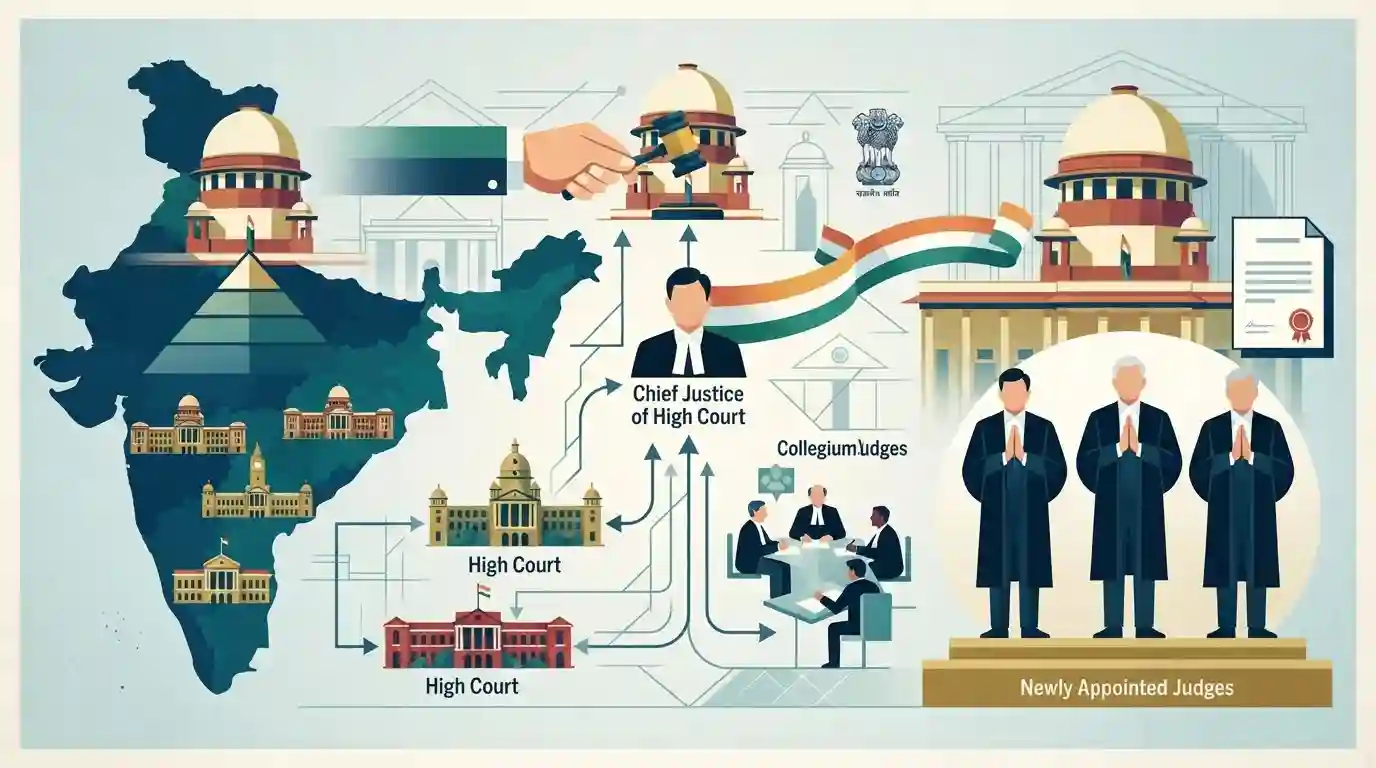
- Appointments to the Supreme Court are made by the President of India under Article 124(2) of the Constitution, following recommendations by the Supreme Court Collegium.
ముఖ్యమైన పదాలు
Supreme Court of India

The apex judicial tribunal of India established under Article 124 of the Constitution, functioning as the ultimate court of appeal and guardian of the Constitution.
UPSC context
UPSC Prelims/Mains (GS Paper II): Structure, Organization and Functioning of the Judiciary; tests knowledge of constitutional provisions and apex judicial powers.
High Courts
The highest judicial courts at the state level in India, established under Article 214 of the Constitution, possessing original and appellate jurisdiction.
UPSC context
UPSC Prelims/Mains (GS Paper II): Structure, Organization and Functioning of the Judiciary; tests understanding of federal judicial architecture and state-level jurisdictions.
ప్రిలిమ్స్ ఉచ్చు
Supreme Court and High Court judges both hold office until they attain the age of 65 years.
Aspirants often confuse the retirement age of Supreme Court judges (65 years) with High Court judges (62 years).
అనుసంధానమైన స్థిర భావనలు
What are the constitutional requirements and retirement ages for Supreme Court and High Court judges in India?
- Qualifications: Must be a citizen of India with 5 years HC judge experience, 10 years HC advocate, or a distinguished jurist.
- Appointment: Appointed by the President under Article 124(2) on the recommendation of the Supreme Court Collegium.
- Retirement Age: Supreme Court judges retire at 65 years, while High Court judges retire at 62 years.
అంతర-అంశ నమూనాలు
Judicial Appointments vs. Basic Structure Doctrine
Higher judicial appointments highlight executive-judiciary checks and balances, tying judicial independence directly to Basic Structure doctrine debates.
Judicial Federalism and Apex Representation
Elevating High Court Chief Justices tests inter-state judicial representation and administrative capacity across apex courts.

Expect statement-based questions on Article 124(2) qualifications, collegium primacy, and age limits for SC vs HC judges.
అనుసంధాన PYQలు · 3
అనుసంధాన PYQలు · 3
- 2019PrelimsGS1
Consider the following statements: 1. The motion to impeach a Judge of the Supreme Court of India cannot be rejected by the Speaker of the Lok Sabha as per the Judges (Inquiry) Act, 1968. 2. The Constitution of India defines and gives details of what constitutes 'incapacity and proved misbehaviour' of the Judges of the Supreme Court of India. 3. The details of the process of impeachment of the Judges of the Supreme Court of India are given in the Judges (Inquiry) Act, 1968. 4. If the motion for the impeachment of a Judge is taken up for voting, the law requires the motion to be backed by each House of the Parliament and supported by a majority of total membership of that House and by not less than two-thirds of total members of that House present and voting. Which of the statements given above is/are correct?
- 2021PrelimsGS1
With reference to Indian judiciary, consider the following statements : 1. Any retired judge of the Supreme Court of India can be called back to sit and act as a Supreme Court judge by the Chief Justice of India with prior permission of the President of India. 2. A High Court in India has the power to review its own judgement as the Supreme Court does. Which of the statements given above is/are correct?
- 2019PrelimsGS1
Consider the following statements: 1. The 44th Amendment to the Constitution of India introduced an Article placing the election of the Prime Minister beyond judicial review. 2. The Supreme Court of India struck down the 99th Amendment to the Constitution of India as being violative of the independence of judiciary. Which of the statements given above is/are correct?
