Indian Telecom Services Performance Indicators and Sector Growth
Source:PIB ↗
কেন এটি গুরুত্বপূর্ণ
Understanding the yearly performance indicators of India's telecom sector is essential for evaluating the nation's digital infrastructure, connectivity expansion, broadband penetration, and progress toward a digital economy, which forms a core component of GS Paper III.
সারসংক্ষেপ
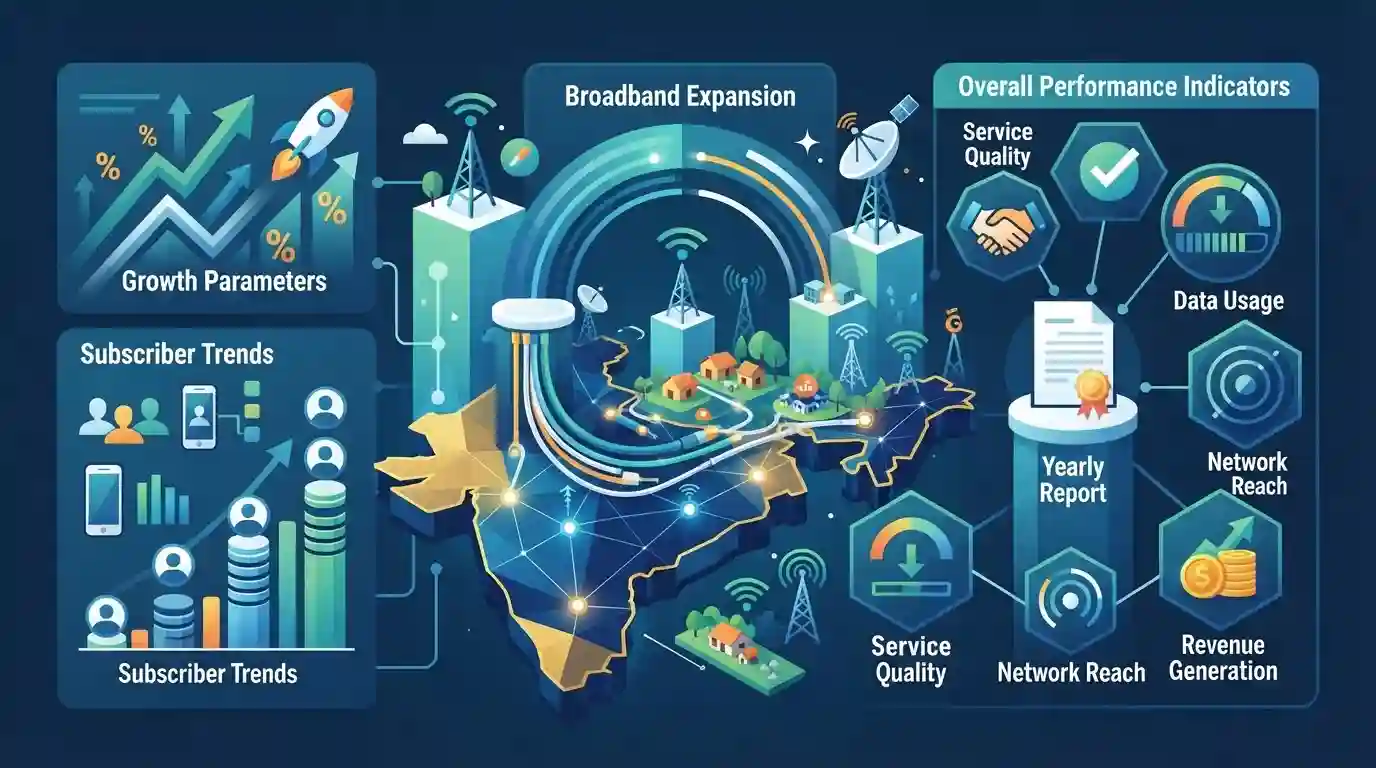
The article highlights the release of 'The Indian Telecom Services Yearly Performance Indicators' report for the year 2025-26, detailing the growth parameters, subscriber trends, broadband expansion, and overall performance indicators of the Indian telecommunications sector.
মূল বিষয়
- The 'Indian Telecom Services Yearly Performance Indicators' for 2025-26 provides comprehensive data on telecommunication growth, subscriber bases, and infrastructure development in India.
- Highlights key metrics including trends in wireless and wireline subscriptions, broadband penetration, and teledensity across urban and rural sectors.
- Serves as a crucial regulatory report tracking the evolution of India's digital communication landscape and infrastructure readiness.
গুরুত্বপূর্ণ শব্দ
TRAI

An independent statutory body established under the TRAI Act, 1997, to regulate telecommunication services, fix tariffs, ensure fair competition, and protect consumer interests in India.
UPSC context
UPSC GS Paper III (Infrastructure: Telecom, Regulatory Bodies). Important for questions on independent regulators and governance in the digital sector.
Ministry of Communications
The union ministry in India responsible for formulating policies, licensing, and coordination of telecommunications, postal services, and related digital infrastructure.
UPSC context
UPSC GS Paper II & III (Governance and Infrastructure). Relevant for policies, digital connectivity schemes, and administrative framework of the telecom sector.
প্রিলিমস ফাঁদ
rural tele-density has caught up with urban numbers due to rapid mobile growth
Aspirants often assume rural tele-density has caught up with urban numbers due to rapid mobile growth, missing the wide gap (urban: 151.47% vs rural: 60.46%).
সংযুক্ত স্থির ধারণা
What are the key mandate and powers of the Telecom Regulatory Authority of India (TRAI)?
- Statutory Origin: Established under the TRAI Act, 1997 to regulate telecommunication services and tariffs in India.
- Advisory Role: Makes recommendations on telecom license terms, spectrum management, and introduction of new service providers.
- Core Mandate: Ensures fair competition, protects consumer interests, and settles tariff-related disputes through the TDSAT.
আন্তঃবিষয় প্যাটার্ন
Telecom Penetration + Rural Financial Inclusion
Rapid rural broadband expansion under BharatNet and TRAI reports feed directly into financial inclusion, Direct Benefit Transfer (DBT) delivery, and rural consumption-led economic growth.
Digital Infrastructure + Public-Private Market Dynamics
Heavy reliance on private telecom operators (92% market share) amidst statutory dues and spectrum auctions tests the resilience of critical digital infrastructure.

Expect statement-based questions contrasting urban vs rural tele-density disparities or measuring average data consumption trends in India.
সংযুক্ত PYQ · 1
সংযুক্ত PYQ · 1
- 2023MainsGS3
What is the status of digitalization in the Indian economy? Examine the problems faced in this regard and suggest improvements.
