Wind Energy Sector Growth and Capacity Targets for 2030
Source:PIB ↗
কেন এটি গুরুত্বপূর্ণ
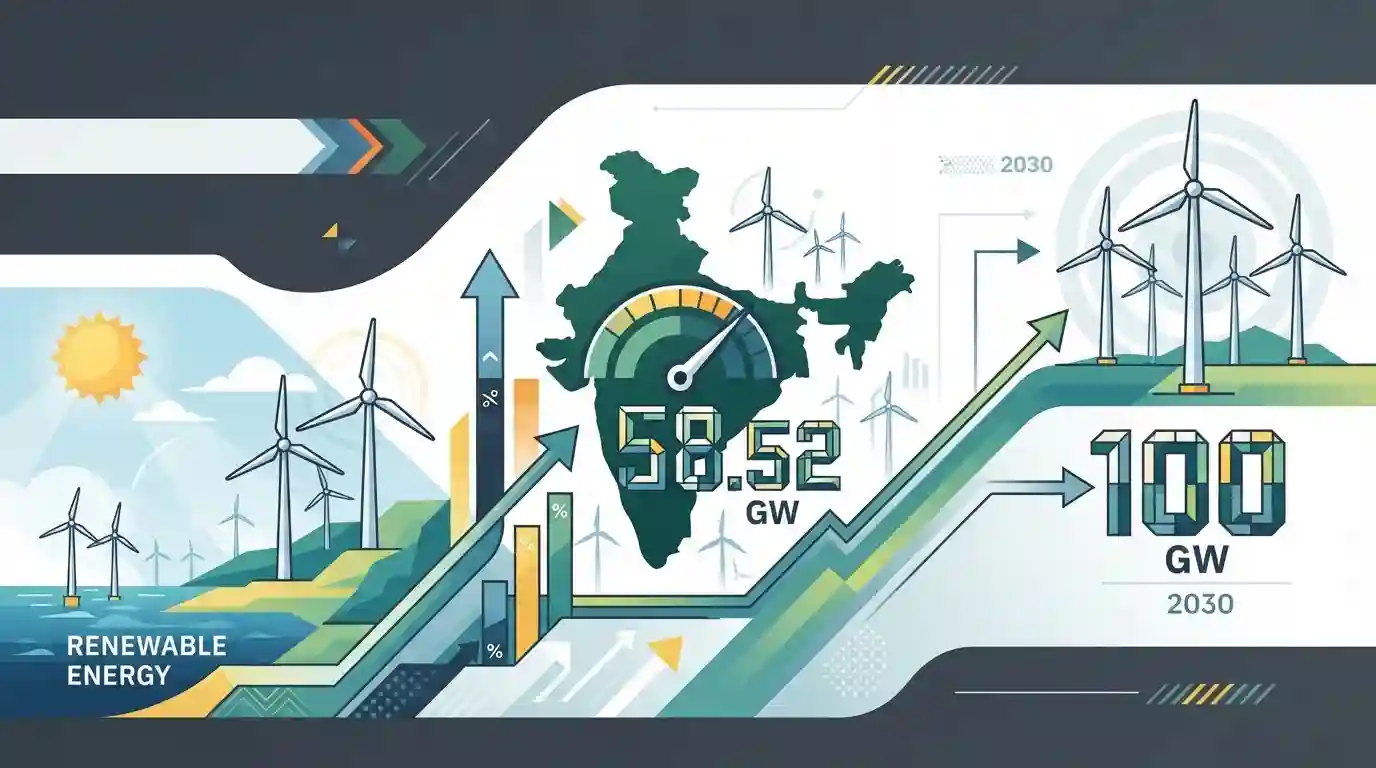
The article provides official data on India's wind energy sector growth (58.52 GW cumulative capacity, target of 100 GW by 2030), which is vital for evaluating India's clean energy transition and international climate commitments under the Paris Agreement.
সারসংক্ষেপ
Union Minister Shri Pralhad Joshi will inaugurate Windergy India 2026 in Chennai, highlighting India's progress in wind energy, which has reached a cumulative capacity of 58.52 GW with a target of 100 GW by 2030.
মূল বিষয়
- Union Minister Shri Pralhad Joshi is set to inaugurate the 8th edition of Windergy India 2026 in Chennai, India's premier wind energy trade fair and conference.
- India added a record 6.05 GW of wind capacity in FY2025-26, bringing cumulative wind capacity to 58.52 GW as of August 2026.
- India aims to achieve 100 GW of wind energy capacity by 2030, with 28 GW currently under implementation.
- Windergy India 2026 features global exhibitors from over 20 countries, with dedicated country pavilions from Denmark, Germany, and Spain, focusing on domestic value addition, next-gen turbines, AI-driven O&M, and offshore wind capabilities.
গুরুত্বপূর্ণ শব্দ
Ministry of New and Renewable Energy (MNRE)

The nodal government ministry in India responsible for policy formulation, research, promotion, and implementation of new and renewable energy sources, including solar, wind, and bioenergy.
UPSC context
Important for GS Paper III (Infrastructure, Energy, and Environment) covering India's clean energy targets, institutional mechanisms, and renewable energy policies.
Indian Wind Turbine Manufacturers Association (IWTMA)
The apex industry body representing wind turbine manufacturers in India, working to promote wind energy adoption, policy advocacy, and domestic manufacturing ecosystems.
UPSC context
Relevant for GS Paper III (Economy and Infrastructure) under industrial associations, private sector participation, and wind energy sector growth in India.
PDA Ventures Pvt. Ltd.
A specialized exhibition and event management firm that co-organizes Windergy India, the country's premier international wind energy trade fair and conference.
UPSC context
Useful for GS Paper III (Economic Development and Renewable Energy Infrastructure) regarding trade promotion events and industry stakeholder collaborations.
প্রিলিমস ফাঁদ
India aims to achieve 100 GW of wind energy capacity by 2030 as part of its total renewable target.
Aspirants often confuse cumulative wind targets with solar targets or general non-fossil targets (500 GW). Wind specifically targets 100 GW by 2030.
সংযুক্ত স্থির ধারণা
What are the key institutional mechanisms and targets for wind energy development in India?
- Global Standing: Rank globally: India ranks 4th in wind power capacity worldwide after China, the US, and Germany.
- Offshore Policy: Offshore policy: National Offshore Wind Energy Policy was notified to harness wind potential along India's 7,600 km coastline.
- Nodal Agency: Nodal agency: National Institute of Wind Energy (NIWE) under MNRE handles resource assessment and testing.
আন্তঃবিষয় প্যাটার্ন
RE expansion + Grid Stability + Energy Security
Wind and solar capacity additions test grid resilience, balancing intermittent sources with storage and peaking power requirements across industrial corridors.
Wind manufacturing + Atmanirbhar Bharat + Supply Chains
Manufacturing capability in domestic wind turbine production links directly to India's Atmanirbhar Bharat initiative and green technology supply chain diversification.

Wind energy targets (100 GW by 2030) and grid balancing with solar are prime candidates for statements in prelims environment questions.
সংযুক্ত PYQ · 3
সংযুক্ত PYQ · 3
- 2022MainsGS3
Do you think India will meet 50 percent of its energy needs from renewable energy by 2030 ? Justify your answer. How will the shift of subsidies from fossil fuels to renewables help achieve the above objective ? Explain.
- 2025MainsGS3
Write a review on India's climate commitments under the Paris Agreement (2015) and mention how these have been further strengthened in COP26 (2021). In this direction, how has the first Nationally Determined Contribution intended by India been updated in 2022?
- 2025MainsGS3
How can India achieve energy independence through clean technology by 2047? How can biotechnology can play a crucial role in this endeavour?
