CAQM Road Dust Inspections for Urban Air Pollution Control
Source:PIB ↗
हे का महत्त्वाचे आहे
Road dust is a critical contributor to particulate air pollution in urban centers like Delhi. Assessing institutional mechanisms like CAQM and their ground-level enforcement provides vital insights for UPSC mains questions concerning urban environmental management and pollution mitigation strategies.
सारांश
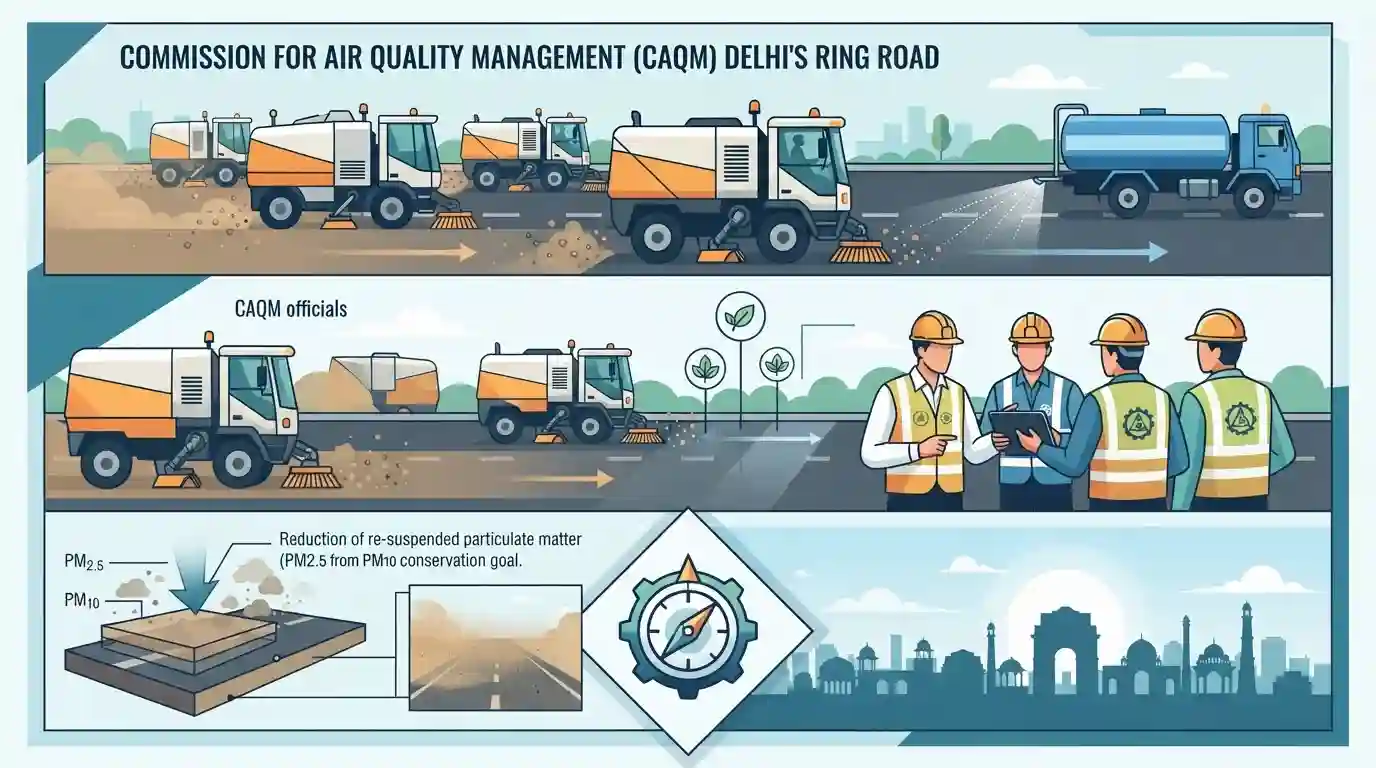
The Commission for Air Quality Management (CAQM) carried out an extensive inspection drive along Delhi's Ring Road to assess road dust management and cleanliness operations. The drive targeted effective mechanical sweeping, water sprinkling, and minimization of re-suspended road dust, which is a major contributor to air pollution in the National Capital Region.
मुख्य मुद्दे
- The Commission for Air Quality Management (CAQM) conducted a surprise inspection drive along the Ring Road in Delhi to evaluate road dust and mechanical sweeping/cleaning operations.
- The inspection checked parameters like dust accumulation on roadsides, mechanical road sweeping (MRS), water sprinkling, and anti-smog guns to mitigate air pollution in the National Capital Region (NCR).
- CAQM emphasized stringent compliance with dust mitigation guidelines, proper disposal of construction and demolition (C&D) waste, and regular wet sweeping to curb particulate matter ($PM_{2.5}$ and $PM_{10}$) pollution.
महत्त्वाच्या संज्ञा
Commission for Air Quality Management (CAQM)

A statutory regulatory body established under a 2021 Act to coordinate, monitor, and plan for air quality management in the National Capital Region and adjoining areas, superseding the EPCA.
UPSC context
UPSC Prelims/Mains (GS Paper III - Environment): Tests institutional mechanisms, environmental governance, and pollution control bodies in India.
Commission for Air Quality Management in National Capital Region and Adjoining Areas Act, 2021
An Act enacted by Parliament to establish a unified and empowered statutory commission for better coordination, research, and resolution of air quality issues in Delhi-NCR and adjoining states.
UPSC context
UPSC Prelims/Mains (GS Paper III - Polity/Environment): Tests statutory backing of environmental laws, parliamentary legislation, and regional governance frameworks.
National Capital Region (NCR)
An inter-state planning region centered upon the National Capital Territory of Delhi, encompassing surrounding districts in Haryana, Uttar Pradesh, and Rajasthan, facing acute regional air pollution challenges.
UPSC context
UPSC Prelims/Mains (GS Paper I & III - Geography/Environment): Tests regional development, urbanization pressures, and airshed-based pollution management.
संबंधित स्थिर संकल्पना
What are the key mandate, statutory status, and jurisdiction of the Commission for Air Quality Management (CAQM)?
- Statutory Origin: Statutory Body established under the CAQM Act, 2021, replacing the EPCA.
- Jurisdiction: Covers the National Capital Region (NCR) and adjoining areas in Punjab, Haryana, Rajasthan, and Uttar Pradesh.
- Powers & Penalties: Powers include issuing directions, laying down air quality parameters, and penalizing violators with fines up to ₹1 crore or 5 years imprisonment.
- Judicial Review: Appeals against CAQM orders lie with the National Green Tribunal (NGT).
आंतर-विषय नमुने
Statutory Environmental Bodies vs. Federal Governance
The transition from judicial ad-hocism (EPCA) to a statutory executive body (CAQM) illustrates the institutional evolution of environmental governance in federal polities.
Municipal Road Sanitation & Regional Air Quality
Urban air pollution management links municipal governance (74th Amendment, urban sanitation) with regional ecological planning under central statutory authorities.

CAQM jurisdiction, statutory powers, and NGT appeal mechanisms are prime candidates for a multi-statement prelims question.
संबंधित PYQ · 1
संबंधित PYQ · 1
- 2021MainsGS3
Describe the key points of the revised Global Air Quality Guidelines (AQGs) recently released by the World Health Organisation (WHO). How are these different from its last update in 2005? What changes in India's National Clean Air Programme are required to achieve these revised standards?
