Ayurveda Institute Concludes Cleanliness Campaign and Special Drive
Source:PIB ↗
Why It Matters
Reflects the ongoing implementation of citizen-centric cleanliness campaigns and institutional housekeeping in government bodies, aligning with governance and public health frameworks.
Summary
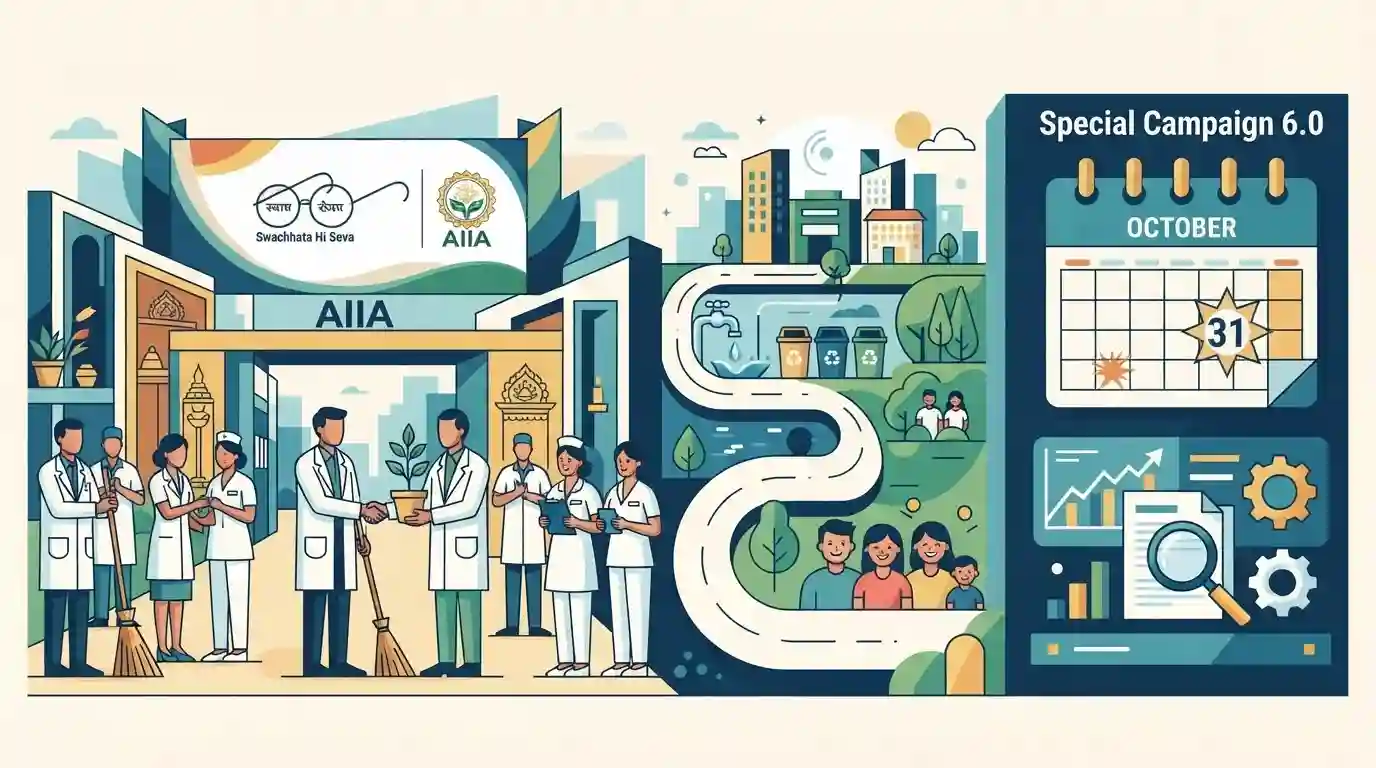
The conclusion of Swachhata Hi Seva 2026 at the All India Institute of Ayurveda (AIIA) marked the ongoing commitment to cleanliness, public health, and institutional accountability under Special Campaign 6.0, which runs through October 31.
Key Points
- Swachhata Hi Seva (SHS) 2026 concluded at the All India Institute of Ayurveda (AIIA), highlighting institutional cleanliness and public participation.
- The Special Campaign 6.0 focuses on institutional housekeeping, pendency reduction, and waste management across government offices, continuing till October 31.
- Emphasized integrating traditional medicine institutions with public health, hygiene, and environmental sustainability goals.
Important Terms
Swachhata Hi Seva

An annual nationwide cleanliness campaign organized ahead of Gandhi Jayanti to foster community participation, voluntary labor (shramdaan), and widespread awareness regarding hygiene and waste management.
UPSC context
UPSC Mains GS Paper II (Governance): Tests government initiatives, public welfare schemes, and citizen participation in sanitation and public health.
Special Campaign 6.0
A targeted administrative drive focused on institutional housekeeping, reducing pendency of public grievances, file management, and eco-friendly practices like e-waste disposal across government offices.
UPSC context
UPSC Mains GS Paper II (Governance): Important for questions on administrative reforms, institutional accountability, and reducing bureaucratic red tape.
All India Institute of Ayurveda (AIIA)
An apex public institution under the Ministry of Ayush dedicated to advancing research, education, and patient care in traditional Ayurvedic medicine.
UPSC context
UPSC Mains GS Paper II (Health/Social Sector): Relevant for health infrastructure, traditional medicine systems, and institutional governance.
Ministry of Ayush
The nodal ministry responsible for the formulation, development, and propagation of indigenous systems of medicine including Ayurveda, Yoga, Unani, Siddha, and Homoeopathy in India.
UPSC context
UPSC Mains GS Paper II (Health & Governance): Tests policies related to traditional healthcare systems and public health administration.
Prelims Trap
Swachhata Hi Seva campaigns and Special Campaigns for pendency reduction are exclusively coordinated by the Ministry of Housing and Urban Affairs.
Aspirants often assume Swachhata Hi Seva is solely a Ministry of Jal Shakti or Ministry of Housing and Urban Affairs initiative, missing its cross-ministerial implementation involving Ayush and DARPG.
Static Concepts Connected
What is the mandate and institutional framework of the Department of Administrative Reforms and Public Grievances (DARPG)?
- Nodal Agency: Nodal agency for administrative reforms, redressal of public grievances, and policy initiatives relating to civil services in India.
- Administrative Control: Operates under the Ministry of Personnel, Public Grievances and Pensions, coordinating annual Special Campaigns for pendency reduction.
- CPGRAMS Portal: Oversees the Centralized Public Grievance Redress and Monitoring System (CPGRAMS) for prompt citizen grievance disposal.
Cross-Topic Patterns
Administrative Reforms & Digital Governance
DARPG-led administrative reforms intersect with digital governance platforms like CPGRAMS to measure grievance disposal rates in annual ministry performance rankings.
Traditional Medicine & Public Health
AYUSH integration into national public health missions showcases the mainstreaming of traditional medicine within primary health infrastructure.

DARPG's Special Campaign framework and pendency reduction metrics are recurring targets for GS Paper II governance and Prelims scheme implementation.
Linked PYQs · 2
Linked PYQs · 2
- 2022PrelimsGS1
Consider the following statements : 1. The India Sanitation Coalition is a platform to promote sustainable sanitation and is funded by the Government of India and the World Health Organization. 2. The National Institute of Urban Affairs is an apex body of the Ministry of Housing and Urban Affairs in Government of India and provides innovative solutions to address the challenges of Urban India. Which of the statements given above is/are correct?
- 2026PrelimsGS1
In a multi-ethnic district where both economic competition and historical grievances frequently led to community tensions, a flashpoint has arisen with a Government decision to allocate land for a waste management facility near a tribal hamlet, sparking protests by the tribal community, which claimed that the land was sacred and critical to their cultural identity. At the same time, urban residents and local industries supported the project, citing severe solid waste challenges and health concerns due to lack of a proper disposal site. The conflict has escalated with road blockades, social media campaigns, and allegations of police excesses. As a responsible Government official, you are tasked with resolving the situation through mediation, ensuring a sustainable outcome that balances environmental needs, tribal rights, and urban public health. Consider the following statements with reference to the above : 1. A successful conflict resolution process must begin with acknowledging the cultural concerns of the protesting tribal community before discussing technical alternatives. 2. The Government should move ahead with the project without delay to address urban health concerns, which outweigh the sentiments of a small group. 3. Creating a multi-stakeholder dialogue platform — including tribal leaders, environmental experts, and municipal representatives — to build mutual understanding and help de-escalate tensions. 4. Conducting an independent Environmental and Social Impact Assessment (ESIA) and sharing findings transparently with both sides to facilitate evidence-based decision-making. Which of the statements given above would contribute to the resolution process ?
