Kautilya Economic Conclave Advocates Light Touch Regulation
Source:PIB ↗
हे का महत्त्वाचे आहे
This article is crucial for GS3 (Indian Economy) as it addresses the core debate of regulatory governance versus economic freedom, market-led growth, and the structural reforms needed to enhance private sector participation and innovation in India.
सारांश
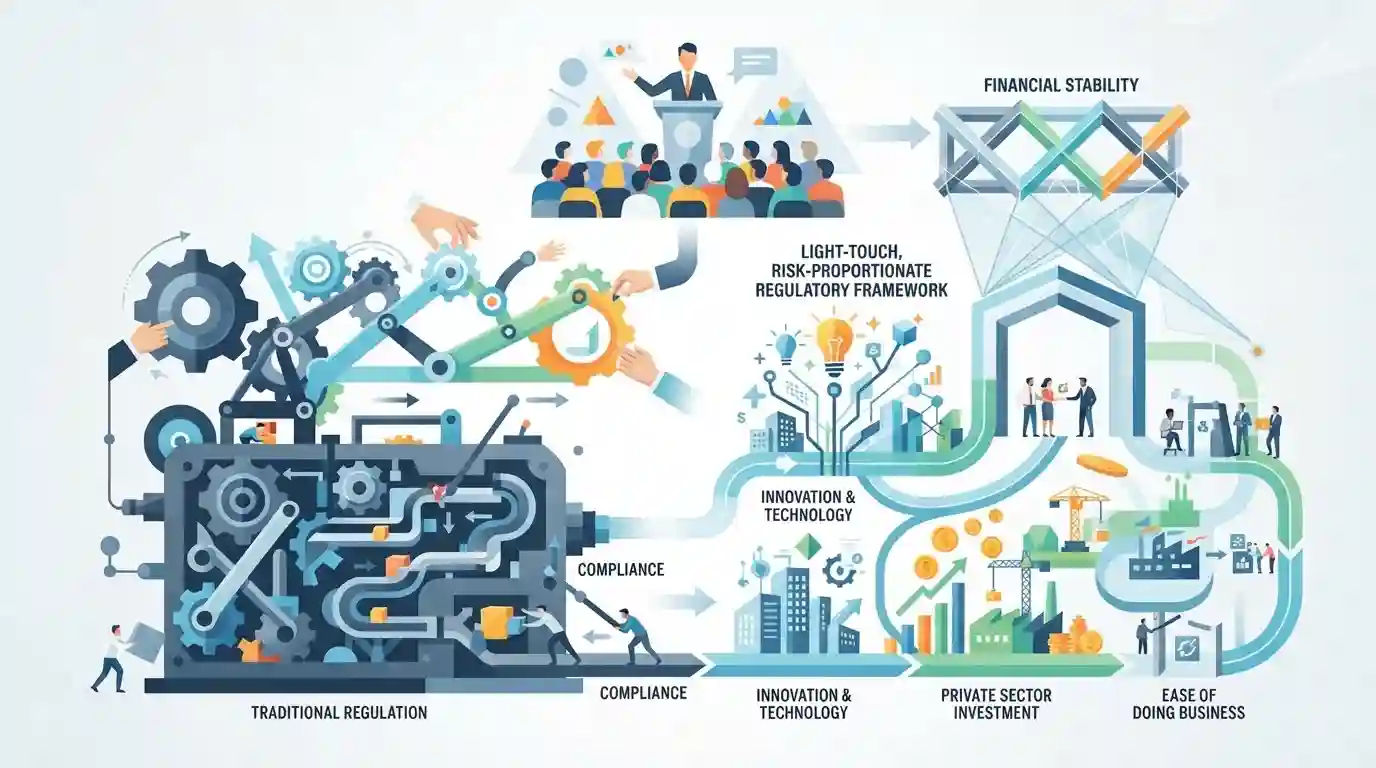
At the 5th Kautilya Economic Conclave, Shri Rajiv Gauba called for transitioning towards a light-touch, risk-proportionate regulatory framework to foster innovation, encourage private sector investment, and improve the ease of doing business in India without compromising financial stability.
मुख्य मुद्दे
- Shri Rajiv Gauba emphasized the need for a shift from prescriptive, heavy-handed regulation to 'Light-Touch, Risk-Proportionate' regulation at the 5th Kautilya Economic Conclave.
- Over-regulation can stifle innovation, slow down decision-making, and create bottlenecks for private investment and entrepreneurship.
- A risk-proportionate regulatory approach helps balance consumer protection and financial stability with the need for growth and ease of doing business.
- The discussion highlights structural economic reforms necessary to boost India's long-term economic growth and foster a competitive market economy.
महत्त्वाच्या संज्ञा
Kautilya Economic Conclave

An annual premier economic conference co-organized by the Ministry of Finance and the Institute of Economic Growth that brings together global policymakers and economists to discuss contemporary national and international economic challenges.
UPSC context
UPSC GS Paper III (Indian Economy): Relevant for questions on economic policy, growth, reforms, and global economic integration.
पूर्वपरीक्षा सापळा
Light-touch regulation implies complete deregulation and the removal of all statutory oversight over private enterprises.
Light-touch regulation advocates for risk-proportionate oversight, not absolute deregulation or the complete removal of consumer protection and financial stability safeguards.
संबंधित स्थिर संकल्पना
What are the core pillars of India's Ease of Doing Business framework and regulatory reform initiatives?
- Decriminalization: Focuses on reducing compliance burden, decriminalizing minor technical defaults, and replacing discretionary approvals with transparent digital processes.
- Regulatory Sandboxes: Utilizes regulatory sandboxes to test innovative financial and technological products in a live, controlled environment with relaxed compliance.
- Self-Certification: Encourages self-certification and third-party audits to replace intrusive inspector-raj mechanisms.
आंतर-विषय नमुने
Light-Touch Regulation + Administrative Reforms
Regulatory sandboxes first tested in fintech now frame broader administrative reforms across telecom, digital governance, and private capital deployment.

Light-touch regulation vs. systemic risk trade-off frequently appears in multi-statement prelims questions on ease of doing business.
संबंधित PYQ · 3
संबंधित PYQ · 3
- 2022MainsGS3
Is inclusive growth possible under market economy ? State the significance of financial inclusion in achieving economic growth in India.
- 2023MainsGS3
Faster economic growth requires increased share of the manufacturing sector in GDP, particularly of MSMEs. Comment on the present policies of the Government in this regard.
- 2020MainsGS3
Explain the meaning of investment in an economy in terms of capital formation. Discuss the factors to be considered while designing a concession agreement between a public entity and a private entity.
