India Demonstrates First Free Space Quantum Key Distribution Link
Source:PIB ↗
ఇది ఎందుకు ముఖ్యం
Quantum Key Distribution (QKD) represents a paradigm shift in national security and cryptography, ensuring unhackable communication networks against the backdrop of emerging quantum computing capabilities. It directly ties into India's strategic push under the National Quantum Mission.
సారాంశం
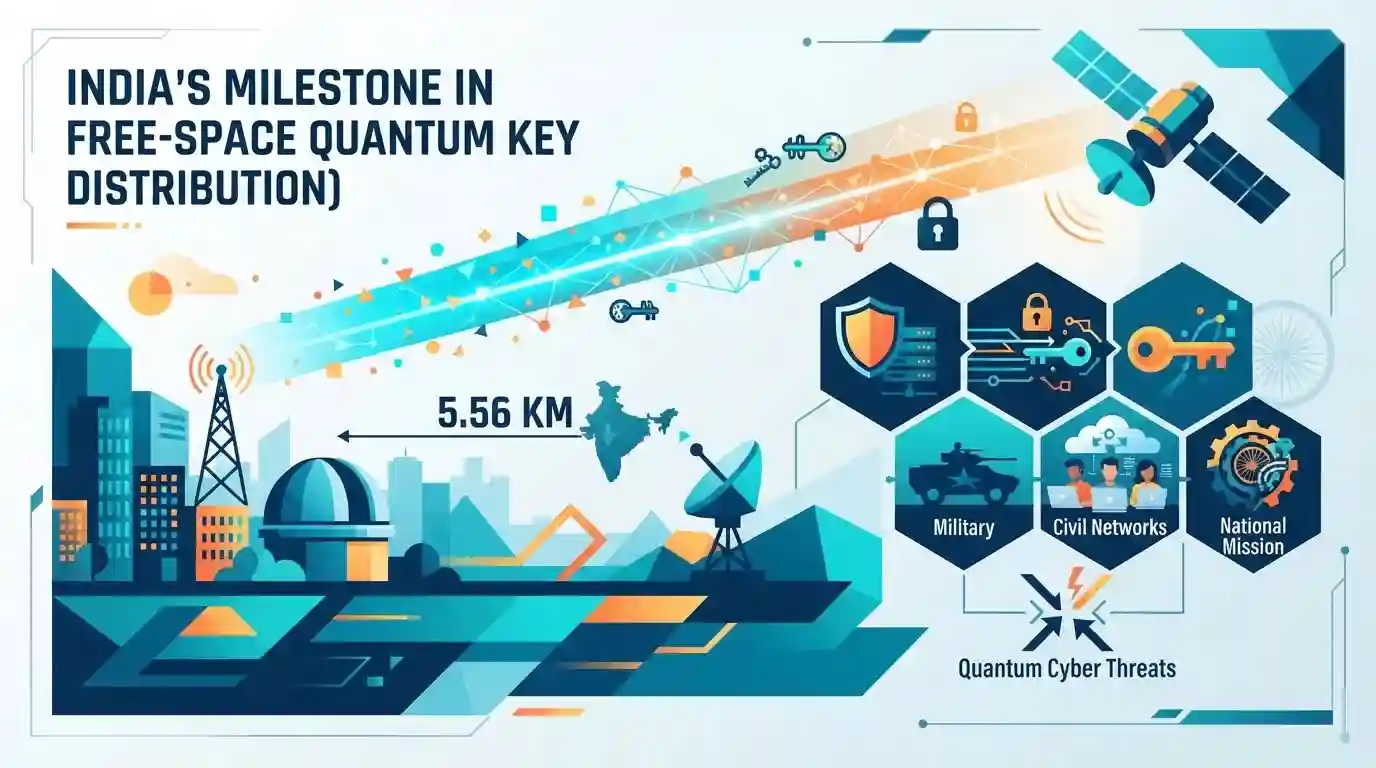
India achieved a major milestone in quantum communication by successfully demonstrating its first free-space Quantum Key Distribution (QKD) link over a distance of 5.56 km. This technology uses quantum mechanics to enable provably secure cryptographic key exchange, safeguarding sensitive military and civil networks from future quantum cyber threats. The breakthrough supports India's National Quantum Mission objectives.
ముఖ్య అంశాలు
- India successfully demonstrated its first free-space Quantum Key Distribution (QKD) link over a distance of 5.56 km.
- The demonstration establishes ultra-secure, unhackable communication channels relying on the principles of quantum mechanics.
- Free-space QKD is crucial for bridging communication links where physical optical fibers cannot be laid, including satellite-based communications and mobile or tactical military units.
- Aligned with the goals of the National Quantum Mission to secure national digital infrastructure against future quantum computing decryption threats.
ముఖ్యమైన పదాలు
Quantum Key Distribution (QKD)

A secure communication method that uses quantum mechanics to exchange cryptographic keys, ensuring any eavesdropping attempt alters the quantum state and is immediately detected.
UPSC context
UPSC Prelims/Mains (Science & Technology): Tests awareness of emerging quantum communication technologies, encryption methods, and national cybersecurity infrastructure.
National Quantum Mission
An ambitious Government of India initiative backed by the Department of Science and Technology to scale scientific R&D in quantum computing, communication, and sensing.
UPSC context
UPSC Prelims/Mains (Science & Technology): Tests policies, funding schemes, and strategic priorities for advanced technological self-reliance in India.
QuNu Labs
A Bengaluru-based deep-tech startup specializing in quantum-safe cryptography, quantum key distribution systems, and quantum random number generators.
UPSC context
UPSC Prelims (Science & Technology / Economy): Relevant for questions on public-private partnerships, domestic startups, and critical defense tech innovation.
అనుసంధానమైన స్థిర భావనలు
What are the foundational working principles and limitations of Quantum Key Distribution (QKD)?
- Physical Security: Based on physics, QKD relies on quantum mechanics principles (like the Heisenberg uncertainty principle) rather than mathematical complexity for key exchange.
- Detection of Eavesdropping: Any eavesdropping attempt alters the quantum state, alerting the communicating parties instantly due to the observer effect.
- Free-space Utility: Free-space QKD overcomes the limitation of physical fiber optics, enabling secure links for satellites and mobile tactical units.
- Operational Limits: Key limitation includes distance degradation in fiber and atmospheric interference affecting free-space optical links.
అంతర-అంశ నమూనాలు
Quantum Cryptography and National Cyber Strategy
Quantum key distribution utilizes Heisenberg's uncertainty principle, forming a vital intersection between fundamental physics principles and applied national cybersecurity frameworks.
National Quantum Mission and Deep-Tech Funding
The National Quantum Mission (NQM) parallels high-tech initiatives like the National Supercomputing Mission, showcasing strategic state funding for deep-tech self-reliance.

Expect a statement-based prelims question distinguishing QKD (unconditional security via physics) from traditional math-based encryption.
అనుసంధాన PYQలు · 2
అనుసంధాన PYQలు · 2
- 2022MainsGS3
What are the different elements of cyber security ? Keeping in view the challenges in cyber security, examine the extent to which India has successfully developed a comprehensive National Cyber Security Strategy.
- 2026PrelimsGS1
Which of the following statements with regard to the National Quantum Mission (NQM) is/are correct? 1. It aims at developing intermediate-scale quantum computers with 50-1000 physical qubits. 2. Its implementation includes setting up of four Thematic Hubs (T-Hubs) in academic and national R&D institutes across India. Select the answer using the code given below :
