PM SETU Scheme Progresses in Transforming Vocational Education
Source:PIB ↗
ఇది ఎందుకు ముఖ్యం
PM-SETU represents a major fiscal and structural intervention to overhaul India's vocational ecosystem, aligning skilling initiatives with industry 4.0 requirements and demographic dividend goals, making it highly relevant for questions on employment, human capital, and economic development in GS Paper III.
సారాంశం
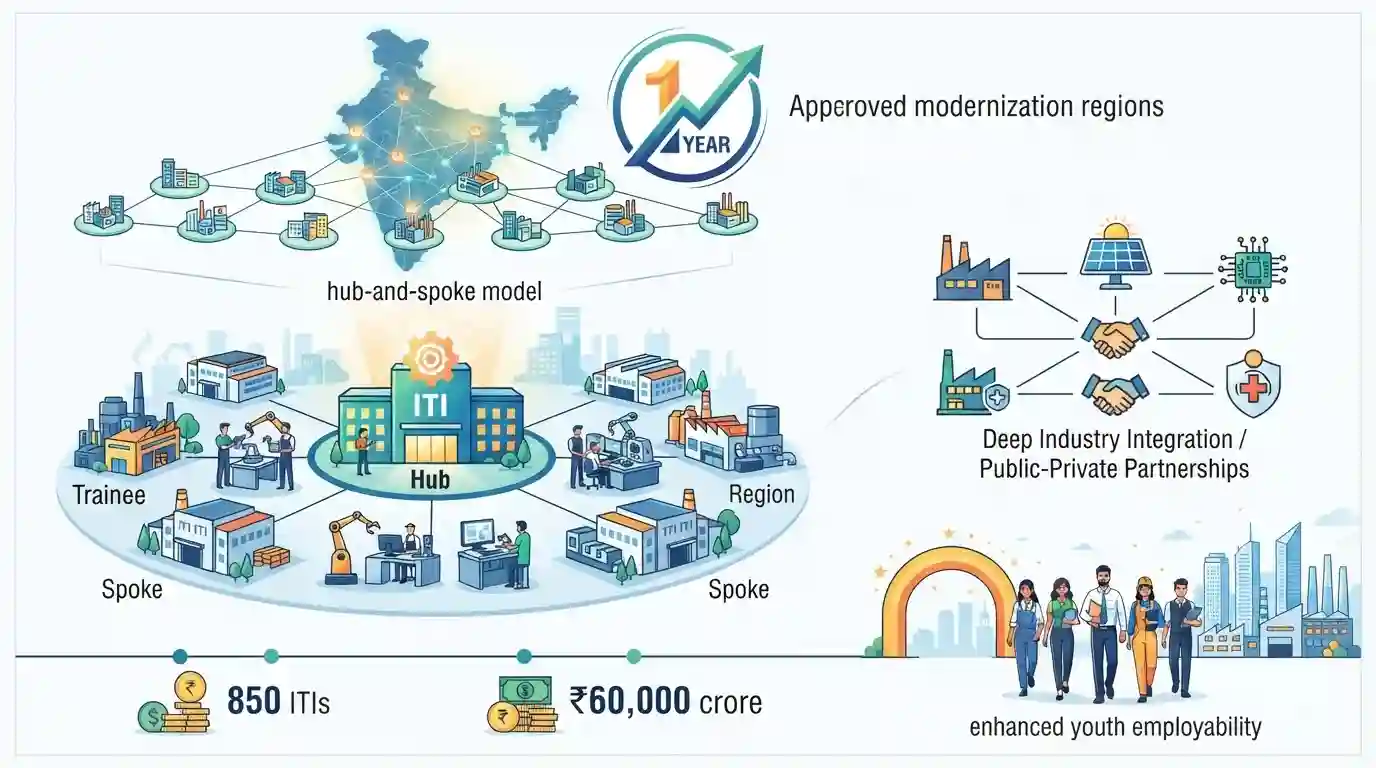
Marking one year of the Pradhan Mantri Skilling and Employability Transformation through Upgraded ITIs (PM-SETU) scheme, the initiative has successfully identified 850 ITIs and approved 14 clusters to modernize India's vocational training infrastructure. With a ₹60,000 crore financial outlay, PM-SETU leverages a hub-and-spoke model and deep industry integration via public-private partnerships to enhance youth employability and align industrial training with contemporary market demands.
ముఖ్య అంశాలు
- PM-SETU (Pradhan Mantri Skilling and Employability Transformation through Upgraded ITIs) marks its one year of implementation, aiming to modernize India's vocational training ecosystem.
- The ₹60,000 crore scheme focuses on upgrading 1,000 government ITIs using a hub-and-spoke model aligned with industry needs.
- In its first year, 850 ITIs (172 hubs and 678 spokes) were identified, and 14 ITI clusters were approved to drive outcome-based training.
- Five National Skill Training Institutes (NSTIs) are being upgraded into National Centres of Excellence with global industry partnerships to train trainers in emerging technologies.
- Promotes active public-private partnerships (PPP) through Special Purpose Vehicles (SPVs) and Anchor Industry Partners, bridging the skill gap outlined in NEP 2020.
ముఖ్యమైన పదాలు
Pradhan Mantri Skilling and Employability Transformation through Upgraded ITIs (PM-SETU)

A centrally sponsored scheme with a ₹60,000 crore outlay to modernize and upgrade 1,000 government ITIs into industry-aligned vocational training centers using a hub-and-spoke model.
UPSC context
GS Paper II/III (Government Policies, Human Resource Development). Tests knowledge of flagship skilling interventions and demographic dividend strategies.
Industrial Training Institutes (ITIs)
Post-secondary vocational training institutes in India offering craftsperson training across various engineering and non-engineering trades to supply skilled technical workforce to industry.
UPSC context
GS Paper III (Employment & Skill Development). Relevant for questions on bridging skill gaps and manufacturing sector human capital.
Ministry of Skill Development and Entrepreneurship (MSDE)
The Union ministry responsible for coordinating vocational training, entrepreneurship policies, and national skill development programs across India.
UPSC context
GS Paper II (Governance - Institutional Mechanisms). Evaluates administrative framework driving India's skilling ecosystem.
National Skill Training Institutes (NSTIs)
Apex institutions established to train vocational training instructors, functioning under the Directorate General of Training to set national instructional benchmarks.
UPSC context
GS Paper III (Human Resource Development). Tests awareness of institutional capacity building for trainer training.
ప్రిలిమ్స్ ఉచ్చు
PM-SETU privatizes all government Industrial Training Institutes (ITIs) by handing over 100% management control to corporate anchor partners.
Aspirants might assume ITIs under PM-SETU are fully privatized, whereas it operates via a Public-Private Partnership where government institutions are upgraded with industry collaboration.
అనుసంధానమైన స్థిర భావనలు
What are the key institutional pillars of India's skill development ecosystem?
- Apex Ministry: Apex Body: Ministry of Skill Development and Entrepreneurship (MSDE) coordinates all skill development efforts across the country.
- Vocational Base: Training Institutes: Industrial Training Institutes (ITIs) provide vocational training under the Craftsmen Training Scheme (CTS).
- Trainer Training: Trainers: National Skill Training Institutes (NSTIs) focus on training the trainers in advanced vocational trades and emerging tech.
- Regulatory Body: Regulation: National Council for Vocational Education and Training (NCVET) regulates vocational education and training providers.
అంతర-అంశ నమూనాలు
Skill Development + Corporate Governance Models
PM-SETU's industry-led governance via Special Purpose Vehicles (SPVs) mirrors the Special Purpose Vehicle models used in defense indigenization and smart cities infrastructure.
Demographic Dividend + Make in India Linkages
Aligning ITIs with NEP 2020 targets reflects India's broader demographic dividend strategy, linking vocational education directly with manufacturing push initiatives like PLI.

PM-SETU's hub-and-spoke model and 51% industry ownership structure are prime targets for a statement-based Prelims question on vocational schemes.
అనుసంధాన PYQలు · 2
అనుసంధాన PYQలు · 2
- 2022PrelimsGS1
In India, which one of the following compiles information on industrial disputes, closures, retrenchments and lay-offs in factories employing workers ?
- 2016PrelimsGS1
'Mission Indradhanush' launched by the Government of India pertains to
