Captive Bred Great Indian Bustards Released into Desert National Park
Source:PIB ↗
কেন এটি গুরুত্বপূর্ণ
The release of captive-bred Great Indian Bustards—a critically endangered species facing severe threats like power lines and habitat loss—into the wild represents a major milestone in Indian wildlife conservation, making it highly relevant for Prelims and GS3 environment questions.
সারসংক্ষেপ
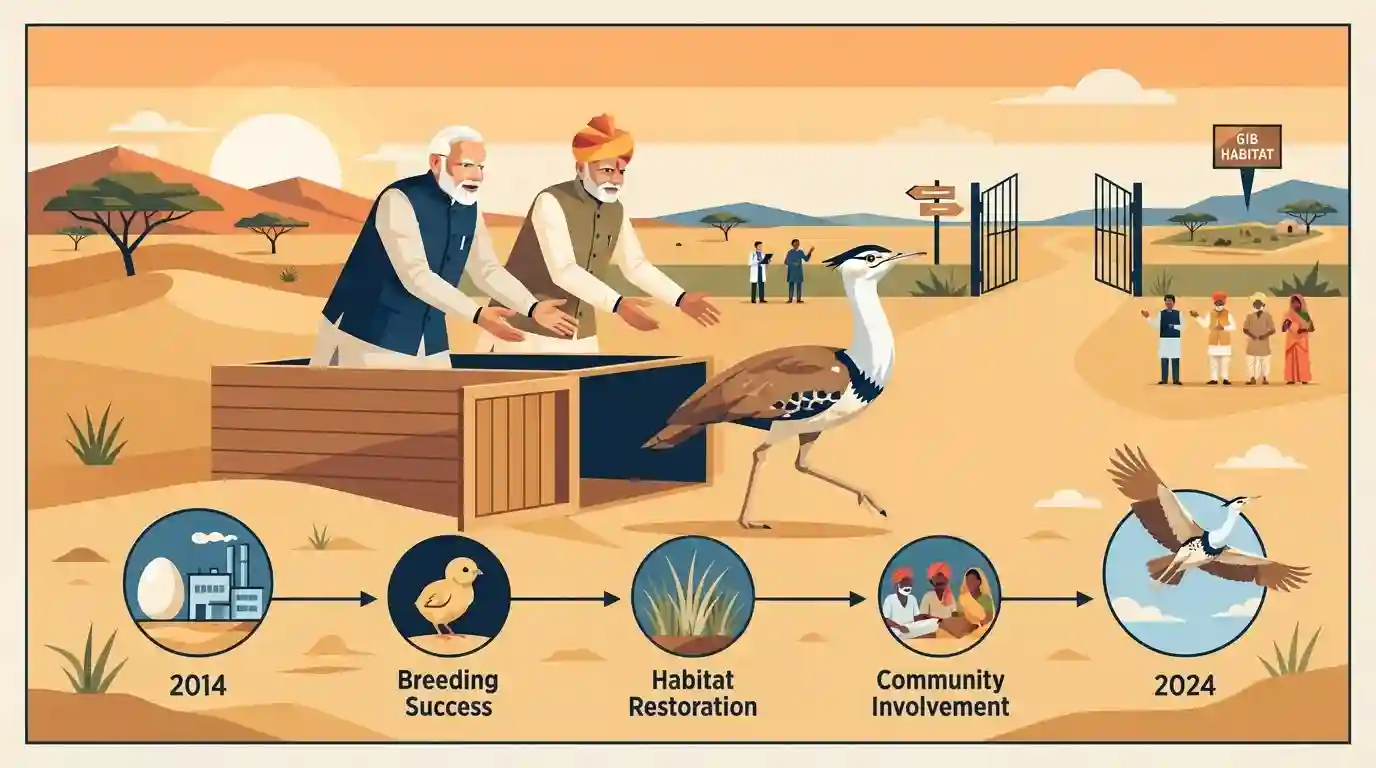
Union Environment Minister and the Chief Minister of Rajasthan initiated the release of captive-bred Great Indian Bustards into the wild at the Desert National Park in Jaisalmer, marking a decade of dedicated conservation and breeding efforts for the critically endangered species.
মূল বিষয়
- Union Environment Minister and the Chief Minister of Rajasthan initiated the release of captive-bred Great Indian Bustards (GIBs) into the wild at the Desert National Park, Jaisalmer.
- This milestone marks the culmination of 10 years of dedicated conservation efforts, including ex-situ breeding programmes.
- The Great Indian Bustard is one of the critically endangered bird species native to Indian arid grasslands, particularly in Rajasthan.
- The initiative highlights India's commitment to species recovery, habitat protection, and wildlife management.
গুরুত্বপূর্ণ শব্দ
Great Indian Bustard Recovery Programme

A multi-agency collaborative conservation initiative by MoEFCC, Rajasthan Forest Department, and Wildlife Institute of India launched to save the critically endangered Great Indian Bustard from extinction via captive breeding and rewilding.
UPSC context
UPSC Prelims/Mains (GS Paper III): Biodiversity conservation, species recovery plans, and wildlife protection legislation.
Desert National Park
A protected area located in Jaisalmer and Barmer districts of Rajasthan, notable for its fragile desert ecosystem and serving as the primary natural habitat and last secure refuge for the Great Indian Bustard.
UPSC context
UPSC Prelims: Protected areas of India, national parks, and endemic flora/fauna habitats.
Ministry of Environment, Forest and Climate Change
The central government ministry responsible for planning, promoting, and coordinating environmental and forestry policies, including wildlife protection programs and species recovery initiatives across India.
UPSC context
UPSC Prelims/Mains (GS Paper II/III): Institutional framework for environmental governance, central ministries, and statutory bodies.
প্রিলিমস ফাঁদ
Desert National Park is a typical protected forest sanctuary rich in dense tree cover and perennial water bodies.
Aspirants often assume Desert National Park is a lush forest ecosystem, but it is actually a fragile desert/arid grassland ecosystem in Rajasthan characterized by sand dunes and rock formations.
সংযুক্ত স্থির ধারণা
What are the conservation status, legal protection, and primary threats facing the Great Indian Bustard (GIB)?
- IUCN Status: Critically Endangered status on the IUCN Red List due to sharp population declines.
- Legal Protection: Protected under Schedule I of the Wildlife (Protection) Act, 1972, granting it the highest level of legal protection in India.
- Habitat Range: Endemic to Indian arid and semi-arid grasslands, with Rajasthan holding the largest remaining wild population.
- Major Threats: Fatal collisions with high-voltage power transmission lines in renewable energy hubs and habitat loss from agriculture.
আন্তঃবিষয় প্যাটার্ন
Renewable Energy Infrastructure vs. Wildlife Conservation
Rapid expansion of solar and wind parks in Thar is fragmenting GIB habitat and causing fatal overhead wire collisions, testing India's balancing act between clean energy goals and biodiversity conservation.
Ex-situ Breeding to Wild Reintroduction Strategies
The 10-year captive breeding initiative demonstrates the complex transition from ex-situ conservation to wild reintroduction, a strategy previously deployed for tigers and vultures in India.

Expect a matching or statement-based question combining GIB status (Critically Endangered, Schedule I), Desert National Park location, and transmission line threats.
সংযুক্ত PYQ · 1
সংযুক্ত PYQ · 1
- 2020PrelimsGS1
With reference to India's Desert National Park, which of the following statements are correct? 1. It is spread over two districts. 2. There is no human habitation inside the Park. 3. It is one of the natural habitats of Great Indian Bustard. Select the correct answer using the code given below:
