Deportation of Narco Kingpin from Turkiye Boosts Security
Source:PIB ↗
কেন এটি গুরুত্বপূর্ণ
This event directly highlights India's evolving strategy against transnational organized crime and narco-terrorism, linking international law enforcement cooperation, extradition mechanisms, and internal security management as frequently tested in Mains GS-3.
সারসংক্ষেপ
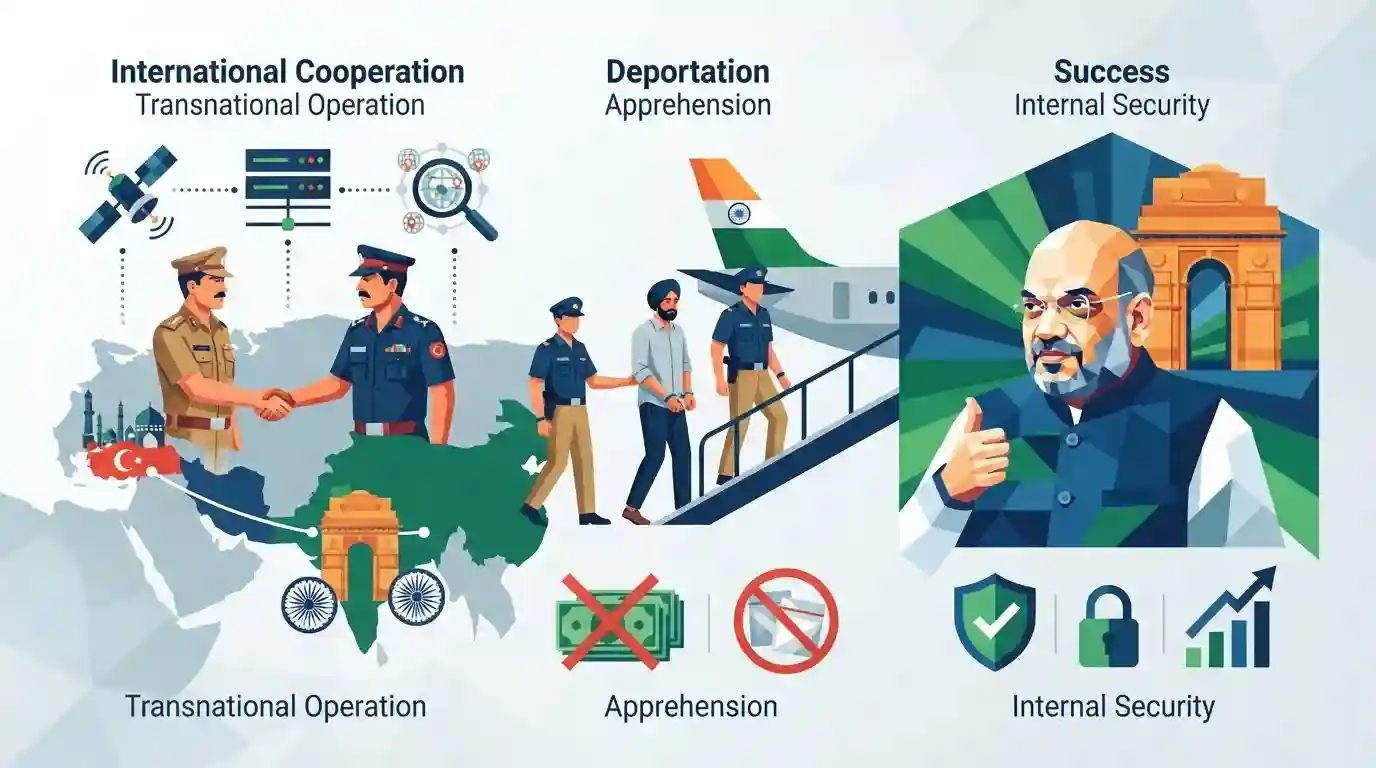
Union Home Minister Amit Shah praised security and intelligence agencies for successfully securing the deportation of international narco-trafficking kingpin Navpreet Singh from Türkiye, marking a major milestone in India's fight against transnational organized crime and narco-terrorism.
মূল বিষয়
- Union Home Minister Shri Amit Shah congratulated security agencies for the successful deportation of hardened narco-trafficking kingpin Navpreet Singh from Türkiye.
- Navpreet Singh was a key figure in international drug trafficking networks, highlighting cross-border and transnational organized crime challenges.
- The achievement underscores India's intensifying international cooperation and diplomatic outreach for cracking down on fugitive criminals and narco-syndicates operating abroad.
- The Ministry of Home Affairs has adopted a zero-tolerance policy against drug trafficking and narco-terrorism to secure internal security.
গুরুত্বপূর্ণ শব্দ
Extradition Treaty

A formal bilateral agreement between sovereign states establishing legal procedures to surrender fugitives wanted for prosecution or serving a sentence for specified crimes.
UPSC context
GS Paper III (Internal Security - Linkages between organized crime and terrorism); tests knowledge of international legal mechanisms for tackling transnational criminals.
Ministry of Home Affairs
The nodal central ministry of India responsible for the maintenance of internal security, domestic policy, state intelligence, border management, and law enforcement agencies.
UPSC context
GS Paper II & III (Polity/Internal Security); tests understanding of institutional roles in counter-terrorism, law enforcement, and national security governance.
সংযুক্ত স্থির ধারণা
What are the primary legal and institutional mechanisms used by India for international law enforcement cooperation against fugitives?
- Extradition Treaties: Deports foreign-based criminals via bilateral Extradition Treaties or arrangements under the Extradition Act, 1962.
- Interpol NCB-India: Facilitates global police coordination, intelligence sharing, and issuing Red Corner Notices through the CBI as the National Central Bureau.
- MLAT Framework: Enables mutual legal assistance in criminal matters across borders for collecting evidence and recovering proceeds of crime.
আন্তঃবিষয় প্যাটার্ন
Extradition Treaties + Internal Security Nexus
India uses extradition treaties and MLATs to dismantle transnational cartels, linking foreign policy leverage to domestic internal security against narcotics and terror funding.

Transnational crime + Interpol Red Notices + extradition mechanisms likely tested via a multi-statement application question.
সংযুক্ত PYQ · 3
সংযুক্ত PYQ · 3
- 2024MainsGS3
Explain how narco-terrorism has emerged as a serious threat across the country. Suggest suitable measures to counter narco-terrorism.
- 2022MainsGS3
Discuss the types of organised crimes. Describe the linkages between terrorists and organised crime that exist at the national and transnational levels.
- 2018MainsGS3
India's proximity to two of the world's biggest illicit opium-growing states has enhanced her internal security concerns. Explain the linkages between drug trafficking and other illicit activities such as gunrunning, money laundering and human trafficking. What counter-measures should be taken to prevent the same?
