Grassroots Democracy and Participatory Planning in Panchayati Raj
Source:PIB ↗
हे का महत्त्वाचे आहे
It highlights the operationalization of decentralized planning and participatory democracy at the village level, aligning with the constitutional mandate of Panchayati Raj Institutions (PRIs) in India.
सारांश
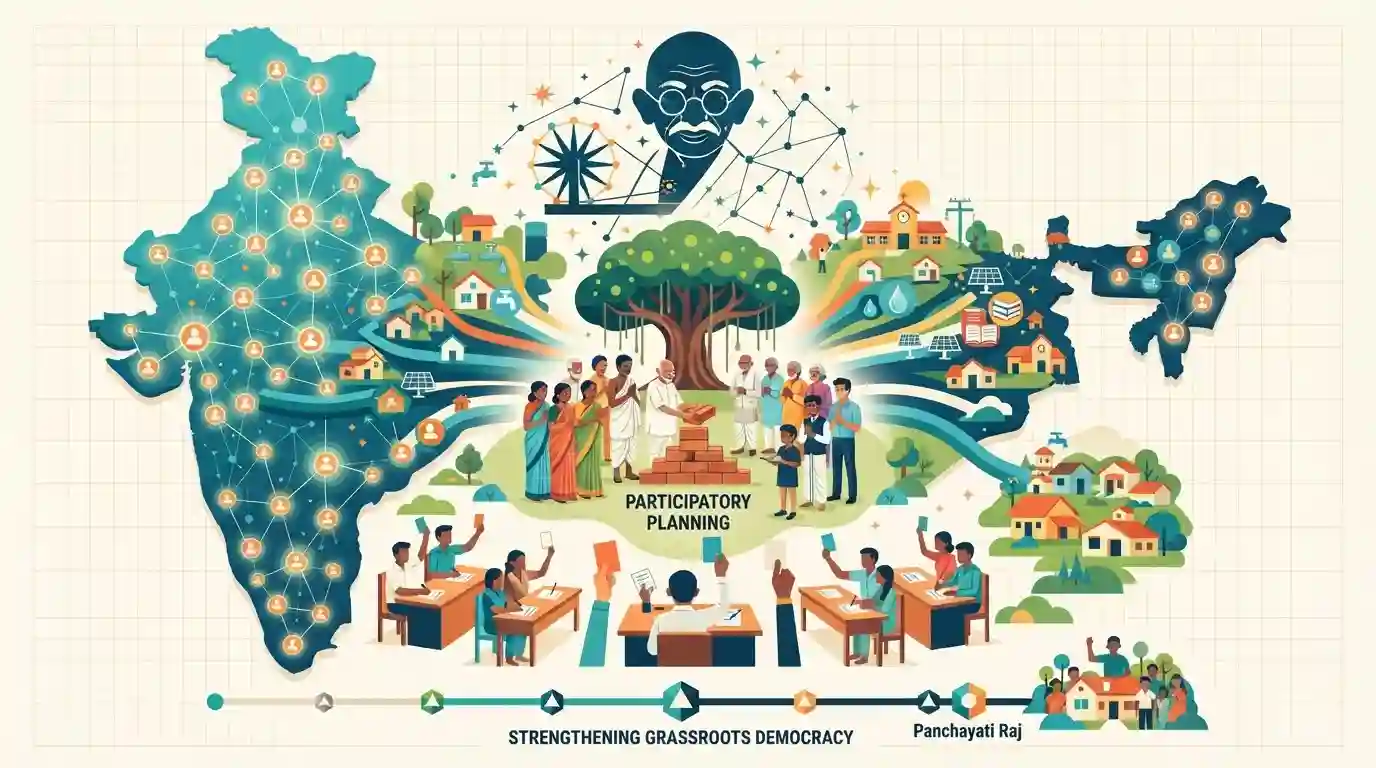
On the occasion of Gandhi Jayanti, over 2.42 lakh special Gram Sabhas were conducted across India, prioritizing citizen-centric initiatives, participatory planning, and strengthening grassroots democracy through Panchayati Raj institutions.
मुख्य मुद्दे
- Over 2.42 lakh special Gram Sabhas were held across India on Gandhi Jayanti, focusing on grassroots democracy and citizen-centric initiatives.
- The initiative emphasized participatory planning, local governance, and decentralized decision-making involving rural communities.
- Special Gram Sabhas serve as platforms to review development schemes, promote transparency, and align local needs with national development goals.
पूर्वपरीक्षा सापळा
Gram Sabha is an executive body consisting only of elected representatives of the village panchayat.
Aspirants often confuse Gram Sabha (constitutional under Article 243A) with Gram Panchayat (constituted under state laws as per Part IX). Gram Sabha comprises all registered voters in a village, not elected representatives alone.
संबंधित स्थिर संकल्पना
What are the constitutional provisions and composition of the Gram Sabha under Part IX of the Constitution?
- Constitutional Status: Article 243A empowers the Gram Sabha to exercise powers and perform functions at the village level as determined by state legislature.
- Composition: It consists of all persons registered in the electoral rolls relating to a village panchayat area.
- Direct Democracy: It acts as the foundational pillar of direct democracy at the grassroots level within the Panchayati Raj framework.
आंतर-विषय नमुने
Gram Sabhas and DPSP Article 40 Linkage
Participatory planning via Gram Sabhas directly implements the Directive Principles of State Policy on village panchayats, linking grassroots democracy to constitutional mandates.
Decentralized Planning and Statutory Social Audits
Special Gram Sabhas serve as statutory social audit platforms for schemes like MGNREGA, bridging decentralized planning with financial accountability.

Expect a statement-based prelims question testing whether Gram Sabha is a constitutional body (Article 243A) vs. statutory body.
संबंधित PYQ · 3
संबंधित PYQ · 3
- 2015MainsGS2
In absence of a well-educated and organized local level government system, 'Panchayats' and 'Samitis' have remained mainly political institutions and not effective instruments of governance. Critically discuss.
- 2024MainsGS2
Analyse the role of local bodies in providing good governance at local level and bring out the pros and cons merging the rural local bodies with the urban local bodies.
- 2015PrelimsGS1
The fundamental object of Panchayati Raj system is to ensure which among the following? 1. People's participation in development 2. Political accountability 3. Democratic decentralization 4. Financial mobilization Select the correct answer using the code given below.
