Indigenous Language Translation Platforms in Public Service Delivery
Source:PIB ↗
हे का महत्त्वाचे आहे
This topic is important for understanding how indigenous digital public infrastructure (DPI) and AI language tools like BHASHINI promote inclusive growth, bridge language divides in essential services like healthcare, and complement human-centric governance.
सारांश
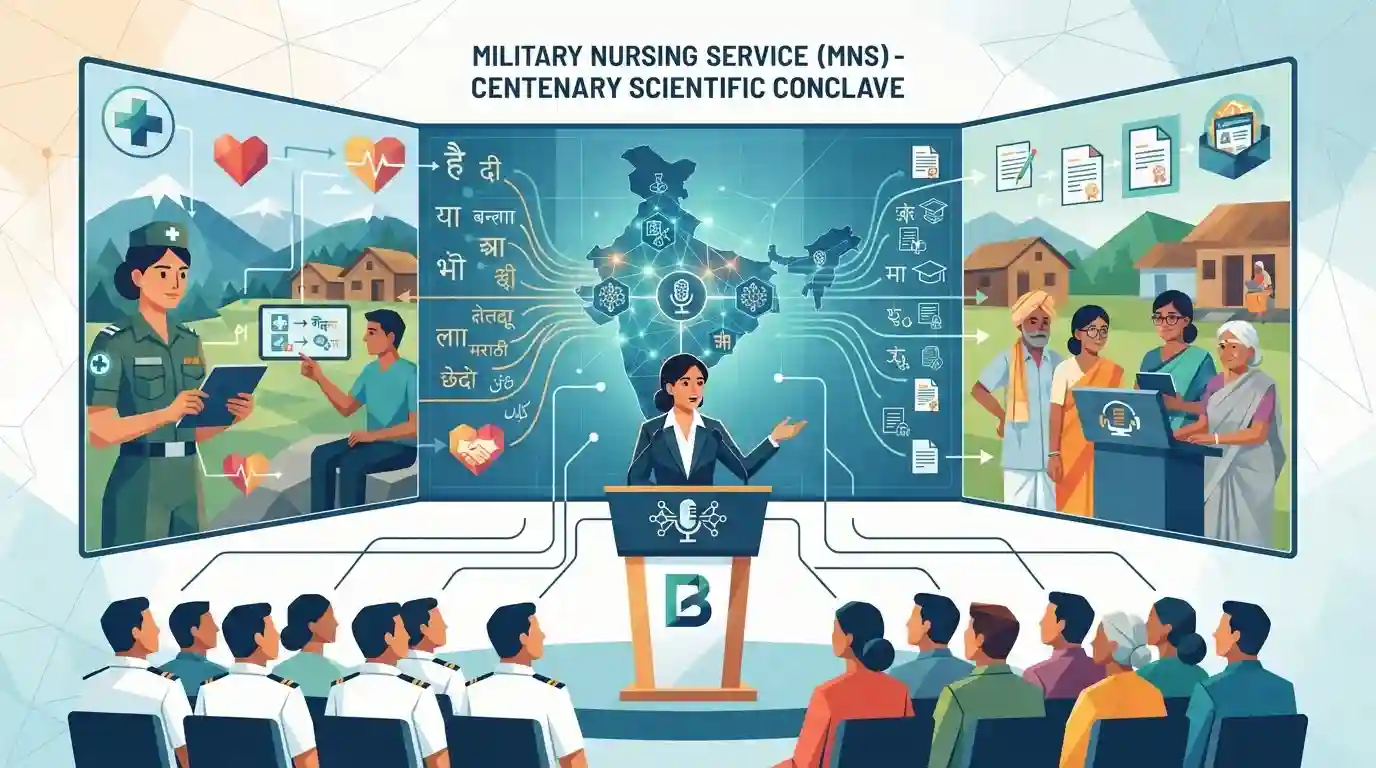
At the Military Nursing Service (MNS) Centenary Scientific Conclave, the CEO of BHASHINI highlighted the convergence of digital technology and human values, emphasizing that context, care, and compassion are vital. The address focused on how AI-driven platforms like BHASHINI can revolutionize healthcare delivery and governance by overcoming linguistic barriers and ensuring inclusive access across India's diverse linguistic landscape.
मुख्य मुद्दे
- The CEO of BHASHINI spoke at the Military Nursing Service (MNS) Centenary Scientific Conclave emphasizing the significance of context, care, and compassion in the evolution of technology and healthcare delivery.
- BHASHINI serves as India's AI-driven language translation platform designed to break down language barriers and bridge the digital divide in public services, healthcare, and governance.
- The integration of AI translation tools in sectors like healthcare ensures that medical services and clinical contexts are effectively communicated in local Indian languages, fostering inclusivity.
- The conclave highlighted the importance of combining technological advancements with human empathy, care, and contextual understanding in professional service sectors like nursing.
महत्त्वाच्या संज्ञा
BHASHINI

India's artificial intelligence-powered language translation platform launched under the National Language Translation Mission to break down linguistic barriers and ensure digital inclusion across Indian languages.
UPSC context
GS Paper III (IT, AI, Digital Public Infrastructure). Tests knowledge of indigenous digital initiatives promoting inclusive governance.
National Language Translation Mission (NLTM)
An ambitious government mission aimed at making governance and public services accessible in all Indian languages through cutting-edge translation technologies.
UPSC context
GS Paper II / III (E-Governance & Technology). Important for questions on digital inclusion and language equity.
Ministry of Electronics and Information Technology (MeitY)
The nodal ministry under the Government of India responsible for formulating policies related to information technology, electronics, and internet proliferation.
UPSC context
GS Paper II / III. Tests institutional frameworks governing India's digital transformation and e-governance policies.
संबंधित स्थिर संकल्पना
What is the National Language Translation Mission (NLTM) and BHASHINI's role within it?
- MeitY Initiative: MeitY Mission: NLTM (BHASHINI) is an initiative under MeitY to make digital content accessible in all Indian languages listed in the 8th Schedule.
- Open Ecosystem: Open Ecosystem: It aggregates datasets, builds open-source AI/NLP models, and fosters a crowdsourcing environment (Bhasha Daan) for voice and text data.
- Core DPI: Digital Public Goods: Functions as a core DPI to eliminate language barriers in e-governance, education, and healthcare across India.
आंतर-विषय नमुने
BHASHINI as Digital Public Infrastructure (DPI)
BHASHINI operates as India's DPI for language, bridging the digital divide similar to Aadhaar for identity and UPI for payments, forming the India Stack triad.
AI in Healthcare & Inclusive Growth
Integrating multilingual AI into healthcare addresses regional disparities, directly linking technology governance with inclusive growth and SDG-3 (Good Health and Well-being).

BHASHINI + DPI architecture + MeitY's AI missions are prime candidates for a multi-statement Prelims conceptual question.
संबंधित PYQ · 2
संबंधित PYQ · 2
- 2023MainsGS3
What is the status of digitalization in the Indian economy? Examine the problems faced in this regard and suggest improvements.
- 2024MainsGS2
e-governance is not just about the routine application of digital technology in service delivery process. It is as much about multifarious interactions for ensuring transparency and accountability. In this context evaluate the role of the 'Interactive Service Model' of e-governance.
