Labour Outreach and Industrial Cluster Welfare Initiatives
Source:PIB ↗
ఇది ఎందుకు ముఖ్యం
Outreach programs like Shram Samvad are vital for assessing ground-level implementation of labour policies, addressing grievances, and ensuring inclusive growth in industrial sectors.
సారాంశం
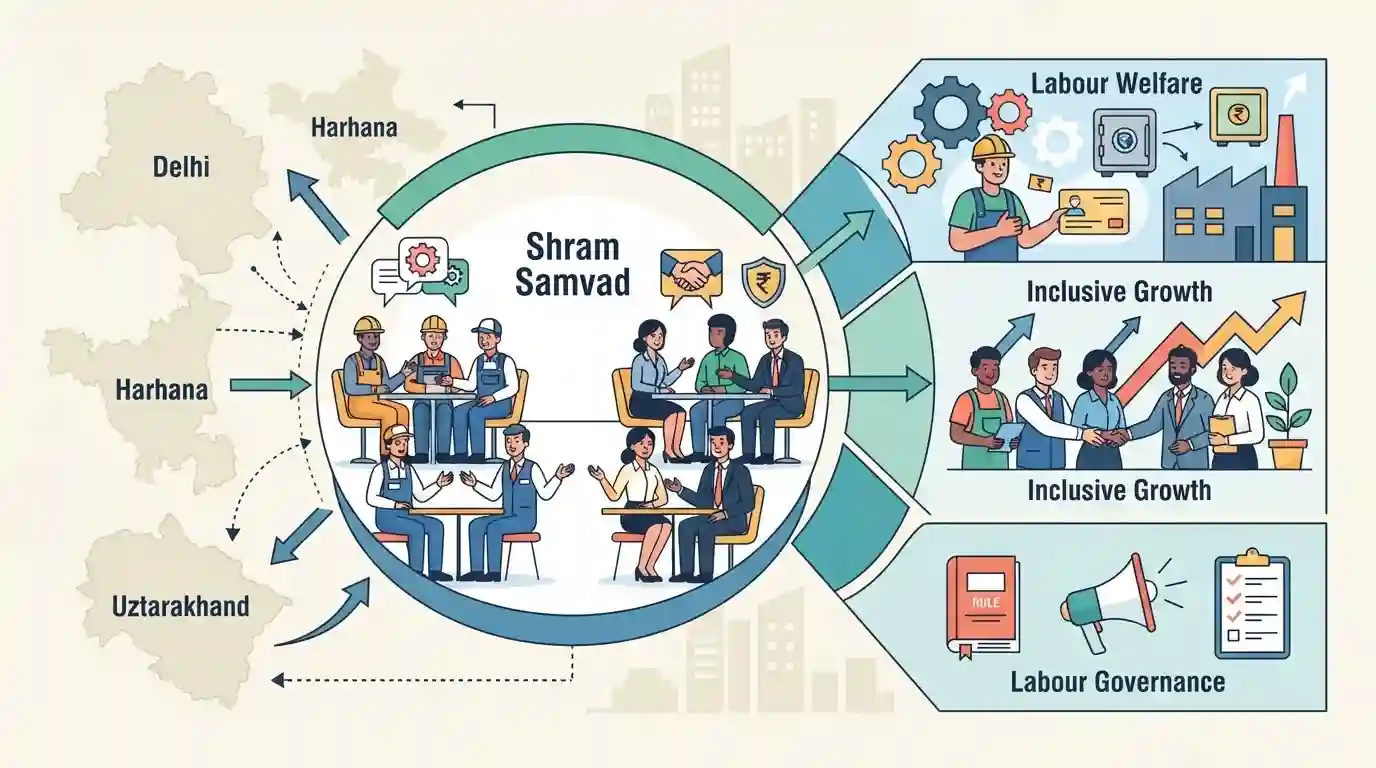
The Ministry of Labour & Employment organized 'Shram Samvad' outreach programs across industrial clusters in Delhi, Haryana, and Uttarakhand to promote direct engagement with workers and employers, improve labour welfare, and ensure effective implementation of labour governance frameworks.
ముఖ్య అంశాలు
- The Ministry of Labour & Employment launched the 'Shram Samvad' outreach initiative across industrial clusters in Delhi, Haryana, and Uttarakhand.
- The initiative aims to bridge the gap between policymakers, workers, and employers, facilitating direct dialogue on labour welfare and governance.
- Focuses on grievance redressal, streamlining implementation of labour laws, and enhancing social security coverage for organized and unorganized workforce.
ముఖ్యమైన పదాలు
Shram Samvad

A nationwide 90-day awareness and outreach campaign launched by the Ministry of Labour and Employment to promote the four new labour codes and enhance dialogue between workers, employers, and administrators.
UPSC context
UPSC GS Paper II / III (Governance & Inclusive Growth): Tests understanding of labour reforms, administrative outreach, and implementation of new labour codes.
Ministry of Labour & Employment
The central government ministry responsible for protecting workers' interests, formulating labour policy, ensuring occupational safety, and implementing social security legislations across industrial and unorganized sectors.
UPSC context
UPSC GS Paper II (Governance): Tests knowledge of key nodal ministries, institutional mechanisms, and welfare frameworks for workforce management.
ప్రిలిమ్స్ ఉచ్చు
The central labour codes entirely replace all state-level labour legislations without requiring state concurrence.
Labour is in the Concurrent List of the Constitution, allowing both Parliament and state legislatures to make laws, not exclusively Parliament.
అనుసంధానమైన స్థిర భావనలు
What are the constitutional provisions relating to labour in India?
- Constitutional List: Labour is listed in the Concurrent List (List III, Entry 22) of the Seventh Schedule, enabling both Centre and States to legislate.
- DPSP Mandate: Part IV (Directive Principles of State Policy) contains key articles like Article 39, 42, and 43A directing state action on labour welfare.
అంతర-అంశ నమూనాలు
Labour Codes & Ease of Doing Business
The 4 Labour Codes consolidate 29 central statutes, directly impacting Ease of Doing Business rankings and formalization metrics tracked by periodic labour force surveys.
Cooperative Federalism in Labour Reforms
Shram Samvad operationalizes cooperative federalism by engaging state-level industrial clusters directly on central statutory compliance.

Expect an assertion-reasoning question on whether the 4 Labour Codes completely eliminate state jurisdiction over labour laws.
అనుసంధాన PYQలు · 2
అనుసంధాన PYQలు · 2
- 2024MainsGS3
Discuss the merits and demerits of the four 'Labour Codes' in the context of labour market reforms in India. What has been the progress so far in this regard?
- 2019MainsGS2
Despite Consistent experience of high growth, India still goes with the lowest indicators of human development. Examine the issues that make balanced and inclusive development elusive.
