Insolvency and Bankruptcy Code Impact on Credit Discipline
Source:PIB ↗
Why It Matters
The IBC is a cornerstone of India's financial sector reforms, addressing Non-Performing Assets (NPAs), improving corporate governance, and boosting investor confidence. Understanding its impacts, challenges, and evolving framework is crucial for aspirants studying economic development and corporate law.
Summary
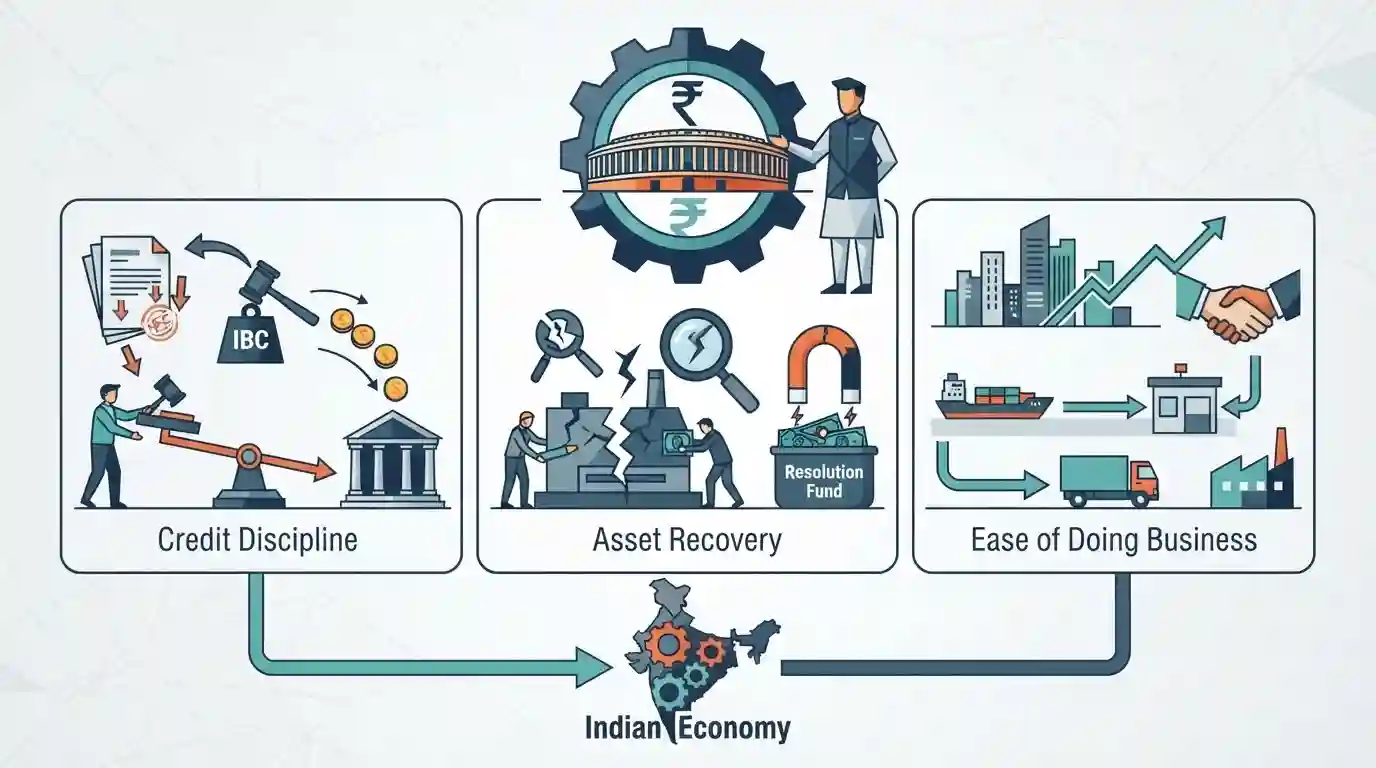
Minister of State for Corporate Affairs Harsh Malhotra stated that the Insolvency and Bankruptcy Code (IBC) has transformed India's economic landscape by enforcing credit discipline, accelerating asset recovery, and improving the ease of doing business.
Key Points
- The Insolvency and Bankruptcy Code (IBC) has significantly strengthened credit discipline and improved the recovery climate in India.
- It has contributed positively to the ease of doing business by ensuring a time-bound resolution of stressed assets.
- MoS for Corporate Affairs Harsh Malhotra highlighted the structural reforms undertaken to make the corporate framework more robust and transparent.
Important Terms
Insolvency and Bankruptcy Code (IBC)

A comprehensive Indian legislation enacted in 2016 to consolidate and streamline insolvency and bankruptcy processes for companies and individuals in a time-bound manner, maximizing asset value and credit availability.
UPSC context
UPSC GS Paper III (Indian Economy): Core reform for resolving stressed assets, improving credit discipline, and ease of doing business.
Insolvency and Bankruptcy Board of India (IBBI)
The apex regulatory body established under the IBC in 2016 to oversee insolvency professionals, insolvency professional agencies, and information utilities in India.
UPSC context
UPSC GS Paper III (Economy): Important statutory regulatory body evaluating corporate governance and financial sector stability.
Ministry of Corporate Affairs
The Indian government ministry responsible for regulating corporate affairs, administering the Companies Act, LLP Act, and the Insolvency and Bankruptcy Code.
UPSC context
UPSC GS Paper II & III: Key administrative ministry for corporate governance, industrial policy, and economic regulation.
Prelims Trap
IBC applies identically to all corporate debtors and financial service providers without any notification or exemption by the Central Government.
Aspirants often assume IBC applies uniformly to all financial service providers without special provisions, ignoring that the Central Government can notify specific FSPs for resolution under amended IBC rules.
Static Concepts Connected
What is the institutional framework and creditor hierarchy under the Insolvency and Bankruptcy Code (IBC)?
- Adjudicating Authorities: Regulated by IBBI, insolvency proceedings are adjudicated by NCLT for corporates and DRT for individuals.
- Committee of Creditors: Secured financial creditors hold dominant voting power in the Committee of Creditors (CoC) to approve resolution plans.
- Waterfall Mechanism: Section 53 sets liquidation priority: insolvency resolution costs, secured creditors with workmen dues, followed by unsecured creditors and government dues.
Cross-Topic Patterns
IBC and Banking NPA Resolution Synergy
IBC's time-bound resolution mechanism intersects with RBI's prompt corrective action (PCA) and NPA management guidelines for public sector banks.
Insolvency Reforms and Ease of Doing Business
The ease of doing business rankings and corporate compliance burdens link insolvency reforms with broader bureaucratic deregulation initiatives.

IBC resolution timelines, creditor hierarchy under Sec 53, and IBBI's regulatory role are perennial UPSC prelims concepts.
Linked PYQs · 2
Linked PYQs · 2
- 2022MainsGS3
Economic growth in the recent past has been led by increase in labour productivity." Explain this statement. Suggest the growth pattern that will lead to creation of more jobs without compromising labour productivity.
- 2021MainsGS3
Do you agree that the Indian economy has recently experienced V-shaped recovery? Give reasons in support of your answer.
