Traditional Knowledge Digital Library and Heritage Protection
Source:PIB ↗
हे का महत्त्वाचे आहे
It highlights institutional synergy between higher education and scientific bodies to protect India's indigenous knowledge systems against misappropriation while fostering academic research.
सारांश
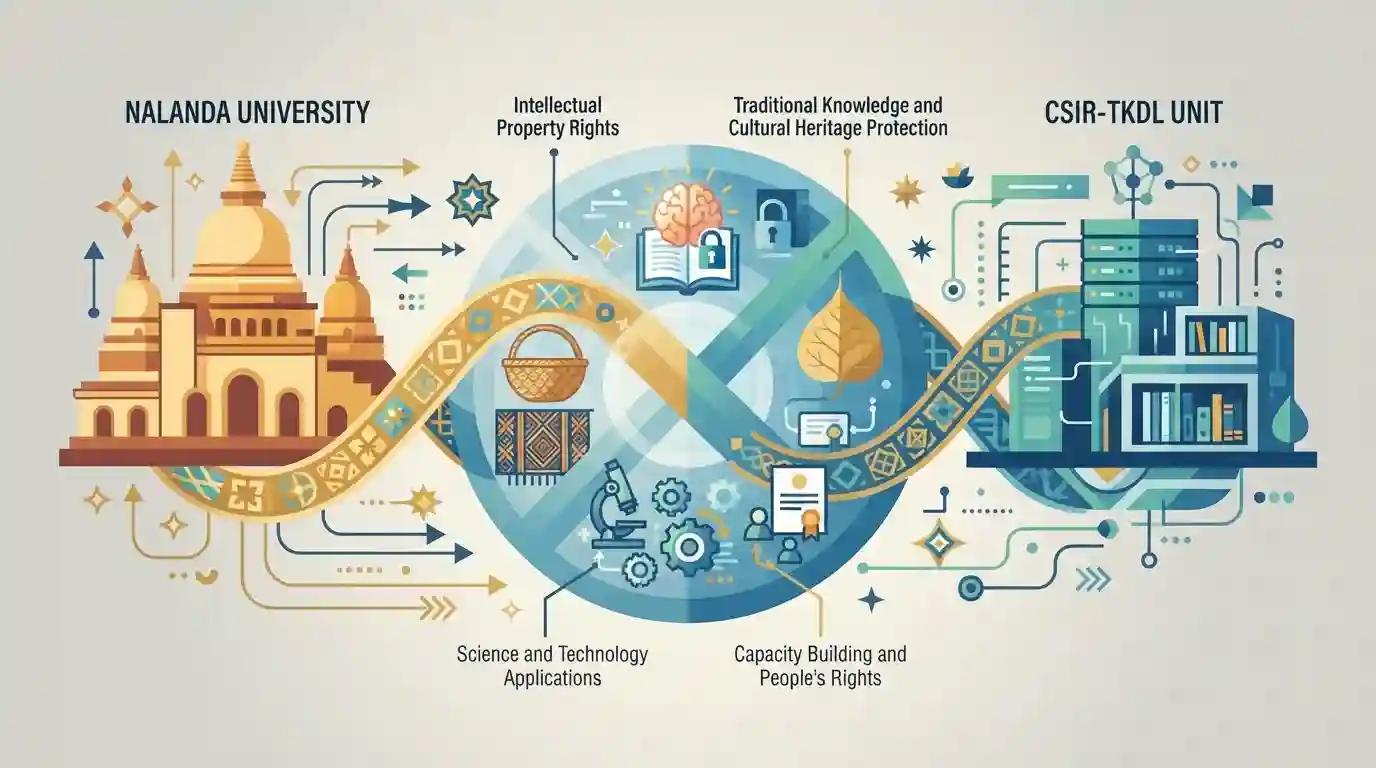
Nalanda University and the CSIR-Traditional Knowledge Digital Library (CSIR-TKDL) Unit have entered into a collaborative partnership to promote research, education, and capacity-building in Traditional Knowledge, Intellectual Property Rights, People's Rights, and Cultural Heritage, merging ancient traditions with modern legal frameworks.
मुख्य मुद्दे
- Nalanda University and CSIR-TKDL Unit have signed an agreement for cooperation in research, education, and capacity-building.
- The partnership focuses on Traditional Knowledge (TK), Intellectual Property Rights (IPR), People's Rights, and Cultural Heritage.
- Aims to bridge ancient wisdom with modern intellectual property frameworks to prevent biopiracy and safeguard indigenous heritage.
महत्त्वाच्या संज्ञा
Traditional Knowledge Digital Library (TKDL)

An Indian digital database established in 2001 by CSIR and the Ministry of Ayush to prevent bio-piracy and wrongful patenting of traditional medicinal knowledge in international patent offices.
UPSC context
Important for GS Paper III (S&T, IPR issues) and GS Paper II/III (biopiracy and protection of indigenous knowledge).
Nalanda University
An international university located in Bihar, established by an Act of Parliament, reviving the historic ancient seat of learning to promote Asian cooperation, heritage, and peace.
UPSC context
Relevant for GS Paper I (Indian Heritage and Culture, historical institutions) and international relations/education policies.
Council of Scientific and Industrial Research (CSIR)
A premier autonomous R&D organization in India established by the Government of India, operating under the Ministry of Science and Technology to drive scientific research and technological innovation.
UPSC context
Frequent in GS Paper III under Science & Technology developments, institutional framework, and indigenous technological capacity.
CSIR-Traditional Knowledge Digital Library Unit
A specialized unit under CSIR responsible for maintaining, updating, and facilitating the defensive protection and legal deployment of India's digitized traditional knowledge database.
UPSC context
Important for GS Paper III (Intellectual Property Rights, IPR enforcement, and traditional knowledge protection mechanisms).
पूर्वपरीक्षा सापळा
The TKDL is a completely open-access digital library available for public patent filing worldwide.
Aspirants often confuse TKDL as a public open-source repository accessible to everyone, whereas it is restricted via Non-Disclosure/Access Agreements strictly for patent examiners to evaluate prior art.
संबंधित स्थिर संकल्पना
What are the key objectives and institutional framework of the Traditional Knowledge Digital Library (TKDL)?
- Origin & Mandate: Jointly established in 2001 by CSIR and Ministry of AYUSH to prevent biopiracy and wrongful patents on Indian systems of medicine.
- Database Scope: Acts as a prior art database documenting formulations from Ayurveda, Unani, Siddha, Yoga, and Sowa Rigpa in international languages.
- Global Access: Signed Access Agreements with major patent offices (EPO, USPTO, etc.) granting examiners restricted search access to prevent erroneous grants.
आंतर-विषय नमुने
Traditional Knowledge Protection & TRIPS Flexibility
The integration of CSIR-TKDL databases with academic curricula mirrors broader efforts to legally weaponize indigenous science under international patent law (TRIPS Agreement).

TKDL's role as a prior art database preventing biopiracy via international patent office agreements is a recurring prelims favorite.
संबंधित PYQ · 3
संबंधित PYQ · 3
- 2015MainsGS3
India's Traditional Knowledge Digital Library (TKDL), which has a database containing formatted information on more than 2 million medicinal formulations is proving a powerful weapon in the country's fight against erroneous patents. Discuss the pros and cons of making this database publicly available under open-source licensing.
- 2019MainsGS3
How is the Government of India protecting traditional knowledge of medicine from patenting by pharmaceutical companies?
- 2023PrelimsGS1
Consider the investments in the following assets: 1. Brand recognition 2. Inventory 3. Intellectual property 4. Mailing list of clients How many of the above are considered intangible investments?
