GOBARdhan Scheme Expansion for Compressed Biogas Sector
Source:PIB ↗
Why It Matters
It relates directly to India's energy security, renewable energy targets (Panchamrit), waste-to-wealth transition, and reduction of stubble burning and fossil fuel dependency.
Summary
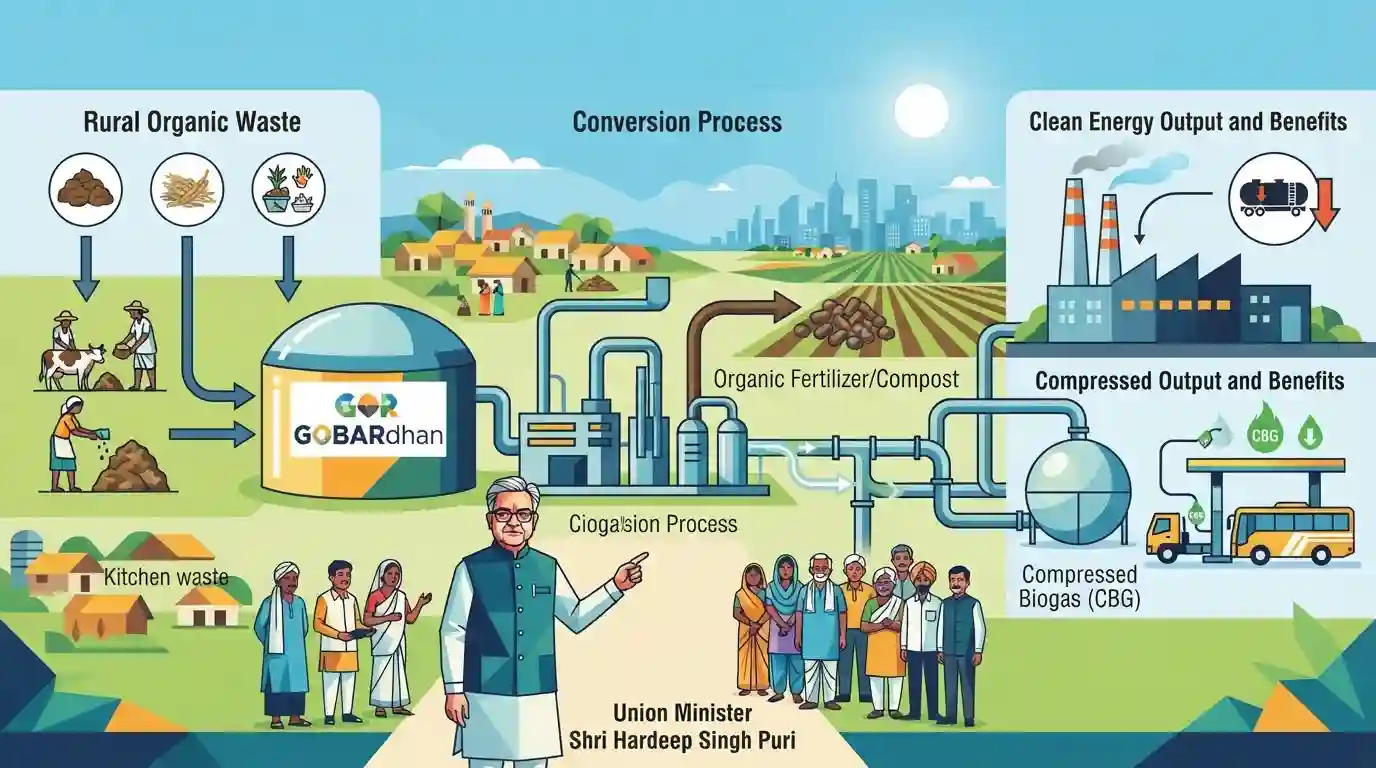
Union Minister of Petroleum and Natural Gas Shri Hardeep Singh Puri launched the GOBARdhan Scheme to boost India's Compressed Biogas (CBG) sector, driving clean energy transition, reducing fossil fuel dependence, and managing organic waste efficiently.
Key Points
- Union Minister Hardeep Singh Puri launched initiatives to accelerate the development of India's Compressed Biogas (CBG) sector under the GOBARdhan scheme.
- The scheme focuses on converting organic waste, agricultural residue, and cattle dung into wealth and clean energy (CBG), boosting circular economy.
- Aimed at reducing fossil fuel import dependence, lowering carbon emissions, and supporting rural livelihoods and waste management.
Important Terms
GOBARdhan Scheme

A multi-ministry initiative aimed at converting organic waste, such as cattle dung and farm residue, into wealth and energy through biogas and compressed biogas (CBG) plants to promote rural cleanliness and circular economy.
UPSC context
UPSC Mains GS Paper III: Environment, waste management, and renewable energy policies (bio-energy).
Compressed Biogas (CBG)
An eco-friendly renewable fuel produced by purifying organic waste sources like agricultural residue and cattle dung, chemically identical to CNG, helping reduce fossil fuel dependence.
UPSC context
UPSC Mains GS Paper III: Infrastructure, energy security, and transition to cleaner alternate fuels.
Ministry of Petroleum and Natural Gas
The central government ministry responsible for the exploration, production, refining, distribution, and pricing of petroleum, natural gas, and allied clean energy products like CBG in India.
UPSC context
UPSC Mains GS Paper II/III: Government ministries, policy formulation, and energy governance structures.
Prelims Trap
administered exclusively by the Ministry of Jal Shakti or Ministry of New and Renewable Energy
Aspirants often assume GOBARdhan is solely under the Ministry of Jal Shakti or Ministry of Agriculture due to its rural/waste nature, but CBG-specific scale-up is administered by the Ministry of Petroleum and Natural Gas.
Static Concepts Connected
What is Compressed Biogas (CBG) and how does anaerobic digestion convert organic waste into energy?
- Anaerobic Process: Decomposition of organic matter by anaerobic bacteria in the absence of oxygen producing biogas (methane and carbon dioxide).
- Purification Steps: Purifying raw biogas to remove carbon dioxide, hydrogen sulfide, and moisture to match the purity of natural gas (>90% methane).
- CBG Properties: High energy density fuel chemically similar to CNG, usable directly in automotive transport and industrial applications.
Cross-Topic Patterns
CBG + Stubble Burning + Fiscal Deficit
Compressed Biogas initiatives directly reduce stubble burning (agricultural residue utilization) while cutting import bills, linking environmental degradation with macroeconomic fiscal deficit management.
Rural Livelihoods + Net-Zero Targets
GOBARdhan integrates rural livelihood generation (MGNREGA-adjacent biomass supply chains) with national net-zero commitments under Panchamrit.

GOBARdhan financial outlay, feedstock diversity, and nodal ministry mapping are high-yield match-the-following or statement questions.
Linked PYQs · 2
Linked PYQs · 2
- 2022MainsGS3
Do you think India will meet 50 percent of its energy needs from renewable energy by 2030 ? Justify your answer. How will the shift of subsidies from fossil fuels to renewables help achieve the above objective ? Explain.
- 2017MainsGS3
One of the intended objectives of the Union Budget 2017-18 is to 'transform, energise and clean India'. Analyse the measures proposed in the Budget 2017-18 to achieve the objective.
