SafaiMitra Suraksha Campaign and Urban Sanitation Worker Welfare
Source:PIB ↗
Why It Matters
It addresses critical issues of occupational safety, social security, and dignity for sanitation workers, reflecting India's policy shift toward mechanized cleaning and welfare entitlement delivery for marginalized urban workers.
Summary
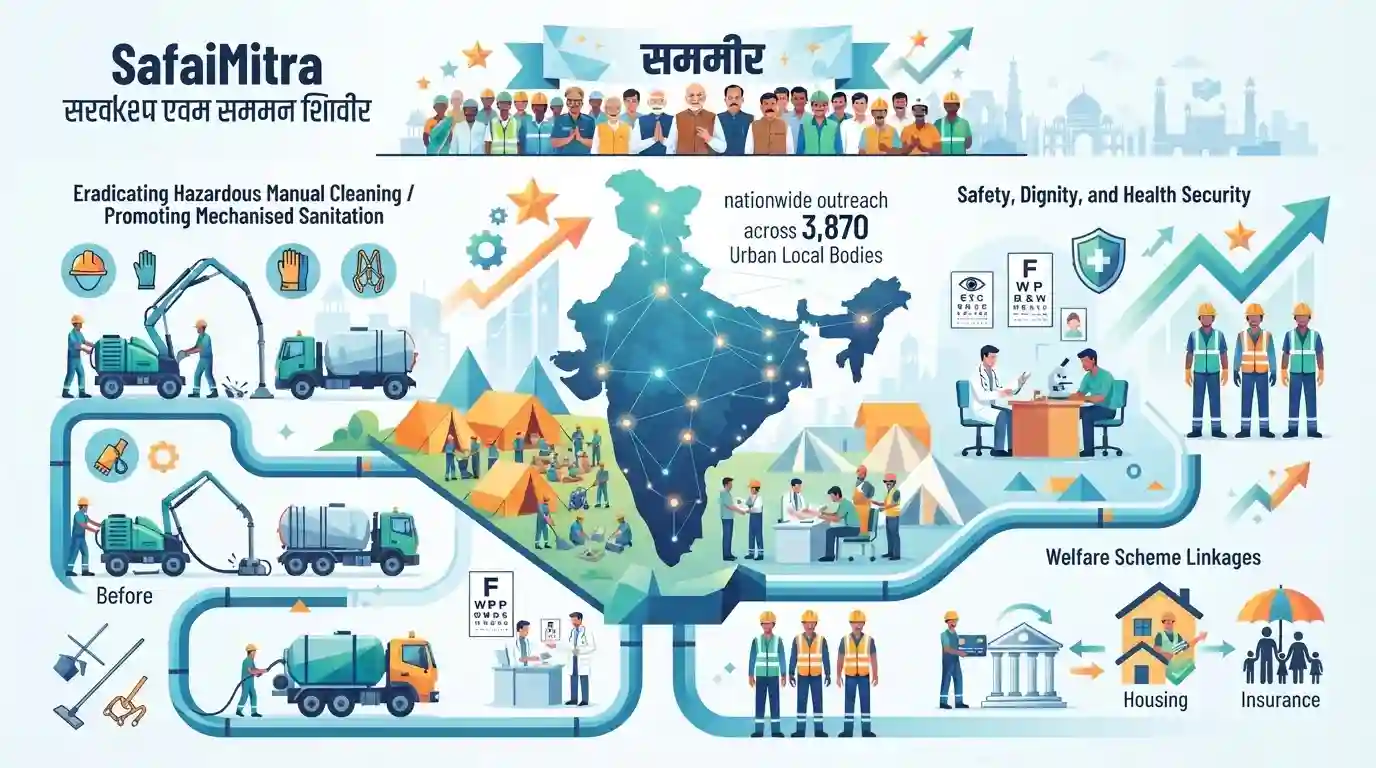
The article outlines the nationwide outreach and achievements of the SafaiMitra Suraksha Evam Samman Shivir, which has benefited over 3.69 lakh sanitation workers across 3,870 Urban Local Bodies. The campaign emphasizes safety, dignity, health security, and welfare scheme linkages for SafaiMitras, aligning with national goals of eradicating hazardous manual cleaning and promoting mechanised sanitation under frameworks like the NAMASTE scheme.
Key Points
- The National-Level SafaiMitra Suraksha Evam Samman Shivir has successfully reached over 3.69 lakh beneficiaries across 3,870 Urban Local Bodies (ULBs).
- The initiative aims to ensure safety, dignity, and socio-economic upliftment of sanitation workers (SafaiMitras), particularly those engaged in hazardous cleaning.
- It focuses on providing institutional safety equipment, health insurance, financial inclusion, and welfare linkages under central schemes like NAMASTE.
- Highlights the government's push towards mechanised sanitation and eliminating manual scavenging through community engagement and structured outreach camps (Shivirs).
Important Terms
SafaiMitra Suraksha Evam Samman Shivir

A nationwide outreach campaign designed to ensure the welfare, safety, health security, and dignity of sanitation workers (SafaiMitras) by linking them with various social security schemes and promoting mechanised sanitation.
UPSC context
Important for GS Paper II (Welfare Schemes for Vulnerable Sections, Social Justice). Tests understanding of governance initiatives targeting sanitation workers.
NAMASTE Scheme
A joint initiative of the Ministry of Social Justice and Empowerment and the Ministry of Housing and Urban Affairs aimed at eradicating hazardous manual cleaning and promoting mechanised sanitation ecosystems.
UPSC context
Crucial for GS Paper II (Social Justice, Governance). Tests policies addressing manual scavenging and welfare of sanitation workers and waste pickers.
Ministry of Social Justice and Empowerment
The nodal central ministry responsible for formulating and administering policies, welfare schemes, and legislation for the empowerment of marginalized groups, including Scheduled Castes, Other Backward Classes, and sanitation workers.
UPSC context
Important for GS Paper II (Ministries, Departments, and Governance structures). Tests knowledge of nodal agencies for vulnerable sections.
Urban Local Bodies (ULBs)
The third tier of government in urban areas responsible for civic administration, local infrastructure, public health, and the grassroots implementation of urban sanitation and welfare campaigns.
UPSC context
Essential for GS Paper II (Constitution, Decentralization, and Governance). Tests understanding of local governance and urban service delivery.
Prelims Trap
The Prohibition of Employment as Manual Scavengers and their Rehabilitation Act, 2013 is merely an advisory framework for urban local bodies.
Aspirants often assume manual scavenging is prohibited only by executive guidelines, overlooking the rigorous statutory backing of the Prohibition Act.
Static Concepts Connected
What are the key provisions of the Prohibition of Employment as Manual Scavengers and their Rehabilitation Act, 2013?
- Statutory Ban: Total Prohibition makes the employment of manual scavengers and construction of insanitary latrines a cognizable, non-bailable offence.
- Survey & Survey: Mandatory Survey obligates local authorities to conduct surveys of insanitary latrines and manual scavengers within a time-bound manner.
- Rehabilitation Package: Rehabilitation includes one-time cash assistance, skill development training with stipend, and capital subsidy for self-employment.
What are the core mandates and implementing ministries of the NAMASTE Scheme?
- Dual Ministries: Joint Initiative implemented by the Ministry of Social Justice and Empowerment and the Ministry of Housing and Urban Affairs.
- Core Objective: Zero Fatalities aims to eradicate hazardous cleaning of sewers and septic tanks through 100% mechanised interventions.
- Worker Scope: Expanded Coverage explicitly includes informal workers and waste pickers alongside traditional sewer and septic tank sanitation workers.
Cross-Topic Patterns
Sanitation Workers + SDG Goals + Urban Governance
The transition from manual scavenging to mechanised cleaning connects directly with SDG 8 (Decent Work) and SDG 6 (Clean Water and Sanitation).
ULB Capacity + Central Welfare Schemes
Welfare camps bridging ULBs and central schemes illustrate cooperative federalism challenges in urban social security delivery.

NAMASTE scheme coverage (waste pickers vs. sewer workers) and statutory provisions against manual scavenging are high-yield for Prelims.
Linked PYQs · 2
Linked PYQs · 2
- 2022MainsGS2
Besides the welfare schemes, India needs deft management of inflation and unemployment to serve the poor and the underprivileged sections of the society. Discuss.
- 2016PrelimsGS1
'Rashtriya Garima Abhiyaan' is a national campaign to
