Election Commission Extends Voter Roll Revision in Two States
Source:PIB ↗
Why It Matters
Understanding the administrative functions and schedule adjustments by the Election Commission of India highlights how constitutional bodies manage electoral rolls and ensure inclusive participation in Indian democracy.
Summary
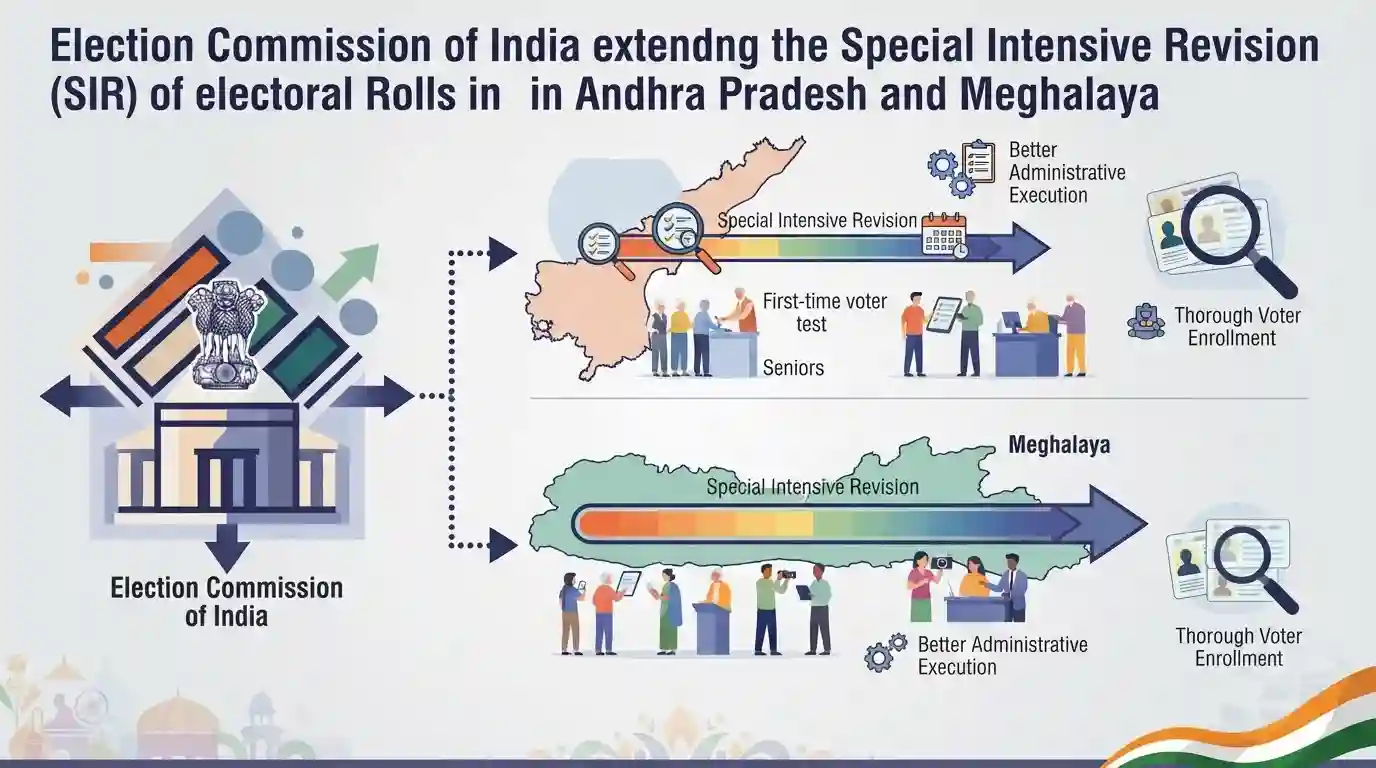
The Election Commission of India has extended the timelines for Special Intensive Revision (SIR) of electoral rolls in the states of Andhra Pradesh and Meghalaya to facilitate better administrative execution and ensure thorough voter enrollment.
Key Points
- The Election Commission of India (ECI) extended the dates for the Special Intensive Revision (SIR) or related electoral roll activities in the states of Andhra Pradesh and Meghalaya.
- Administrative adjustments in electoral roll revisions ensure comprehensive voter registration, inclusivity, and accuracy of electoral databases.
- Such extensions highlight the ECI's flexibility and constitutional mandate under Article 324 to superintend, direct, and control free and fair elections.
Important Terms
Election Commission of India

An independent constitutional body established under Article 324 of the Indian Constitution, responsible for administering election processes in India across parliament, state legislatures, and the offices of the President and Vice-President.
UPSC context
GS Paper II (Polity & Governance) — Tests knowledge of constitutional bodies, their powers, independence, and role in upholding democratic integrity.
Special Intensive Revision
A comprehensive, rigorous exercise conducted by the Election Commission of India to update, verify, and purify voter lists by eliminating fake, duplicate, or dead entries while ensuring all eligible citizens are enrolled.
UPSC context
GS Paper II (Polity & Governance) — Important for questions regarding electoral reforms, franchise purity, and administrative measures by the ECI.
Electoral Rolls
Official registers containing names and details of all eligible citizens registered to vote in a given constituency, serving as the foundational document for conducting democratic elections.
UPSC context
GS Paper II (Polity & Governance) — Essential for understanding voter registration processes, Representation of the People Acts, and grassroots democracy.
Prelims Trap
statutory and constitutional authority to alter, extend, or modify timelines
Aspirants often assume ECI acts under statutory rules made by Parliament alone, overlooking its plenary constitutional powers under Article 324 to issue independent administrative directions.
Static Concepts Connected
What are the constitutional provisions and composition relating to the Election Commission of India?
- Constitutional Basis: Article 324 vests superintendence, direction, and control of elections in an Election Commission consisting of the Chief Election Commissioner and other Election Commissioners.
- Composition & Tenure: President fixes the number of election commissioners, and they enjoy tenure and removal safeguards akin to Supreme Court judges.
Cross-Topic Patterns
Electoral Rolls and Democratic Representation
Electoral roll revisions connect administrative federalism with fundamental democratic rights, as accurate databases prevent disenfranchisement and underpin representation under Article 324.

Article 324 powers and ECI's authority over electoral roll revisions will feature in a statement-based polity question.
Linked PYQs · 3
Linked PYQs · 3
- 2018MainsGS2
In the light of recent controversy regarding the use of Electronic Voting Machines (EVM), what are the challenges before the Election Commission of India to ensure the trustworthiness of elections in India?
- 2017MainsGS2
To enhance the quality of democracy in India the Election Commission of India has proposed electoral reforms in 2016. What are the suggested reforms and how far are they significant to make democracy successful?
- 2022MainsGS2
Discuss the role of the Election Commission of India in the light of the evolution of the Model Code of Conduct.
