National Biodiversity Authority ABS Framework Progress
Source:PIB ↗
কেন এটি গুরুত্বপূর্ণ
It evaluates India's statutory framework for biodiversity conservation, community rights, and the operationalization of Access and Benefit Sharing (ABS) mechanisms, which are frequently tested in UPSC Prelims and Mains.
সারসংক্ষেপ
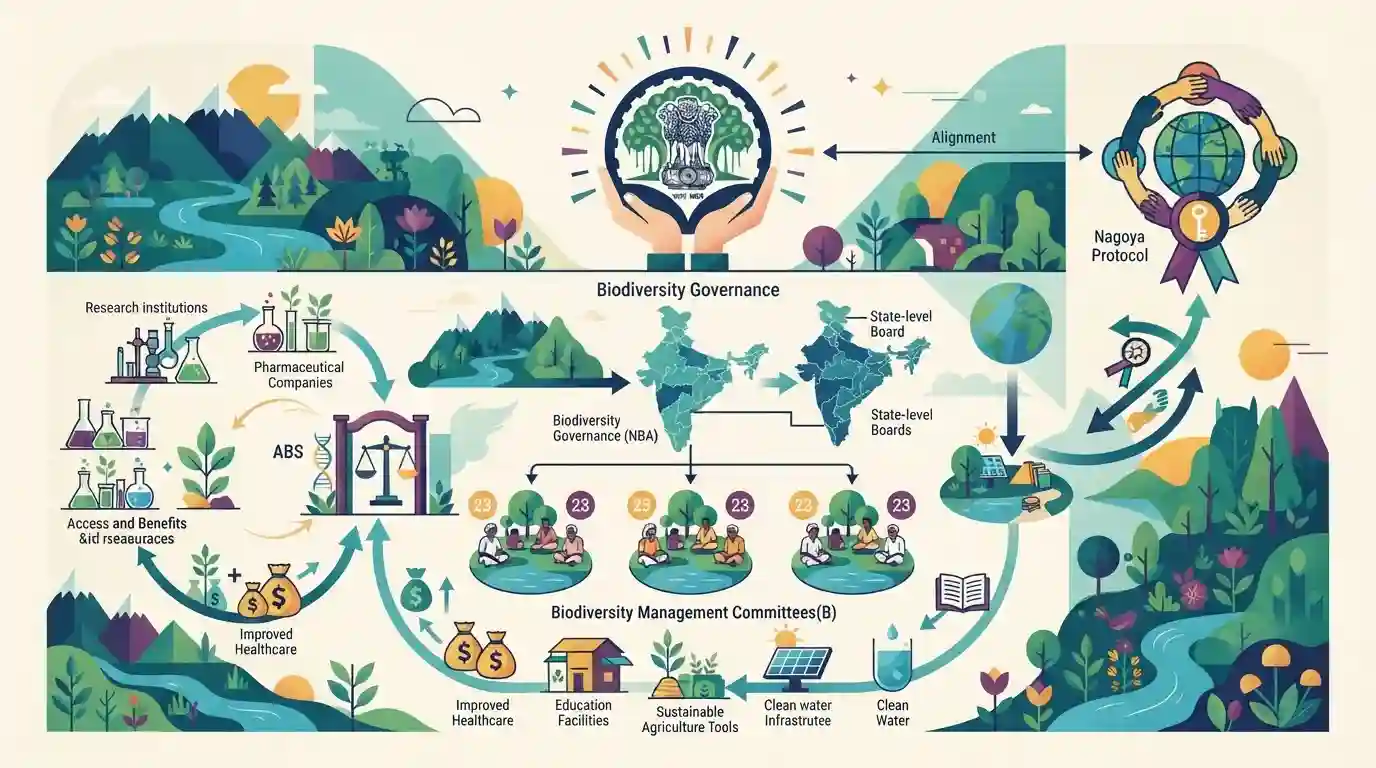
The article details the 23rd Foundation Day celebration of the National Biodiversity Authority (NBA), emphasizing advancements made in implementing Access and Benefit Sharing (ABS) frameworks, decentralized biodiversity governance via Biodiversity Management Committees (BMCs), and alignment with international commitments like the Nagoya Protocol under the Biological Diversity Act, 2002.
মূল বিষয়
- The National Biodiversity Authority (NBA) marks its 23rd Foundation Day, highlighting significant milestones in biodiversity conservation.
- Focus on Access and Benefit Sharing (ABS) mechanisms under the Biological Diversity Act, 2002, ensuring fair sharing of benefits derived from biological resources with local communities.
- Emphasizes decentralized conservation through Biodiversity Management Committees (BMCs) and People's Biodiversity Registers (PBRs).
গুরুত্বপূর্ণ শব্দ
Biological Diversity Act, 2002

India's principal legislation enacted to implement the Convention on Biological Diversity (CBD), focusing on biodiversity conservation, sustainable use of its components, and fair and equitable sharing of benefits arising from biological resources.
UPSC context
UPSC Paper III (Environment & Ecology): Core environmental legislation tested frequently on statutory bodies, ABS mechanisms, and biodiversity conservation.
National Biodiversity Authority (NBA)
A statutory autonomous body established under the Biological Diversity Act, 2002, to regulate access to biological resources and promote equitable benefit-sharing in India.
UPSC context
UPSC Paper III (Environment): Important for questions on institutional frameworks, decentralized governance, and regulatory bodies managing natural resources.
Nagoya Protocol
A supplementary agreement to the Convention on Biological Diversity that provides a transparent legal framework for the fair and equitable sharing of benefits arising from genetic resources.
UPSC context
UPSC Paper III (Environment): Tests international conventions, biodiversity protocols, and India's global environmental commitments.
Ministry of Environment, Forest and Climate Change (MoEFCC)
The central government ministry in India responsible for policy formulation, planning, promotion, and coordination of environmental and forestry programs, including biodiversity conservation.
UPSC context
UPSC Paper III (Environment): Crucial nodal ministry for environmental laws, administrative frameworks, and policy implementation.
সংযুক্ত স্থির ধারণা
What is the three-tier institutional structure under the Biological Diversity Act, 2002?
- National Level: National level body established under the Act to regulate use, advise the central government, and coordinate State Biodiversity Boards.
- State Level: State-level bodies that coordinate with the NBA and advise state governments on biodiversity conservation and commercial approvals.
- Local Level (BMC): Local body level entities mandated to promote conservation, sustainable use, and documentation of local biodiversity.
আন্তঃবিষয় প্যাটার্ন
ABS + Traditional Knowledge + TRIPs Agreement
The Nagoya Protocol's Access and Benefit Sharing framework intersects with IPR regimes under TRIPs, particularly regarding the protection of traditional knowledge and geographical indications.

UPSC frequently tests the 3-tier institutional setup (NBA, SBB, BMC) and the mandatory role of BMCs in drafting People's Biodiversity Registers.
সংযুক্ত PYQ · 1
সংযুক্ত PYQ · 1
- 2023PrelimsGS1
Consider the following statements: 1. In India, the Biodiversity Management Committees are key to the realization of the objectives of the Nagoya Protocol. 2. The Biodiversity Management Committees have important functions in determining access and benefit sharing, including the power to levy collection fees on the access of biological resources within its jurisdiction. Which of the statements given above is/are correct?
