UPSC Manthan Event on Future Civil Services
Source:PIB ↗
हे का महत्त्वाचे आहे
It addresses critical governance debates surrounding civil service reforms, institutional accountability, neutrality, and adapting public administration to modern technological and developmental demands.
सारांश
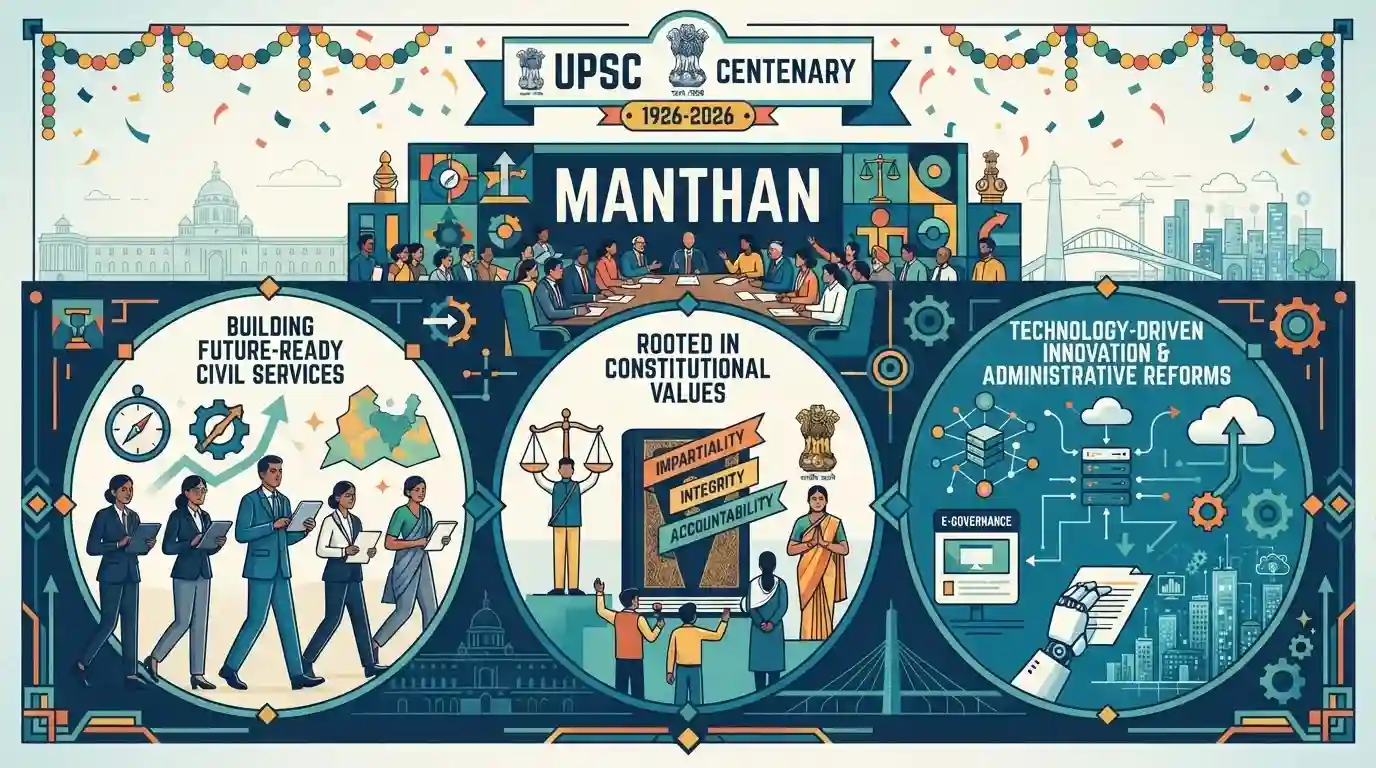
The Union Public Service Commission (UPSC) marked its centenary celebrations with a national seminar named 'Manthan', focusing on building future-ready civil services rooted in constitutional values, technology-driven innovation, and administrative reforms to address modern governance challenges.
मुख्य मुद्दे
- The UPSC organized the centenary celebrations seminar titled 'Manthan' focusing on future-ready civil services, innovation, and constitutional values.
- Discussions centered on transitioning from traditional bureaucracy to agile, tech-enabled, and citizen-centric governance.
- Emphasis was laid on upholding constitutional morality, integrity, impartiality, and empathy in public service delivery.
- The event highlighted the integration of emerging technologies, data-driven decision making, and capacity-building initiatives like Mission Karmayogi.
महत्त्वाच्या संज्ञा
Union Public Service Commission (UPSC)

An independent constitutional body established under Article 315 of the Indian Constitution, responsible for conducting examinations for appointments to the all-India services and central civil services.
UPSC context
GS Paper II (Polity & Governance) — tests role, functions, and constitutional safeguards of independent regulatory and constitutional bodies in India.
संबंधित स्थिर संकल्पना
What are the constitutional provisions and independence safeguards of the UPSC?
- Articles 315-323: Constitutional Status: Established under Articles 315-323 in Part XIV of the Constitution as an independent watchdog for central recruitment.
- Removal Safeguards: Security of Tenure: Chairman and members can be removed only by the President on grounds of proved misbehavior after Supreme Court inquiry.
- Charged Expenditure: Financial Autonomy: Expenses are charged upon the Consolidated Fund of India, not subject to annual vote of Parliament.
- Non-detrimental Rules: Service Conditions: Conditions of service cannot be varied to their disadvantage after appointment to ensure political neutrality.
आंतर-विषय नमुने
Civil Services Reforms + Digital Governance
UPSC centenary discussions reinforce the shift to Mission Karmayogi, tying constitutional recruitment directly to digital capacity building.

Expect a Mains GS-2 question on reconciling traditional bureaucratic neutrality with agile, tech-driven citizen-centric governance under Mission Karmayogi.
संबंधित PYQ · 2
संबंधित PYQ · 2
- 2020MainsGS2
Institutional quality is a crucial driver of economic performance". In this context suggest reforms in Civil Service for strengthening democracy.
- 2017MainsGS2
Initially Civil Services in India were designed to achieve the goals of neutrality and effectiveness, which seems to be lacking in the present context. Do you agree with the view that drastic reforms are required in Civil Services? Comment.
