Delhi Air Quality Index Trends and Regional Action
Source:PIB ↗
ఇది ఎందుకు ముఖ్యం
It provides data on urban air quality management, tracking the efficacy of institutional measures like the CAQM and NCAP in tackling severe air pollution in the national capital region.
సారాంశం
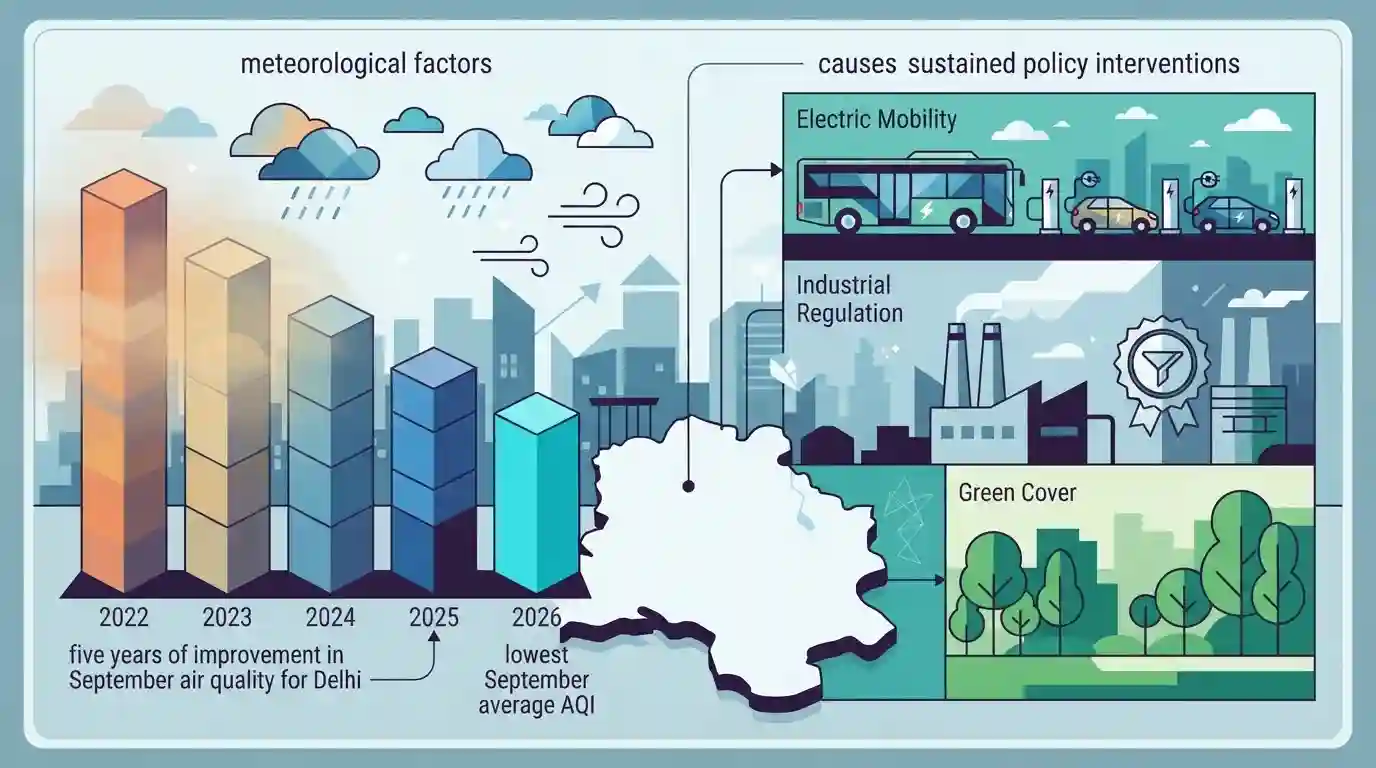
The PIB release highlights that Delhi recorded its lowest September average Air Quality Index (AQI) in five years in 2026, marking a continuous improvement trend in air quality due to sustained policy interventions and meteorological factors.
ముఖ్య అంశాలు
- Delhi recorded its lowest September average Air Quality Index (AQI) in five years in 2026, pointing to a progressive improvement in air quality.
- Favourable meteorological conditions combined with sustained institutional interventions contributed to the reduction in particulate matter.
- The ongoing positive trend highlights the effectiveness of coordinated regional measures implemented by bodies like CAQM and local governance frameworks.
ముఖ్యమైన పదాలు
National Clean Air Programme (NCAP)

India's national policy launched by MoEFCC to improve air quality across 131 cities through time-bound reduction targets for particulate matter.
UPSC context
GS Paper III (Environmental Pollution & Degradation). Tests knowledge of government frameworks and city-specific action plans to tackle air pollution.
Commission for Air Quality Management (CAQM)
A statutory body established to monitor, coordinate, and regulate air quality management in the National Capital Region and adjoining industrial and agricultural areas.
UPSC context
GS Paper III (Conservation and Environmental Impact Assessment). Essential for questions concerning institutional mechanisms for regional air pollution control in Delhi-NCR.
IMD
The national meteorological service under the Ministry of Earth Sciences responsible for weather forecasting, meteorological observations, and early warnings for extreme weather.
UPSC context
GS Paper I & III (Geography/Disaster Management). Tests understanding of meteorological factors influencing seasonal air quality trends and dispersion.
ప్రిలిమ్స్ ఉచ్చు
Commission for Air Quality Management (CAQM) is an executive advisory body established under the Environment Protection Act, 1986.
Aspirants often assume AQI management in the NCR is governed entirely by the Central Pollution Control Board (CPCB) under the Environment Protection Act, overlooking the specific statutory origin of CAQM under a dedicated 2021 Act.
అనుసంధానమైన స్థిర భావనలు
What are the statutory powers and composition of the Commission for Air Quality Management (CAQM)?
- Statutory Basis: Statutory Status: Established under the Commission for Air Quality Management in National Capital Region and Adjoining Areas Act, 2021.
- Territorial Scope: Jurisdiction: Exercises exclusive jurisdiction over Delhi-NCR and adjoining areas in Haryana, Punjab, Rajasthan, and Uttar Pradesh.
- Legal Primacy: Overriding Powers: CAQM directions prevail over inconsistent orders of state governments or state pollution control boards in the region.
అంతర-అంశ నమూనాలు
Urban Pollution vs. Cooperative Federalism
Metropolitan air pollution management requires statutory cross-border coordination, linking environmental governance (CAQM) with federalism debates under Article 263 (Inter-State Councils).
Air Quality and Urban Public Health Economics
Declining AQI trends connect environmental indicators with public health economics, directly impacting urban labor productivity and healthcare expenditure burdens.

CAQM statutory powers, jurisdiction over NCR/adjoining states, and its distinction from executive bodies like CPCB will be tested.
అనుసంధాన PYQలు · 3
అనుసంధాన PYQలు · 3
- 2022PrelimsGS1
In the context of WHO Air Quality Guidelines, consider the following statements: 1. The 24-hour mean of PM2.5 should not exceed 15 µg/m³ and annual mean of PM2.5 should not exceed 5 µg/m³. 2. In a year, the highest levels of ozone pollution occur during the periods of inclement weather. 3. PM10 can penetrate the lung barrier and enter the bloodstream. 4. Excessive ozone in the air can trigger asthma. Which of the statements given above are correct?
- 2025PrelimsGS1
Artificial way of causing rainfall to reduce air pollution makes use of
- 2021MainsGS3
Describe the key points of the revised Global Air Quality Guidelines (AQGs) recently released by the World Health Organisation (WHO). How are these different from its last update in 2005? What changes in India's National Clean Air Programme are required to achieve these revised standards?
