National Coastal Mission Guidelines and Ecosystems
Source:PIB ↗
हे का महत्त्वाचे आहे
Crucial for UPSC GS3 (Environment and Disaster Management), the National Coastal Mission 2.0 represents a major policy instrument for addressing coastal erosion, safeguarding marine biodiversity, and building climate resilience along India's vast coastline.
सारांश
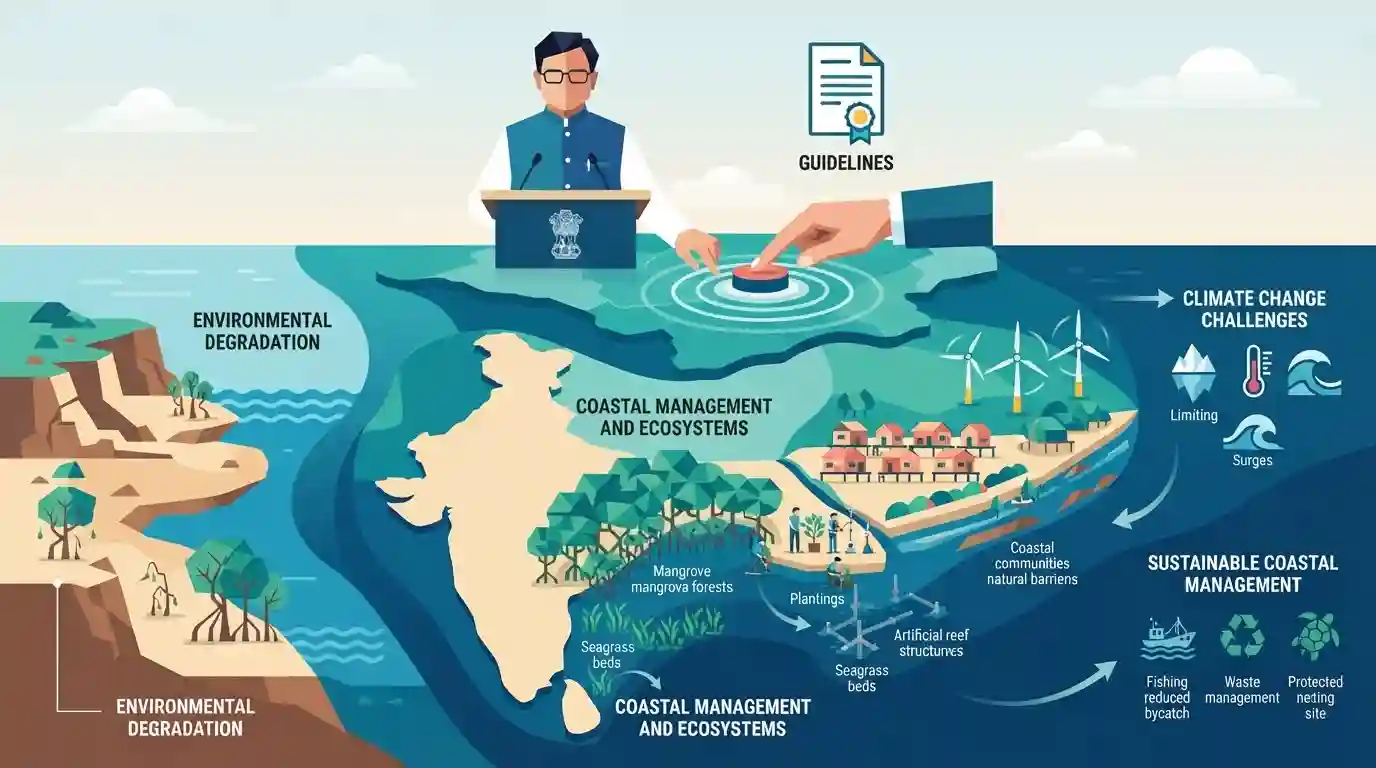
Union Environment Minister Shri Bhupender Yadav launched the Guidelines for National Coastal Mission 2.0, aiming to fortify coastal ecosystems, address climate change challenges like coastal erosion and sea-level rise, and promote sustainable coastal management across India's extensive coastline.
मुख्य मुद्दे
- Union Environment Minister Shri Bhupender Yadav launched the Guidelines for National Coastal Mission 2.0 to strengthen India's coastal ecosystem management and climate resilience.
- The mission focuses on protecting coastal habitats, mitigating coastal erosion, enhancing blue economy initiatives, and supporting local coastal communities through sustainable practices.
- It emphasizes community participation, science-based interventions, and multi-sectoral convergence for integrated coastal zone management.
महत्त्वाच्या संज्ञा
National Coastal Mission 2.0

A central sector scheme launched by the Ministry of Environment, Forest and Climate Change to enhance coastal resilience, combat coastal erosion, and promote sustainable coastal management across India's coastal states and UTs.
UPSC context
UPSC Prelims/Mains (GS Paper III): Important for environmental conservation initiatives, climate change adaptation strategies, and coastal ecosystem management.
Ministry of Environment, Forest and Climate Change
The nodal central ministry in India charged with planning, promoting, coordinating, and overseeing the implementation of environmental and forestry policies, including biodiversity conservation and climate change mitigation.
UPSC context
UPSC Prelims/Mains (GS Paper II/III): Essential for understanding institutional frameworks governing environmental laws, policies, and statutory bodies in India.
पूर्वपरीक्षा सापळा
Central Sector Scheme executed solely by central ministries without state or local government coordination.
Aspirants often assume central sector schemes are implemented exclusively by central agencies without state or local community participation; NCM 2.0 explicitly requires multi-sectoral convergence across 9 states and 4 UTs.
संबंधित स्थिर संकल्पना
What are the key regulatory zones and classifications under India's Coastal Regulation Zone (CRZ) Notification?
- CRZ-I Sensitivity: CRZ-I comprises ecologically sensitive areas like mangroves, corals, and nesting grounds where no new construction is generally permitted.
- CRZ-II Urban Areas: CRZ-II covers developed urban coastal areas up to the shoreline, allowing building activities subject to extant municipal guidelines.
- CRZ-III Rural Areas: CRZ-III includes rural and relatively undisturbed coastal areas, permitting restricted activities related to agriculture and allied sectors.
- CRZ-IV Water Areas: CRZ-IV spans water areas from the Low Tide Line (LTL) up to the territorial waters limits (12 nautical miles).
आंतर-विषय नमुने
Coastal Conservation + Blue Economy Financing
Coastal Mission 2.0 integrates climate adaptation with blue economy financing, linking environmental conservation to maritime trade and coastal livelihood security.
Mangrove Restoration + Disaster Management Framework
Mitigating sea-level rise and coastal erosion through mangrove restoration connects biodiversity protection directly to disaster management and Sendai Framework targets.

Expect a match-the-column or statement-based question pairing National Coastal Mission 2.0 with its funding structure and implementing states.
संबंधित PYQ · 2
संबंधित PYQ · 2
- 2022MainsGS3
Explain the causes and effects of coastal erosion in India. What are the available coastal management techniques for combating the hazard?
- 2026PrelimsGS1
Which of the following best explain(s) the rationale for protecting mangrove ecosystems in the context of climate resilience? 1. Mangroves reduce tidal energy and store freshwater, making them ideal sites for paddy cultivation in saline estuarine belts. 2. Their salt-sensitive roots filter seawater, making mangroves key to converting coastal land into freshwater aquaculture zones. 3. By withstanding tidal surges and offering biomass resources, mangroves function both as natural bio-shields and livelihood bases for rural communities. Select the answer using the code given below :
